Book review: Radical shift in political culture

While the  focus of 'Abundance' is the US, the problems the authors consider — in housing, transportation, energy and healthcare — apply to most developed economies
Book review: Radical shift in political culture

Ezra Klein is a columnist with 'The New York Times' and host of an influential podcast
and Derek Thompson is a staff writer at 'The Atlantic'. Pictures: Lucas Foglia Photography and Shaughn and John Inc

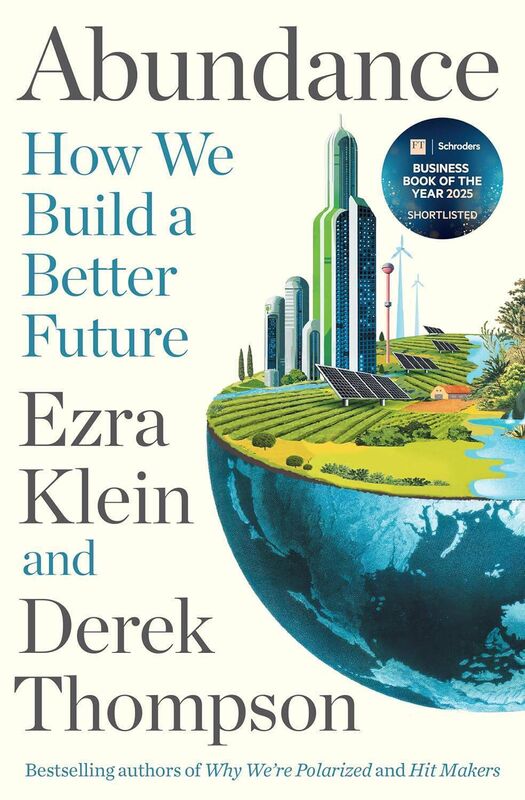
  • Abundance: How We Build a Better Future 
  • Ezra Klein and Derek Thompson 
  • Profile Books, €21.99 

Ezra Klein is the poster child of the American left. But in Abundance, he urges liberals to examine the unintended yet devastating consequences of some of their fundamental beliefs.
The Californian is, arguably, the leading media figure for US Democrats.

The 41-year-old is a columnist with The New York Times and the host of The Ezra Klein Show (tagline: “Real conversations about ideas that matter”) — an influential podcast of long-form interviews where Klein, a policy wonk, discusses topics shaping American society and politics.

Co-written with Derek Thompson, a staff writer at The Atlantic, Abundance contends that progressive US legislation motivated by idealism but preoccupied by regulation has inadvertently produced systems beset by scarcity.

While the authors’ focus is the US, the problems that they consider — in housing, transportation, energy and healthcare — apply to most developed economies.

In two of the infrastructure case studies they explore, the parallels with Ireland are especially pronounced. 

In Houston, Texas, a city of nearly eight million, the median home price is about $300,000.

The city has no zoning rules and the lowest homelessness rate of any major US city. 

In San Francisco, with about 4.6m residents, the median home price is over $1.7m.

California has about 12% of the country’s population, but roughly 50% of its homeless. 

The introduction of extensive environmental laws in the 1970s has led to a severe housing shortage today. 

In this Democratic-dominated state, liberal policies have obliterated affordable housing and forced residents out.

Until the 1960s, the population of California grew twice as fast as the rest of the country. But in 2020, for the first time in its history, the numbers living in California fell.

Meanwhile, in 1996 the state started planning the construction of a 1,250km, high-speed railway, including a San Francisco-Los Angeles travel time of two hours 40 minutes. 

Voters in 2008 approved proposals to allocate $33bn to it and the federal government pledged to invest billions more. 

But, echoing the problems associated with Dublin’s MetroLink, California’s high-speed track remains an aspiration.

An environmental review process started in 2012, just to assess the effect of the railway, is ongoing. In contrast, since 2008 China has built more than 38,000km of high-speed rail.

California’s previous haphazard development prompted environmental protections that require consultation with multiple competing interest groups and make it easier for individuals to sue the government, resulting in a paralysing process.

“California’s High-Speed Rail Authority has been scrupulous in following the law,” the authors write, “but has been unable to deliver a train.” 

Abundance includes 45 pages of references, but the prose never feels stilted by the research.

The authors write in a clear, supple style flecked with revealing vignettes.

 They display an eye for details that encapsulate broader stories and an instinct for arguments that will discomfit progressives. 

Strict zoning regulations in Democratic states choke the housing supply and deepen existing affordability pressures that the right then exploits.

So, liberal miscalculations are fuelling the rise of illiberalism. Yet for all its diagnoses, Abundance doesn’t seek to catalogue specific remedies.

A weakness of the book is failing to outline how we might evaluate what regulations to keep and those to discard, but they convincingly claim that their overall intention is more ambitious than advocating policy changes: they want a radical shift in political culture.

The progressive checks enacted 50 years ago to solve unfettered growth have created today’s problems where development is significantly stymied.

“This book,” they write, “is dedicated to a simple idea: to have the future we want, we need to build and invent more of what we need.”

x

BOOKS & MORE

Check out our Books Hub where you will find the latest news, reviews, features, opinions and analysis on all things books from the Irish Examiner's team of specialist writers, columnists and contributors.

More in this section

Scene & Heard

Newsletter

Music, film art, culture, books and more from Munster and beyond.......curated weekly by the Irish Examiner Arts Editor.

Cookie Policy Privacy Policy Brand Safety FAQ Help Contact Us Terms and Conditions

© Examiner Echo Group Limited