Book review: That was then, this is now in mingling of the personal and the polemical

Westerners dismiss their ancestors, individually and en masse, as 'racists, thieves, and murderers', but this brown-skinned woman from North Africa has come to tell whitey to get over himself
Book review: That was then, this is now in mingling of the personal and the polemical

Marie Kawthar Daouda: Born and raised in Morocco, moved to France in her late teens to study, and then left for England.

  • Not Your Victim: How Our Obsession with Race Entraps and Divides Us 
  • Marie Kawthar Daouda 
  • Polity, hb €24 

Marie Kawthat Daouda is an immigrant twice over. 

She was born and raised in Morocco, moved to France in her late teens to study, and then left for England around seven years ago to take up a post in Oxford as a lecturer in French literature, specialising in the late-19th century symbolists.
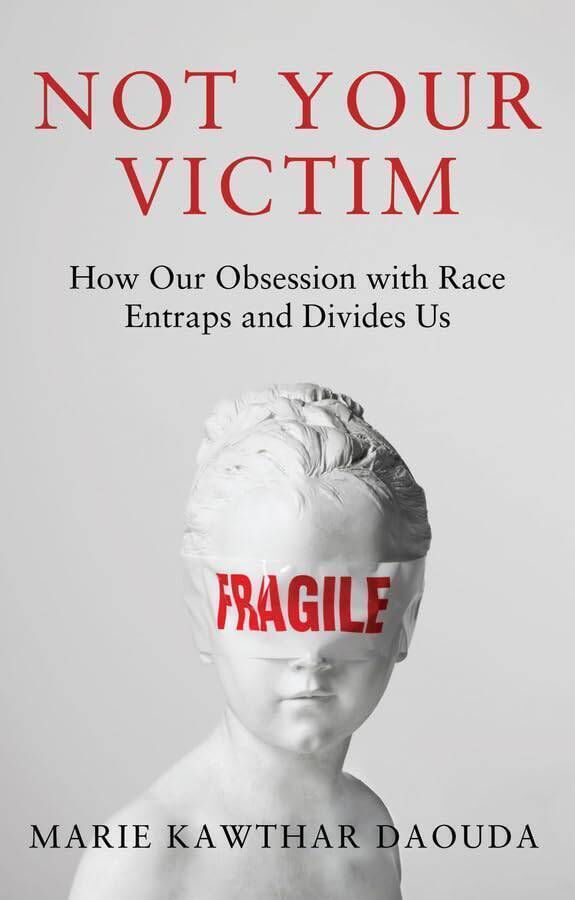
She opens her polemic against the post-George Floyd obsession with race with something unexpected: A brief but beguiling picture of her student days in “the twilight of a certain Paris”. 

She arrived on the Left Bank from Rabat as a 17-year-old “into The Cure, long black dresses, and ruffled shirts” and threw herself into a life full of tiny secondhand bookstores to be raided with her friends, of cafes buzzing with conversation, of arguments over Balzac, of “friendships broken because someone criticised someone else’s poem”.

There is an elegiac note to all of this. That was then, this is now, and, Daouda observes, the very idea of appreciating Europe, its art, and its history has become suspicious. 

Westerners dismiss their ancestors, individually and en masse, as “racists, thieves, and murderers”. But this brown-skinned woman from North Africa has come to tell whitey to get over himself.

Not Your Victim maintains its mingling of the personal and the polemical throughout. 

When examining the trend in recent years for statue-toppling, the author weaves in an enlightening disquisition on the history and culture of her beloved homeland, Morocco — “a country with no statues” (due to Islamic precepts prohibiting figurative art). 

In Oxford, she saw at first hand the ‘Rhodes Must Fall’ movement and concluded that the image projected of the coloniser Cecil Rhodes by protestors demonstrated an inability to accept that “people and facts are complex”, and a craving for “radical and cruel simplicity” that would legitimise “the passage into a new era” in which the inheritance of the West has been devalued and discarded.

Daouda turns to Nelson Mandela to put the capstone on this part of her case. 

When Mandela saw a Rhodes memorial in Westminster Abbey, he told an Anglican clergyman: “Memorials like this must remain because we need to see history in the round.” 

On she goes, examining one race-based contemporary phenomenon after another. 

Even when raging against cultural appropriation by their fellow westerners, she finds, campaigners and complainers are simply reinforcing, not dismantling, the ostensibly hateful perception that whatever is western must be a universal norm.

The appropriations raged against, Daouda notes, always run in one direction, even though this is clearly not a true reflection of the full reality. 

Non-westerners are always the appropriated from, never the appropriators. Their nominal champions thus allow them no “agency”, a key term for Daouda.

The book is also peppered with re-inspections of our unconscious assumptions about slavery and empire. 

Morocco is talked of by westerners only in terms of its time as a protectorate of colonial France. But it once had an empire too. 

At different times, this “stretched as far north as Toulouse… and as far south as Timbuktu”.

Daouda alludes to “white slaves my forefathers used to own” and reminds us that members of many other ethnic minorities are themselves “heirs of fallen empires”. 

Once again, guilt-ridden westerners, when they fail to acknowledge these histories, infantilise non-westerners, rob them of agency, and reduce them to the status of the ‘noble savage’ dreamed up by Rousseau.

Not Your Victim is a bracing, provocative read then. But it never loses its idiosyncratic, highly personal flavour. 

In the concluding paragraph, Marie Kawthar Daouda pays tribute to certain tutelary spirits that have overseen her settling in to Oxford and England. 

They are an eclectic bunch: from Oscar Wilde to Thomas More, from Elizabeth Anscombe (“teaching philosophy, smoking cigars, and opposing the nuclear attacks on Japan with a handful of babies around her”) to John Keats. 

This is a book with a lot to say about contemporary society, but it comes from the pen of an old Romantic.

x

BOOKS & MORE

Check out our Books Hub where you will find the latest news, reviews, features, opinions and analysis on all things books from the Irish Examiner's team of specialist writers, columnists and contributors.
More in this section

Scene & Heard

Newsletter

Music, film art, culture, books and more from Munster and beyond.......curated weekly by the Irish Examiner Arts Editor.

Cookie Policy Privacy Policy Brand Safety FAQ Help Contact Us Terms and Conditions

© Examiner Echo Group Limited