Author interview: ‘I don’t really think too much about writing when I’m doing my day job’

In 'The Benefactors', a cast of memorable characters coalesce when teenager Misty Johnson, from a hardscrabble background, is sexually assaulted by three boys with a more privileged upbringing
Author interview: ‘I don’t really think too much about writing when I’m doing my day job’

Author Wendy Erskine has previously published two short story collections, ‘Sweet Home’ and ‘Dance Move’. Picture: Khara Pringle

  • The Benefactors 
  • Wendy Erskine
  • Sceptre, €15.99

Wendy Erskine is talking to me on Zoom from the kitchen in her home in Belfast.

“I’ve positioned this so you can’t see the devastation,” she laughs.

The author, who has a full-time job as a secondary school teacher, is musing on the reality of balancing writing with all her other responsibilities: 

“You have other priorities and you do what you can. So many people all have other things going on.

“If you’ve got a full-time job but you also have to act as a carer for somebody, how is that much different than me trying to write a novel?

“People elevate these things as though they’re a big deal but so many people have got stuff that they have to deal with.”

Such empathy, deployed with incisive intelligence and wit, underscores all of Erskine’s work — from her acclaimed short story collections Sweet Home and Dance Move, to her recently published debut novel, The Benefactors, which has been attracting deserved rave reviews.

That her energies are not all directed into writing has also been very much to her benefit.

She began publishing fiction in her 40s and her talent was swiftly recognised. 

As a writer, and one senses as a person, Erskine is very much grounded in the everyday and the many little epiphanies it can deliver to someone who is curious and interested in human nature.

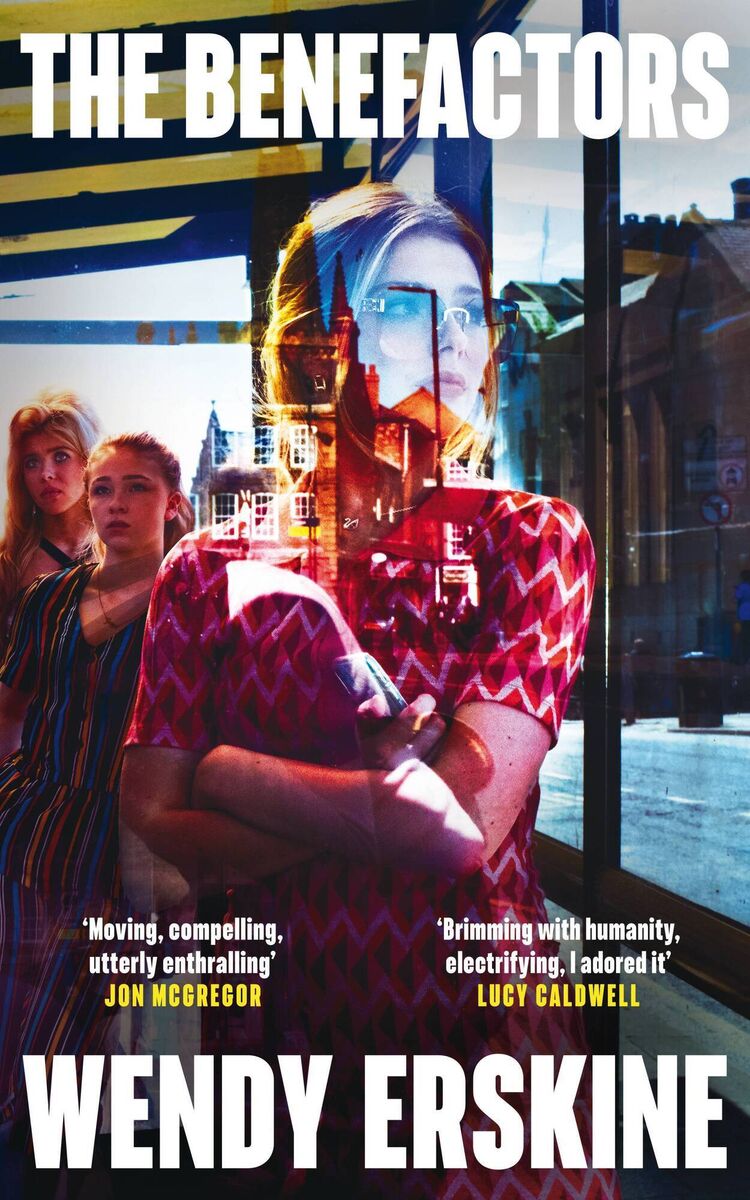
In The Benefactors, a cast of memorable characters coalesce when teenager Misty Johnson, from a hardscrabble background, is sexually assaulted by three boys with a more privileged upbringing. 

When she goes to the police, their mothers and stepmother — Miriam, Bronagh, and Frankie — pool resources to protect the boys.

Big themes intersect throughout the book — misogyny, class, sex, power, parenthood — but for Erskine, it all starts with character.

“It wasn’t that I started with a list of topics, ingredients that I wanted to include,” she says.

“For me, it has to be driven by the characters, and the preoccupations of the novel have to arise in a reasonably organic way, from the presentation of the characters.”

Erskine was also interested in exploring the possibilities of writing in a different form.

“I did not want to write a long short story,” she says. 

I wanted to write something that would be able to encompass all sorts of different preoccupations and ideas.

In The Benefactors, Misty is raised by her mother’s ex-partner Boogie, a cab driver who, although not her natural father and still only in his 20s, steps up to the plate. 

The reader very much roots for Boogie, who seems to have the nearest thing to a moral compass in the book. He has been raised by his grandmother, Nan D, the definition of a tough old bird with a brilliant line in dry sarcasm.

Erskine’s characters are so authentically drawn that one could be forgiven for thinking that they are based on real people, a notion that Erskine is at pains to dispel.

“I’ve always felt that I want to live in the real world and not alienate people — it’s my job as a writer to invent things” she says. 

“I don’t really know anybody that is like any of those particular characters. But it’s got to start somewhere — it might well be just the way somebody walks in the street that I’ll pay attention to.

“Or it could be something about the way somebody says — or doesn’t say — thank you in a shop.

“It’s normally quite small things that end up building up a character.”

For example, with Boogie, I just happened to come across a video on YouTube of this guy with his kids doing that Mentos exploding in the Coke thing.

“I just remember thinking there was just such fun and joy in having a laugh with your kids, that started him off for me.”

Misogyny is woven throughout the book and it was a topic that Erskine wanted to explore from a less obvious viewpoint. 

Rather than being sleazy or predatory, Misty’s adventures in the world of fan-cam content are imbued with an almost touching naivete. 

The character of Frankie is groomed as a teenager in care, later acquiring one form of power when she marries a wealthy businessman.

“There’s no point in me writing something to say ‘sexually assaulting people is wrong’. People don’t need to be told it’s wrong. I was trying to look at this in terms of different types of experiences,” she says.

“Some of the misogyny is overt, some of it is implicit; some of it is class-based as well.

“Frankie ends up with this rich man and there are these conversations about maximising your assets. So I was looking at how the language of finance is then applied to women’s bodies.”

Frankie identifies with Misty but she can’t afford to indulge that.

The Benefactors might deal with weighty topics — one of the first-person vignettes that are scattered throughout the book delivers a seriously short and sharp shock — but like much of Erskine’s work, it is also shot through with humour. She recognises that it can be a delicate balancing act.

“We can find things funny, and find things desperately sad and upsetting, and the idea that these things can’t co-exist isn’t realistic,” she says. 

“But it also depends on a reader being attuned to that. And I think that’s a very unpredictable thing.”

Erskine also captures the world of a teenager very well, perhaps unsurprisingly as someone with plenty of experience in that area, as both a mother and teacher. 

However, she says her teaching has a limited influence on her writing.

“I don’t think I’ve ever had one conversation with students about my books,” she says. “But it is an interesting one, because the nature of teaching is that you are listening to a lot of people a lot of the time.

“It was the writer Neil Hegarty who pointed out to me that my job is very polyphonic. So there’s that dimension. 

“But the nature of what I do is very much about making sure that pupils feel confident writing about literary texts and it is very much pupil-centred.

“I don’t really think too much about writing when I’m actually doing my day job. It’s very, very distinct.”
Even though she is working on another novel — “I need to get a bit further to decide if I actually like it enough” — she has not abandoned the short story. 

She does not have any truck with those who believe you haven’t really made it as an author until you write a novel.

She says: “People’s attitudes sometimes, it’s like it’s just rookie prep, you do the short stories as a bit of throat-clearing before you start on the main event of the novel, which is absolutely not to have enough respect for the form itself and what it can do.”

Erskine is now looking forward to returning to the West Cork Literary Festival next month:

“I was there before a few years ago and I did a creative writing workshop, it was wonderful. I just love Cork, I would move there.”

As for how she feels about discussing her work, she is refreshingly honest: “I wrote the book so people could read the book, so sometimes it seems a little strange to be talking about it because it can seem reductive.

“But mostly, I really like talking about it, I mean, you should be grateful that anybody is interested.”

Going on the evidence so far, I don’t think she needs to worry.

  • Wendy Erskine will be at the Marino Church, Bantry, at 2.30pm on July 18, alongside Lisa Harding as part of the West Cork Literary Festival
  • westcorkliteraryfestival.ie

More in this section

Scene & Heard

Newsletter

Music, film art, culture, books and more from Munster and beyond.......curated weekly by the Irish Examiner Arts Editor.

Cookie Policy Privacy Policy Brand Safety FAQ Help Contact Us Terms and Conditions

© Examiner Echo Group Limited