'A few pound and free drink was a good encouragement': Cormac Begley on Kerry sessions and his viral marching tune
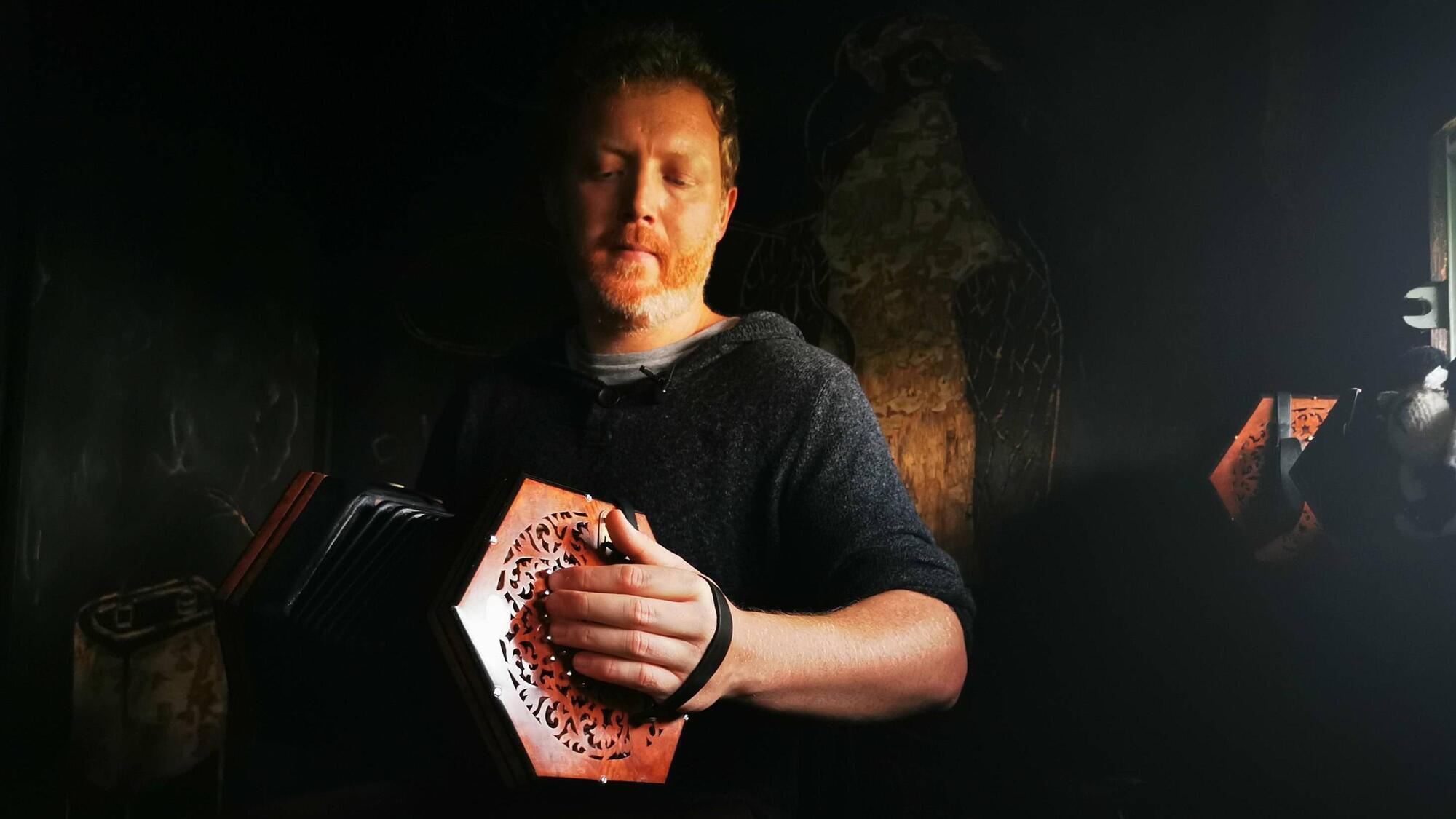
Cormac Begley plays in Cork Opera House in May. Picture: Oda Dineen
Music is the family business for Cormac Begley. The West Kerry concertina player was born into it – his dad, Breanndán, is an accordionist and singer, his uncle the late, great Séamus Begley, a sweet singer and accordion player, Tommy 'An Lord' O’Connor, an uncle on his mother’s side, also an accordian player. Begley got into music in earnest as a 16-year-old, playing gigs around the Dingle Peninsula.
“My brother, who’s about two years older, started playing guitar,” explains Begley.
“We learnt a good few tunes. My cousins, Séamus Begley’s sons, Eoin and Níall, were playing around at the same time. We were offered gigs along the peninsula. It was a case of under-age drinking, free drink, a few pound.
"They talk about the importance of the tradition, but a few pound and free drink was a good encouragement and central to our musical development!”
Páidí Ó Sé, the legendary Kerry footballer and manager, also hired Begley for gigs in his Ventry pub. The musician recalls having enjoyable chats with Ó Sé during that crucial era in his musical apprenticeship.
Begley went off to university shortly afterwards to study psychology, but the draw of traditional music was too strong. In 2017, he released his self-titled debut album, which he followed up five years later with B, the world’s first solo bass concertina album, acclaimed works which have established him as one of Ireland’s finest musicians.
“I consider myself a traditional musician first and foremost,” he says. “I never studied music. I inherited it from my family and my community. I'm often asked to play in different genres. I've recorded with Lisa O'Neill, Ye Vagabonds, Lankum, but they're within the traditional world so there is some commonality there.
“I believe that playing with other people outside your comfort zone is really good for growth. I always try to play with people I admire and look up to and that are better than me, that I can learn from. That keeps you sharp. It improves you overall as a person and as a musician. If they're doing something interesting and if it's challenging that’s my criteria.
“If it’s traditional music, I'm fine. Some people like Liam Ó Maonlaí, for example, is incredible. He can sit in with any musician from any genre and he'll give it a go and he'll get there most of the time, but I wouldn’t be a natural musician across the board.”
Begley, 40, penned his tune, as a gift for his godson’s birthday. It became a viral sensation, with north of 40 million views on social media. is a signature tune, which has personal resonance – his ancestors, the Begleys, fought on the side of Owen Roe O’Neill, the legendary Ulster general.
“The Begleys came from Scotland originally,” he says. “They were up in Donegal for a few generations. They were mercenaries, gallowglasses. They'd fight for cash. They fought on behalf of the O'Neills in the Battle of Kinsale in 1601.
“O'Neill's March was documented first in an old book from the 1790s where it noted it was an old tune going back a few hundred years. Folklore has it that the tune was played as O’Neill’s Army marched into battle as a signal of who they were, to intimidate the opposition, and to psyche up their warriors for battle. It's a powerful tune.”
After years on the road gigging, Begley set up a residential arts space, Airt, which offers week-long retreats for artists. John Spillane and the firecracker Californian cellist Rushad Eggleston are amongst those who’ve put on courses there, which cater for arts and crafts, including knitting, stone-wall building and videography.
Begley also runs secret concerts, a concept he devised during the covid lockdowns. He’ll advertise a concert within a 15-kilometre radius of Dingle.
The day of the gig, the audience discovers its location – it could be by a pier, a river, a lake or the side of a mountain. He heads to the gig in 'Beauty', his 1979 campervan.
“It’s a bit of a Ryanair job,” says Begley. “I ask the audience to bring their own chairs. They sit around in a semicircular. I might do an hour’s concert, and chat away to people afterwards. People enjoy it because of the anticipation; they don't know where they're going.
“You hear birds. You can hear the waves, the river. The location informs the setlist I play. I talk about local history and how it relates to a certain tune. I encourage questions.
"Often at a gig like, say, my upcoming gig at the Cork Opera House there’s a barrier between the audience. I love concerts where people ask questions, where it’s a two-way thing.
“What’s my favourite question? ‘Are you single?’ ”
- Cormac Begley will play at Cork Opera House, Friday, May 2. He will be supported by Lemoncello. See: www.corkoperahouse.ie.