Menopause, patches and milestones inspire Éadaoin Glynn

The Summer Exhibition at the Lavit Gallery continues until August 22 
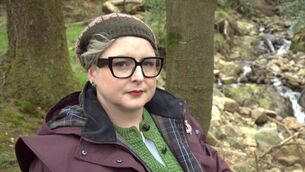
Éadaoin Glynn with her painting, Self-Portrait With Estrogen Patch 1 (Bathroom Mirror Selfie)

Éadaoin Glynn with her painting, Self-Portrait With Estrogen Patch 1 (Bathroom Mirror Selfie)

One of the most striking artworks in the Summer Exhibition at the Lavit Gallery in Cork is a painting by Éadaoin Glynn, called Self-Portrait With Estrogen Patch 1 (Bathroom Mirror Selfie). The piece is part of a series Glynn is currently working on, inspired by the medical options available to those going through the menopause.

“I studied English and French at UCC, and they say you should write what you know,” says Glynn.

“So I paint what I know. These paintings are quite autobiographical, and they’re purely about my own experience of Hormone Replacement Therapy, or HRT. I’m a visual artist, so I wanted to make a visual record of it.”

The menopause, says Glynn, “is a milestone for a woman. There’s lots of different milestones, but it’s the first one I encountered that I didn’t know that much about. I was surrounded by silence, even though there is more conversation about the menopause now. I just found it really different; I remember when I first started having symptoms, I was having hot flushes out of the blue.”

Around that time, Glynn was attending a painting workshop in Italy. “The women were mostly older than me, and I asked them, how long does this last? They were really uncomfortable with my question, and they didn’t really answer it. I found that strange. It didn’t seem to be something that you could just bring up in conversation like you would anything else.”

“I remember asking my GP, ‘why don’t I know more about this?’ And she said, ‘it’s the last taboo’. That phrase really struck me. Not all women will experience pregnancy or birth, but all women will go through menopause. It affects half the population.”

When Glynn began researching the subject in earnest, she found the medical information quite confusing. “There were a lot of mixed messages,” she says. “So I decided to try and treat the symptoms of the menopause myself, thinking, ‘surely it’s going to stop’. But then, five years later, there was still no sign of it stopping. So I thought I would try HRT.”

“I was nervous about starting the treatment initially. The idea of applying or ingesting hormones didn’t appeal to me. I would have much preferred if I was able to manage it with acupuncture. But it needed something more aggressive. I was prescribed an estrogen patch and a progestogen tablet to take at night. The estrogen patch came in a blue box with white clouds in it. It reminded me of those tampon ads in the 1970s, where the girls are wearing whites and playing tennis. It seemed to be a visual euphemism for the end of hot flushes. Like it’s going to be the blue sky from here on in.”

Glynn was surprised by the size of the patch. “I thought it was going to be this massive plaster, like a big nicotine patch. But it’s actually really small. It comes in this blue, condom-sized wrapper, and the plaster is tiny, about half the size of my finger. And it’s translucent. You have to apply it to alternative sides of your torso every three and a half days. It took me a long time to get the knack of how to do it. It just seemed very strange and bizarre.”

Éadaoin Glynn tackles the realities of the menopause 

The treatment proved to be highly effective, however. “I’d been struggling with the symptoms,” she says. “But they disappeared almost overnight. It was like magic in that sense.”

Glynn recorded the experience from the beginning. “I started off doing a series of charcoal drawings and selfies and sketches. Then I noticed that as I changed the patches from one side of my body to the other, they left these little marks. I had these little patchwork marks on either side of my body, and I thought, that’s really interesting.

“At the time, I was painting a lot of abstract paintings. I love mark making and how you see marks in nature. I was fascinated by these marks on my body that the medication was leaving, and I decided I would document that.”

Self-Portrait With Estrogen Patch was one of a series Glynn made by painting her reflection in a mirror. “It was me, cropped from my shoulders to my hips. I was trying to bend to one side to see which side the patch was on. I wanted the patch to be the hero of the story in the painting. And for that particular painting, I used leftover Quality Street wrappers to represent the patches.

“The wrappers are really neon, and I made the patches slightly bigger than they actually are. The whole thing is amplifying what is hidden. When I shared it on social media, I got a huge response — personal messages and comments from other women sharing their stories. I’ve done four or five paintings in that series now, and I think I’ll go back to it again. They’re all slightly different. But each has a cropped torso, almost like a statue. It was a way of making it not just about me. It could be anybody, and how we see ourselves in the mirror.”

Glynn has had no formal training as an artist. “I was offered a place at art college when I did my Leaving Cert,” she says. “But I was also offered a place at UCC. I tossed a coin, and it came up for UCC. I went on to do a Masters in French, and later I went into business.

“But I was always painting a little bit in the background, and I became more active about it when my children were young. I didn’t really know any artists at the time, but then I joined Backwater Artists and Sample Studios, and I made a lot of contacts at both. I’d love to go back to art college, but it’s still too tricky with my family. At the moment, I have a studio at home in Douglas, and I try to make time for painting, like everyone else.”

Glynn’s favourite painters include Elizabeth Cope, Marlene Dumas and Helen Frankenthaler, the American abstract expressionist: “She had this technique where she stained the raw canvas with thinned down paint. I’ve done a lot of abstract paintings with that method. The paint bleeds through the canvas and creates really interesting effects.”

Glynn has had two solo exhibitions this year, Girl Unknown at the Limerick Museum and Translucence at ArtNetDir in Dublin. She will also have work showing in three exhibitions in September: Crosscurrents at Dun Laoghaire Lexicon Gallery; the RBSA Prize in Bristol; and Transitus — along with Mary Bowen Galvin and Oonagh Hurley — at the Long Gallery at Backwater Artists in Cork.

She also finds time to produce the Warrior Artist Podcast, which features practical advice on how to manage a career as an artist, as well as interviews with creatives such as Aideen Barry, Eamon Coleman and Orla O’Byrne.

“In a way it’s like my own art education,” says Glynn. “I can reach out to artists I admire on Instagram and say, ‘would you like to be interviewed on my podcast’, and 99% of people would say ‘yes’. I get to be nosy and ask questions. ‘What is your studio like?’ ‘What is your journey?’ I love it.”

* The Summer Exhibition at the Lavit Gallery continues until August 22.

Further information: lavitgallery.com

eadaoinglynn.com

More in this section

Scene & Heard

Newsletter

From music and film to books and visual art, explore the best of culture in Munster and beyond. Selected by our Arts Editor and delivered weekly.

Cookie Policy Privacy Policy Brand Safety FAQ Help Contact Us Terms and Conditions

© Examiner Echo Group Limited