Book review: Finely tuned historical imagination comes to life in Pax

As ever, it is a pleasure to trail after Tom Holland, a loquacious, ebullient guide.
Book review: Finely tuned historical imagination comes to life in Pax

Tom Holland. Picture Leonardo Cendamo/Getty Images

Tom Holland bestrides the writing of popular history about the ancient world like — well, like a colossus. In part, his enormous success is owed to an unfailing eye for telling details in which to ground the grandest narratives.
He opens his latest book, Pax, with two bridges built by and named after Hadrian: One for crossing the Tiber, connecting Rome to the emperor’s own mausoleum on the far bank; the other for crossing the Tyne at the empire’s furthest northern extremity. Both were displays of superpower energy, but Holland also segues them into interesting reflections on Hadrian’s Wall and the wall of ice in A Game of Thrones. As ever, it is a pleasure to trail after Tom Holland, a loquacious, ebullient guide.

Hadrian was one of the greatest and most compelling figures from the centuries when the Roman Empire had subdued the world around the Mediterranean (and some of its fringes), allowing safe passage of people and goods and civilisational flourishing on an unprecedented scale. Rome, according to Pliny the Elder, was humanity’s “second sun”. But the Roman Pax was, of course, nothing like the Peace and Love variety. It was underwritten by “an aptitude for killing”. Holland’s book is divided into two parts: War comes first, then Peace. And much of the war is of the civil variety as Holland chronicles the violent churning of four emperors in one year, AD69.

Having been obsessed with them since boyhood, Holland knows that the Romans were “unnervingly, compellingly different” to us. Pax is a heady brew: Plotting, vanity, idealism, vengeance, lust, novelty, tradition, and superstition (that saw portents everywhere, in the sky and in the entrails of dead animals); martial discipline and indiscipline, the movement of armies from north to south, east to west, and mass slaughter (“I have forbidden the Nasmonians to exist,” the emperor Domitian said of one tribe in Africa). Peace is the fruit of eternal victory.

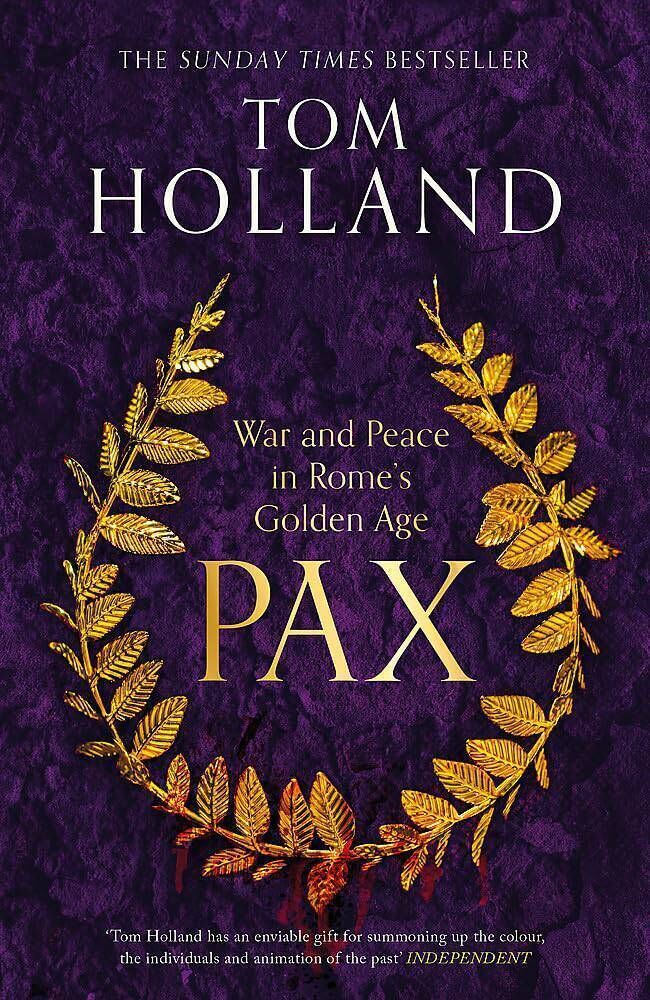
Pax: War and Peace in Rome's Golden Age by Tom Holland

Holland also takes time to lay bare the Roman reliance on slavery to satisfy everything from material needs to sexual desire, teasing out the many ironies and contradictions of the system. The excesses of Nero are here too — though I find that they can become oddly boring, surely the very opposite of one of their intended effects. (Though, had I been there, I would not have been volunteering this opinion to the man himself).

Among many tremendous set pieces are the destruction of the Second Temple in Jerusalem by the army of Titus in AD70; the eruption of Vesuvius and the destruction of Pompeii; the conquest and withdrawal from Caledonia; and Hadrian’s visits to Athens and Sparta, each by then a “ghost of its own greatness”.

There is much to chew on in Pax about the natural limits of Roman expansion and Roman rule and how the Romans themselves viewed the question.

Reading Holland, the reader finds himself in the presence of a fervent but finely tuned historical imagination, extracting a plenitude of colour, motive, and meaning from the known facts, and serving these up in trademark dashing prose that seems at times to take us right up to the boundary with historical fiction. Pax is full of Hollandesque phrasemaking that can both delights his readers and imprint history on our dull brains.

Page after page of such deeply purple prose can sometimes get cloying, though; and, towards the end — when, for example, introducing (admittedly interesting) characters like the Greek orator and adviser to Trajan, Dio Chrysostom — I had the nagging feeling that Holland was perhaps stretching his canvas too far, and risking thematic repetitiveness.

However, the closing pages of Pax contain something fascinating too: A strange sect “founded by a criminal who had been put to death by Pontius Pilate”, which proclaimed a very different understanding of the nature, sources and guarantees of peace, comes creeping into the peripheral vision of the Roman elites. To find out what happened next (over a 2,000-year stretch), readers should try Holland’s previous and possibly finest book, Dominion.

  • Pax: War and Peace in Rome’s Golden Age by Tom Holland
  • Abacus, €18.99

x

More in this section

Scene & Heard

Newsletter

Music, film art, culture, books and more from Munster and beyond.......curated weekly by the Irish Examiner Arts Editor.

Cookie Policy Privacy Policy Brand Safety FAQ Help Contact Us Terms and Conditions

© Examiner Echo Group Limited