Book Interview: Julian Vignoles looks at dementia in fourth book Tides Go Out
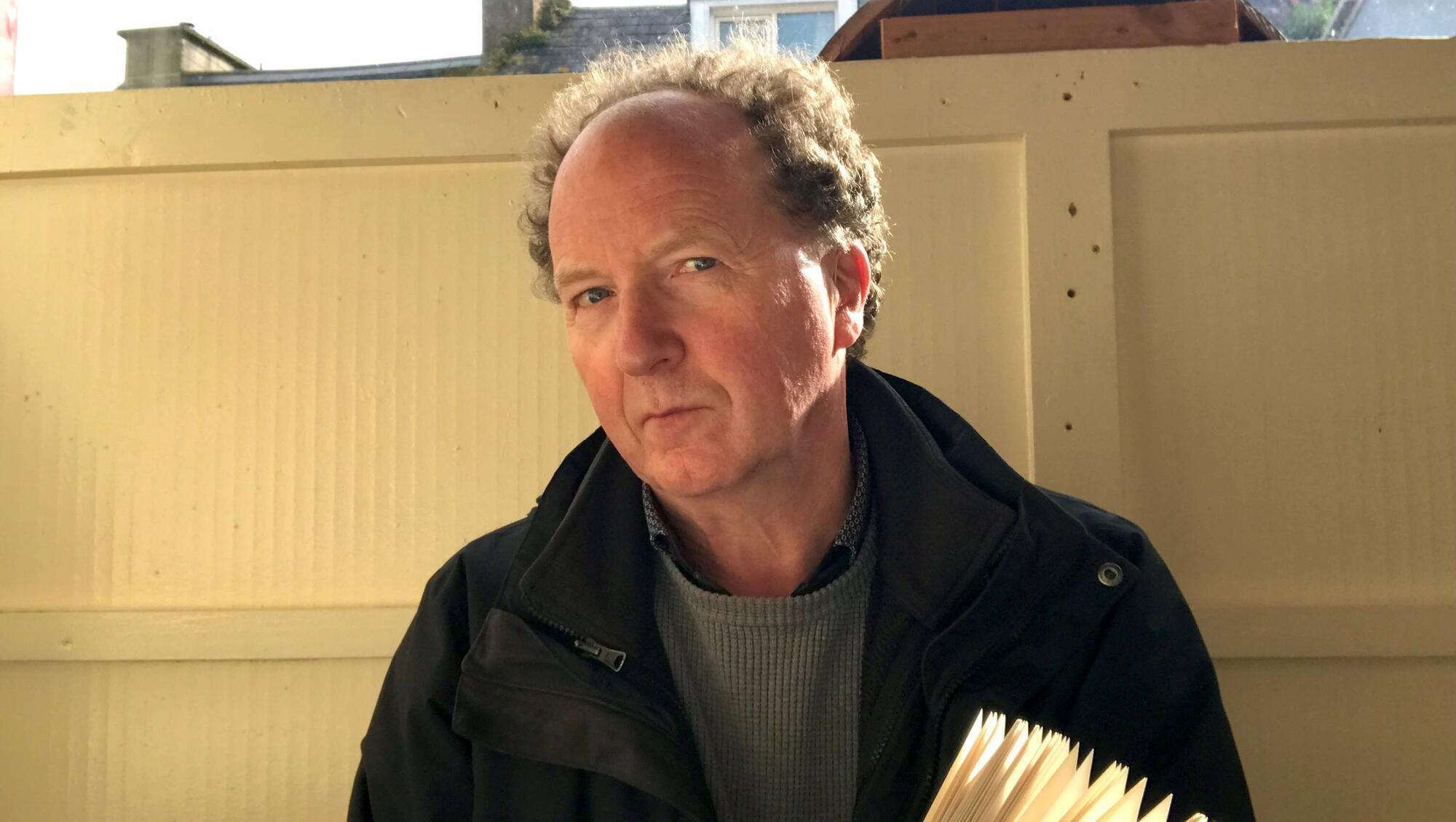
Julian Vignoles, author and former RTÉ ents executive
- Tides Go Out
- Julian Vignoles
- Orpen, €12.99
Julian Vignoles had a long, and successful career with RTÉ. Starting as a producer at the newly formed RTÉ Radio 2 — he moved to Radio One, before ending up in TV, where he worked on documentaries and light entertainment. He ended his career in management, as assistant head of entertainment.
Head of entertainment at the time, was Kevin Linehan — a man who was hugely respected, and loved. But after working happily with Kevin for four years, Vignoles noticed a change in his boss.
“He was saying to me, ‘we must make a decision about such and such a proposal, and I said, ‘Kevin, we talked about that a week ago, and we decided it.’ That’s when I knew there was something … and Kevin was never great at emails, but at that time, they really started to build up.”
It turned out that Linehan had early onset Alzheimer’s. He had to leave work, and died, finally, in 2017. Vignoles kept in touch with him after he’d left RTÉ. He noticed his friend’s decline; moving from a time when he seemed fine, yet couldn’t follow a conversation, until, finally, he went into hospital.
“I was one of the people who visited him there,” says Vignoles, when me meet in Kilmacanogue, County Wicklow, the village Vignoles grew up in. We’re here to discuss his debut novel, , which is based on a character suffering from dementia.
“I became fascinated by that whole mystery,” says Vignoles. “You have someone who is physically present. Who is there; who looks exactly the same; yet he has lost his mental facilities. He can’t remember things, and, eventually, he doesn’t even recognise you. I was wondering, what is going on in his head? And that, in a sense, we all have a loose grip on reality. And what if your mental powers fail you?
“You’d wonder, at what stage do they lose consciousness,” he muses. “Maybe it’s like dying. You don’t know you’re dead — maybe you don’t know you’ve lost your memory.”

Always interested in journalism, Vignoles worked on the student paper at University College Dublin where he was studying English and Philosophy, but was, he says, a terrible student.
“I was more interested in my social life and the left-wing carry on at the time,” he says. “When I finished college in 1976, I got a call from Niall Stokes who was starting Hot Press. He said, ‘you know all about layout?’ and he gave me a job.”
He stayed there until he joined RTÉ. And, after he left, in 2012, he went back to writing again.
“One of our pet projects at RTÉ was to do some commemoration for David Thompson, who, famously, wrote . I put together a module for the McGahern Summer School, and somebody said, ‘why don’t you write a book?’. So, I rang his widow, Martina, and she said, ‘I think that is a rather nice idea, come to London.’ Lilliput Press took that on, and that was it. You have to keep on writing.”
He wrote two more non-fiction books. One on the history of the Eurovision; the other on Rory Gallagher — a project he was clearly passionate about.
“You have a great story,” he says. “A kid joins a showband at 15. He’s an excellent guitarist, everyone loves him, and he becomes a global star in the seventies. He takes to drink; he can’t handle the idea that the career slides, and he has nothing to fall back on — not children, relationships, or golf — he becomes depressed and dies at 47. All you have to do is write it up.”
It was, of course, more complicated than that. He had to conduct multiple interviews — read everything that had been written, look at the songs, and how they relate to his life — and try to find new angles.
In 2020, Vignoles was trying to decide what his next book would be, when the pandemic hit.
“I’d no idea for a fourth book, so I thought, why not try this fiction thing? It should be easy.”
He started with a character, Con, who gets that terrible diagnosis. We see him wandering the streets of his native Cork — a little bit confused.
“There is not a novel there, so what happens? He is married to somebody — then I had the idea that they both have secrets. What’s hers? Well, a bad love affair in her past. His secret is a Danish liaison, but he can’t quite remember it.”

This all makes for a fascinating exploration, not just into the dynamics of a failing memory. While through Con’s experience, we get a version of dementia that feels utterly authentic — the novel also looks into a once happy marriage which has been upended when Con becomes ill, and examines the secrets we hide, from ourselves and each other.
The redemptive power of music plays a part too. Vignoles give the character of Con this passion.
“That, and his love of sport comes from me,” says Vignoles. “And Fiona’s religious conviction is ‘me’ too. I’m a practising Catholic. Con and Fiona have a daughter and a son. I don’t have a daughter — I know no women of 21 — I have two boys and they are much older.”
Saying that ‘this writing thing’ is a terribly solitary business, Vignoles admits that fiction did not come to him as easily as he had hoped.
“When I started out, I was telling, not showing,” he says. “Because you have to undo a lot of what you do in non-fiction. The first draft was incredibly literal. And then I got advice from an editor, Paula Elmore. I had to learn how to talk about rain — and to know the difference between scenario and plot.”
The finished novel reads beautifully. And, clearly, it was as much a joy to write, as it is to read.
“You’re in this kind of never world,” he says, of the creative process. "And so — this might be very late at night, and you’ve got the laptop, and you go into this world. And it can be very creative and fulfilling for a couple of hours, and then, you might wake up in the middle of the night and think, so that’s what would happen in that situation.”
For his day job, Vignoles is a tour guide — driving mainly American tourists around the West of Ireland.
“I’ve been doing it since 2019 — with a gap for Covid,” he says. “It’s a way of seeing the country. I now know Kerry and Cork like the back of my hand.”
Doing one tour of six, seven or eight days once a month, he has to talk while he drives, and answer questions.
“They say, ‘how come there are two states on the island,’ and ‘what’s the healthcare system.’ And they always say there are a lot of cattle. You get all those kinds of things.”
When he’s not writing, or driving tourists, he like to follow sport — especially Gaelic football and soccer — drink pints with friends and walk his dog — a lurcher rescued from a Wicklow pound. He also adores reading. We discuss recent publications, and it’s clear that he reads all the emerging women writers. He especially admired Louise Nealon’s , and Eimear Ryan’s, .
“And at my advanced years I’ve discovered the Brontës,” he says. “I thought was extraordinary. And also, . They lived in this peaceful place — these moors and saw all this darkness. I want to go and see the museum and walk the moors.”
Is he keen to write another novel? “I don’t know,” he says. “I’m still recovering from this one.”