Richard Scott at Ballymaloe: Sculpting a business in the art world
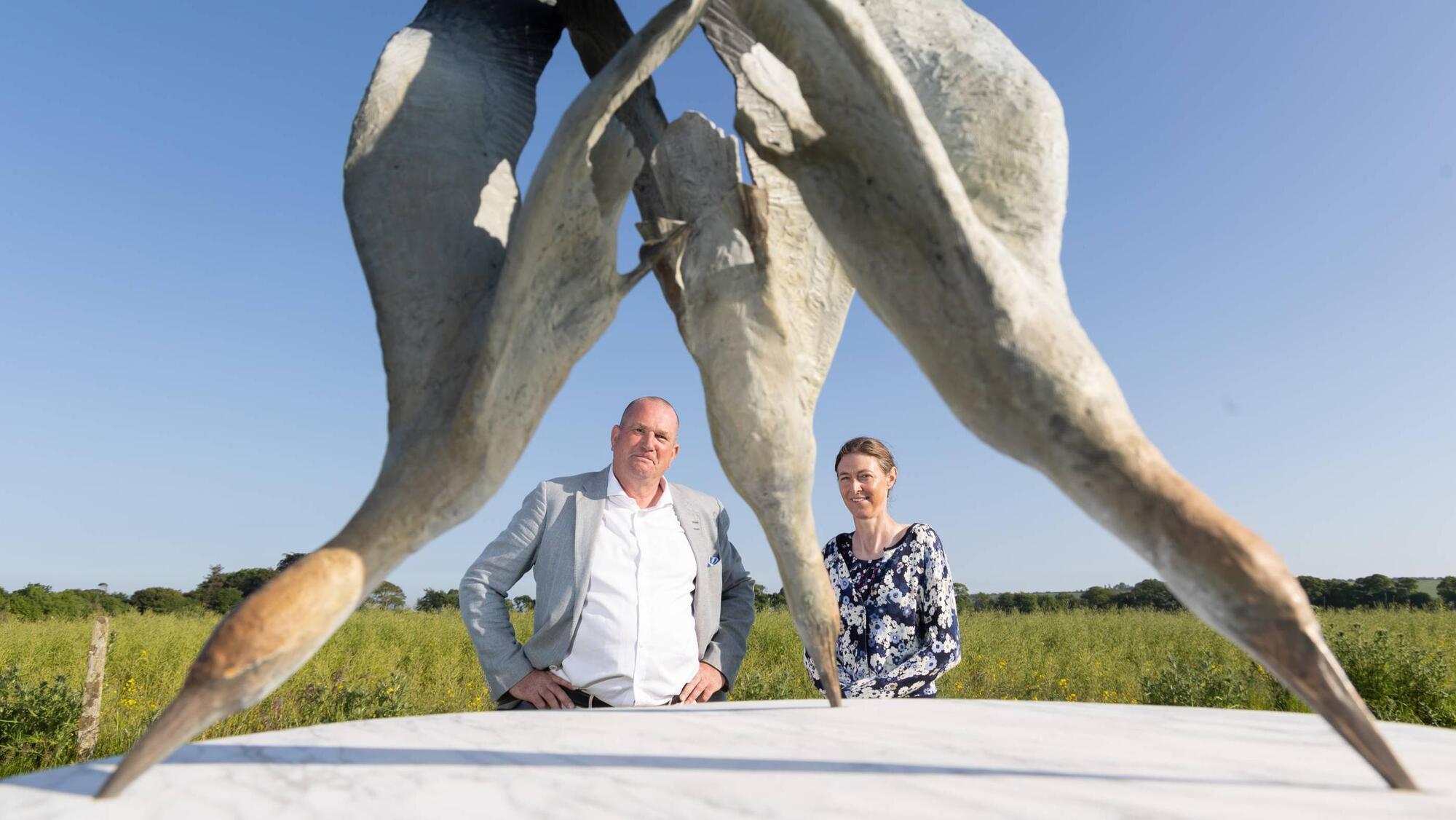
Richard Scott with artist Ester Barrett with one of her sculptures titled Gannet Plunge at Ballymaloe House Hotel. Picture: Darragh Kane
Birds and animals feature prominently at the Richard Scott Sculpture Gallery’s annual showcase in the grounds of Ballymaloe House in Shanagarry, East Cork. This is the event’s ninth year, and among the 47 pieces by 27 artists are Ester Barrett’s spectacular Gannet Plunge and Peter Killeen’s Sakra Hare, both cast in bronze, as well as Michael Quane’s Horse Rider and Quadruped, carved from Kilkenny limestone.
Their inclusion is hardly surprising; curator Richard Scott is a former veterinarian whose passion for art eventually won out over his keenness for working with animals.
“I loved being a vet,” he says. “I studied at UCD and worked in the Curragh before moving to Cornwall in the early 1990s. There was a bunch of us working there at the time, young people with a few bob and no great responsibilities, and I couldn’t have been happier. Eventually, I approached the two vets I worked for to ask if they would make me a partner. One said yes, and the other said no. I think, if they’d both yes, I would probably have stayed on there for life.”
It was in Cornwall that he started collecting art. “I became great friends with a painter named Paul Lewin, and I bought a lot of his work. As a child, my parents had often brought me around to exhibitions in Cork, at the Lavit Gallery and the Crawford and galleries like that, so it was a world I’d always been familiar with.”

He left Cornwall eventually, travelling for a time before settling in Dublin, where he continued working as a vet for twelve years. “And then, when I was in my early forties, there was a family tragedy at home in Cork, and I felt it was time to move back. I could have opened a veterinary practice of my own, but Paul asked if I would consider organising an exhibition of his work in Ireland, and I did. That first show was at the Grainstore in Ballymaloe, and it was a huge success.”
An old school friend, Colin Donovan, was managing Mount Juliet Estate in Kilkenny, and asked if he would consider curating an outdoor sculpture exhibition there. “That was a real challenge, and the biggest learning curve I’ve ever been on in my life. Financially, it proved to be something of a disaster, but it was through working on that exhibition that I got to know sculptors like Don Cronin and Martin Lyttle, who I still work with today.”
Over the years, Scott has extended the pool of sculptors he represents. This year, there are nine female and 18 male artists. For many, the exhibition is a welcome opportunity to show their work in a sympathetic environment, particularly as traditional showcases such as the Royal Hibernian Academy summer exhibition in Dublin tend to favour paintings, prints and photographs – works that can be hung on the walls - over sculpture.
“I think they’ve had problems in the past with sculptures being knocked over and broken, so they tend to keep the floor as clear as possible,” says Scott.
Mounting an outdoor exhibition can reduce or eliminate such worries, but the Ballymaloe showcase remains a costly business to put together, not least in producing the catalogue that Scott feels is essential to the project. “This year we’ve printed 1,500 copies of a 40-page book, at a cost of €4,400,” he says. “But it’s worth it. People will take those home with them, and very often they’ll ring me in September or October to enquire about a work they saw over the summer.”

About eight years ago, Scott invested in 20 teak plinths to place the sculptures on. “They only cost €250 each, and they’ve proven to be a great investment. I use them every year, and they’ve really stood the test of time.”
He also invested in a number of marble columns, which were originally intended for a church in Co Kilkenny. “The church was never built, and when I got my hands on them, I brought them up to McKeons’ stone yard in Stradbally and had them each cut to two metres tall. The area I exhibit in at Ballymaloe is about 50 square metres, and I’ve placed the marble columns around the perimeter. It gives the whole thing a bit of muscle.”
Scott estimates that about two-thirds of those who buy the work at Ballymaloe are Irish collectors. “The rest are mostly British and American visitors who’ll have seen the exhibition when they’re staying in the area. Year on year, at least 50% of the sales are to collectors who’ve bought work from me before. I work on those relationships. I’ll ring someone I think would be interested in a piece by, say, Martin Lyttle. It might be a limestone sculpture, and I’d tell them it’s a gem of a piece, and very well priced.
“If you have a good relationship with someone and they trust you, then they’re likely to have a look at the work and give serious consideration to buying it. Some people will buy a number of works by a particular artist they like, but more often they’re looking to build up a diverse collection. Obviously, we have to sell a decent amount of work to make sure everybody gets paid, but this year’s already looking good.”
- The Richard Scott Sculpture Gallery Ballymaloe Exhibition is open daily from 9am to 9pm until August 31. Richard Scott will lead a free tour of the exhibition at 5.30pm each Thursday until July 27. No booking required. See rssculpture.com.