Ireland In 50 Albums, No 17: Lights of the City, by Jubilee Allstars
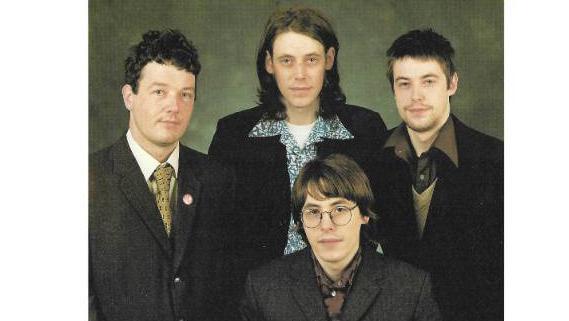
Jubilee Allstars' cover picture was inspired by Kraftwerk.
Lights of the City by Jubilee Allstars sounds as contemporary now as it did upon its release 23 years ago, mostly because its themes of homelessness, racism and gentrification are as pertinent today as they were at the turn of the century.
Upon its release The Guardian called Lights of the City “an absolute revelation” and wrote that, “the closing title track is probably the first great song explicitly written about the bittersweet effects of inner-city gentrification.”

Barry McCormack, Jubilee Allstars’ guitarist and vocalist, laughs as he recalls the review, “My joke is that it’s the only song about the bittersweet effects of urban gentrification, I’m proud of the song 'Lights of the City'. It was a leap forward for me as a songwriter.”
Jubilee Allstars were formed in the mid-90s by McCormack’s two older brothers, Niall on guitar and vocals and Fergus on bass, and their friend Lee Casey on drums.
“Every band is a family in microcosm and in retrospect it’s probably easier being in a band with actual brothers because the roles are really clear,” says Casey. “Anything that needs to get said tends to get said. It certainly wasn’t without arguments or tension but I think everything got expressed.”
They self-released their debut single ‘Everyone’s Clown’ in 1995. A second single, ‘Don’t Give Up On Me’, was put out by Dublin indie label Dead Elvis later that year. The BBC’s John Peel started playing the band and then Fergus got a telephone call from the DJ.
“It was the day Mark Kennedy had signed for Liverpool; he was the most expensive teenager at the time, and John [a Liverpool fan] was wondering what Kennedy was like,” says Fergus.
“He said, ‘he’s a Dub isn’t he, is he any use?’ I told him he was alright. I ended up talking about football with John Peel. He gave me his home address and asked me to send him our latest single.”
Jubilee Allstars signed to Lakota Records, a Sony-funded label. Their debut album, Sunday Miscellany, was released to acclaim in 1998. They were influenced by Memphis cult heroes Big Star, and Minneapolis bands The Replacements and country-tinged The Jayhawks. Melody Maker called their distillation of these inspirations, “a defiantly fragile brand of lo-tone country-blue heartbreak.”
This was music that was at odds with the prevailing mood of the late 90s. After some time in purgatory producing demos for a second album they managed to extract themselves from the Sony deal.
Album number two would aspire to say something about their Dublin. They looked at how the city had inspired others. “Paul Cleary’s ‘Downmarket’ is the best song ever written about Dublin, it will never be beaten,” says Fergus.
“The Dublin of The Blades and The Radiator’s Ghostown and ‘Under Cleary’s Clock’. Paul Cleary, Philip Chevron, Stephen Ryan and Stan Erraught from the Stars of Heaven, these were our heroes. Songs from Dublin, about Dublin and steeped in Dublin. The history of Dublin was important to us.”
Niall agrees, “it’s our version of a romanticised Dublin, a Dublin that was disappearing at this point. We were obsessed with 40s and 50s Baggotonia, Behan, even further back to Joyce.”
“All the stuff that Fontaines DC have taken over the world with,” smiles Niall. “We were doing that donkey’s years ago, and we were actually Dubs. Dublin was our muse.” Recording the album without major label backing meant a back to basics approach was required.
“We had no studio to do it in and then we had the hair-brained idea of just hiring a mixing desk and recording equipment and doing it in a nice house somewhere,” says Niall.
The band were offered the use of a house in Windy Arbour, near Dundrum.
“The Carrolls are a massive musical family on the Southside and they’re quite bohemian,” recalls Niall.
“We lugged all this hired equipment into their garage. It was no skin off their nose if there was an idiotic rock ‘n’ roll band in the garage.” Thom Monahan, from the American band Pernice Brothers agreed to produce the album. “We had played a few gigs with the Pernice Brothers,” remembers Fergus. “We got on well with them and that’s how we met Thom.”

Monahan remembers the sessions with affection. “The recording process seemed normal to me at the time. Coming up in rehearsal spaces and cheap studios, I was used to making records in houses on whatever gear could be found at the moment,” he says.
“The Jubilee Allstars were a lovely bunch of people, that obviously were ready to make a record. For such a ragtag crew they were focused, rehearsed and knew what they wanted. We were just trying to get something that felt true to them. It probably wouldn’t have mattered where we were recording.”
“They told me stories about the writing process, who the songs were about, the way Dublin was changing,” recalls Monahan. “They were individual people but the band was a visceral living organism, conversations were all shorthand, old jokes, the three brothers and Lee so tight you’d never get a knife in between them,”.
“No good record is made without strife and stress of some sort,” says the producer. “I had sprained my arm and wound up with a little bit of an addiction issue mid-recording because I was gobbling Nurofen Plus. I had to take a half day off to get focused on the withdrawal and felt guilty because we were on a tight deadline.”
The associations with literary Dublin continued to the presentation of the album in a sleeve that resembles a Penguin Classics cover.
“We went around to our haunts back in the day. Pubs The Long Hall, The Lord Edward and Frank Ryan’s. Bogart Menswear on Aungier Street, our go-to for dodgy second hand suits,” recalls Niall. “I took pictures of all these places and gave them to Colm Greene, a brilliant artist, and asked if he could put them into an imagined street scene.”
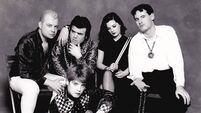
The band photograph on the sleeve continued the link with a bygone Dublin. “We went to Layfayette Photography, a traditional family photography studio,” recalls Barry.
“I was into Kraftwerk’s Trans-Europe Express. They’d gone for a 1930s studio portrait of themselves in suits,” says Niall. “I thought we’d do an homage to that. Layfayette had been there since the 1880s so it felt like another route into a lost Dublin. It’s Kraftwerk via 19th century Dublin.”
“There’s a real coherency to it from the sleeve, to the playing and the lyrics and the presentation,” says Casey. “I think we managed to capture something about our spirit and maybe unconsciously capture something about what was going on in the city.” Lights of the City is a singular work of art from a band of brothers and their best friend.
“The Jubilee Allstars were the purest group of musicians, songwriters, gentlemen and scoundrels I have ever had the pleasure to get addicted to over the counter pain relievers with,” says Monahan.
“Forever hopeful, forever doomed, all heart, all balls, and glorious. Forever glorious. Forever Dublin.”
- Paul McDermott’s podcast To Here Knows When – Great Irish Albums Revisited is available on all listening platforms. www.paulmcdermott.ie/podcast
- Jubilee Allstars released one more album, 2004’s The Struggle Continues, before calling it a day.
- Barry McCormack has released seven solo albums, 2019’s Mean Time is his latest.
- Niall McCormack is a graphic designer. His book Grand Stuff collects over 600 examples of Irish label art from the 1890s to the 1990s.
- Fergus McCormack works in the publicity department of RTÉ.
- Lee Casey plays in Dublin three-piece Soft On Crime. New Suite, their debut album was released earlier this year.