Book Review: Anja Murray's 'Wild Embrace' bears a powerful message
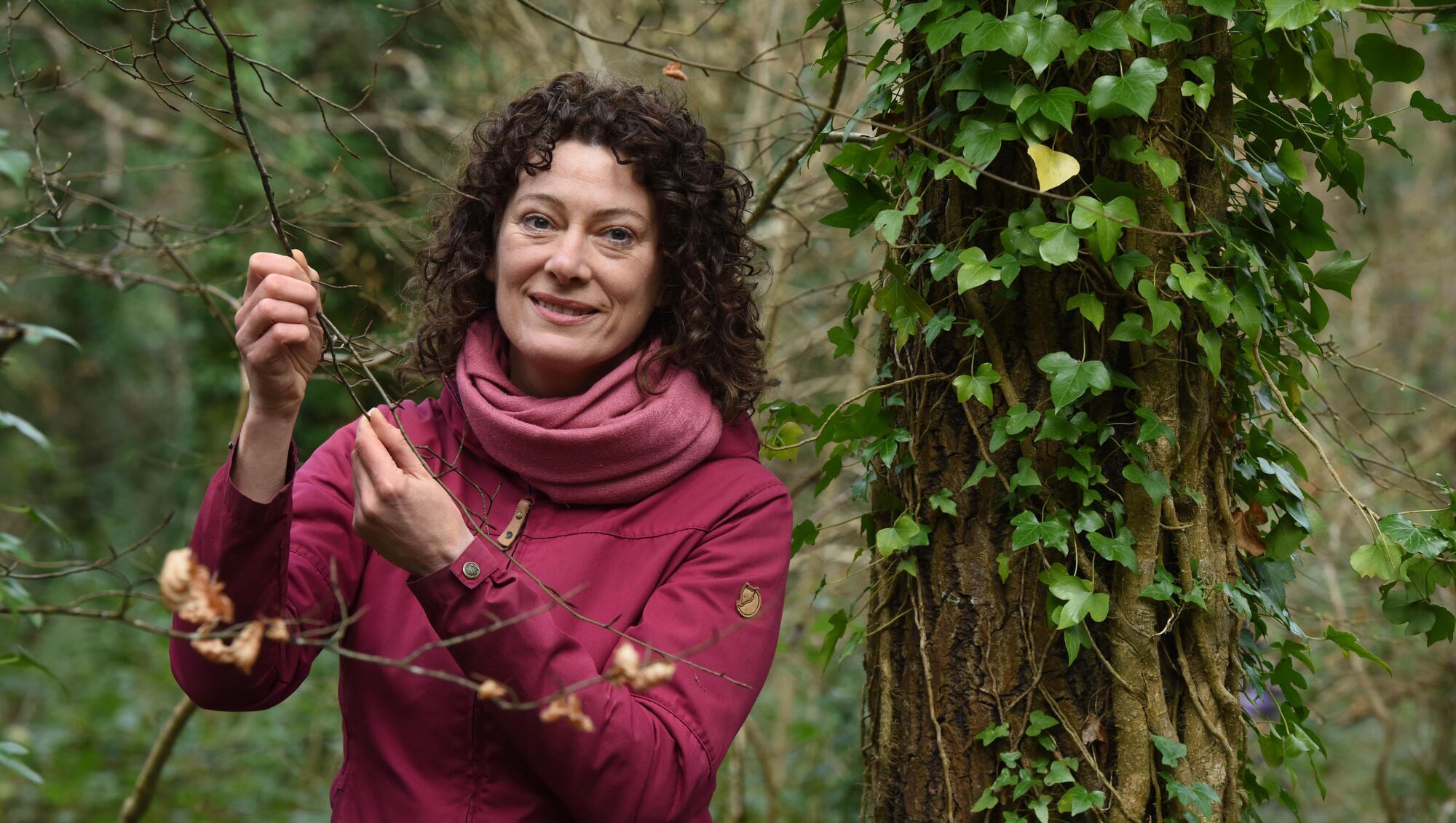
Anja Murray. Photograph: Moya Nolan
- Wild Embrace: Connecting to The Wonder of Ireland’s Natural World
- Anja Murray
- Hachette Ireland, €17.99
Cherishing natural world
IT’S almost half a century since I was wrapped in my own, unwavering Wild Embrace. Enthralled by moving waters and the rushy, slithery borderlands ribboned between river and pasture, stream and hill I felt, and feel, the kind of passion all too often sustained only by unrequited love.
I had hoped that the fates had gifted me the aptitudes, the deftness, the lightness of touch needed to become a tolerable angler. Though that objective is still in play Anja Murray’s beautifully produced book stirred a deep memory about surrendering to one of nature’s many embraces that had lain dormant for decades.
All those years ago, when it was still possible to describe most salmon anglers as gentlemen without even the slightest hint of irony, I was befriended by a venerable of our local river. He shared some of his knowledge, everything from knots and lures to how tides, moon and rains conflate to produce the best salmon fishing conditions, what makes a cautious trout brave enough to rise and expose itself on a bright day, to his ideas around how other creatures see our world.
He was also the first to point out to me that ‘our world’ is one we share with an almost innumerable species and if we are to be good stewards of the great, irreplaceable (yes, irreplaceable) gifts entrusted to us we must see their needs and especially their difficulties as our own.
My long-gone mentor had fished the Lee before the river was dammed and, like the husk of RP McMurphy in One Flew Over The Cuckoo’s Nest’s closing scenes subjugated in the name of an imagined higher cause. He saw magnificence reduced to a tawdry relic. He remembered better, more abundant times. How he might judge the river today, and our collective indifference in its evisceration, is not difficult to imagine. Stultified by relentless abstraction, polluted in thousands of ways it is comparatively almost devoid of life though the defiant remnants of some species linger but for how long more?
In one of our last meetings, he wore his default green tweed jacket labelled ‘Moynihan, Merchant Tailor, Cork’ and left me with a caution that has taken me decades to appreciate fully. “Enjoy the river,” he said, “but falling in love with salmon fishing in is like falling in love with a dying woman.”
That half sentence does not reflect Anja Murray’s thesis precisely, but she is no less cautionary, maybe too cautionary at this minutes-to-midnight juncture: “Witnessing the demise of nature,” she writes, “can feel overwhelming, but we must not turn away. The purpose of this book is to encourage you to spend time in nature; rekindling life-affirming relationships with wild plants and animals, cultivating curiosity, and gaining fluency in the many wonderous phenomena that we are still fortunate enough to still have in Ireland.”
It may be overly dramatic, and maybe a tad too dismal, but unfortunately realistic, to suggest that that encouragement is akin to lusting after a fading, once-radiant woman as she views that River of Jordan from her death bed.
It is increasingly difficult to imagine, much less hope, we will have an 11th hour conversion and mend our suicidal ways. We have, after all, ignored warning after warning, sobering chastisement after sobering chastisement and have barely tipped our hats to the kind of lifestyle changes needed to make humanity’s survival even a plausible prospect.

FINAL WARNING
Just weeks ago, scientists delivered a ‘final warning’ on the climate crisis as ever-increasing greenhouse gas emissions push ‘our’ world ever closer to irrevocable implosion that can only be averted by swift and discomfiting change in first-world lifestyles.
The Intergovernmental Panel on Climate Change (IPCC) a collaborative of the world’s leading scientists, gave the closing part of its mammoth sixth assessment report in early March. That report took eight years to finalise. It is unambivalent: Act now or it will be too late. It would be nice to imagine, reassuring too, that when the details of that report were published that a cabal of senior Department of Agriculture officials cleared their diaries and met to urgently consider how Irish farm policy must immediately change, how €1bn-a-day-plus EU subsidies must be redirected so we can move towards a Wild Embrace.
Equally, it would be reassuring to imagine that each of the lengthening litany of Environmental Protection Agency reports detailing ever-declining water quality provoked urgent meetings in the Department of the Environment to avert a homemade and entirely predictable catastrophe.
However then, as in all organisations, the culture is set at the top and only one-of-three party leaders in government has shown any worthwhile understanding of the consequences of our inaction. And, if the government is not stirred into immediate, forceful action, it is more than unlikely that industry will take up the baton and lead essential change.
Nero, Fiddles, Rome, Burns … Murray‘s book was written to charm us into re-forging our sundered relationships with nature, a gargantuan if not Sisyphean task. Her contention is that once we remember that our world is full of vulnerable wonders that need our protection, that beauty flies past our doors and windows most days, that once we “arise now and go to Innisfree … a hive for the honey-bee”, we will move almost as one and demand the kind of action the IPCC and other scientists have advocated for decades.
A sceptic might file that contention under ‘N’ for naive, and a cynic would use ‘D’ for delusion. That, however, is not Murray’s fault. Living as we do in a post-truth society, where vaccination during an epidemic is challenged by hinge-eyed cranks, where turf-cutting is seen as an act of rebellion against the ‘elite’ rather than infantile gobdawery, it is impossible to hope that such a mild-mannered argument might lead to the kind of change so urgent today. It seems like offering chamomile tea to an unrepentant alcoholic.

IN THE PATH OF THE GREATS
Writing rooted in nature has long been one of the platforms great writers use to encourage us to be better humans, more worthy individuals, more reliable citizens of this world. Murray continues in that tradition.
If you look back no further than 1851 when Melville’s masterwork Moby Dick was published, you will know that Captain Ahab’s insanity and death spiral were followed by the great writings of the poet and novelist Thomas Hardy who often made landscape a central character in his work.
He was, decades after his death, followed by Aldo Leopold whose A Sand County Almanac was, and is, a catalyst for modern conservation. In time, he was followed by Rachel Carson who, in 1962, gave us the startlingly prescient Silent Spring. In Ireland, Seamus Heaney and John McGahern, Michael Viney too, march to that drum beat.
My Lee mentor would justifiably include Ernest Hemingway and Zane Grey, Sidney Spencer and TC Kingsmill Moore on any list of great nature writers — and in more recent times, and with equal magnificence, Helen McDonald, who gave us a modern masterpiece H Is for Hawk.
Yet, despite that great back catalogue — and those writers only wrote in English — we find ourselves rabbits calcified in the headlights of oblivion because we put greed ahead of science.
Murray is to be thanked for adding to the great chorus demanding change but, tragically, the kind of optimism needed to imagine her arguments might prevail is in ever shorter supply. And though the book focuses on the plight of our natural world it highlights a second one — the absence of proper editing.
A sometimes clunky text would have benefitted from some professional TLC, making an already powerful message even more so.
- Anja Murray is an Irish Examiner columnist and writes for the Outdoors pages each Monday