Kirsten Murray: An artist inspired by the feral cats of Cobh
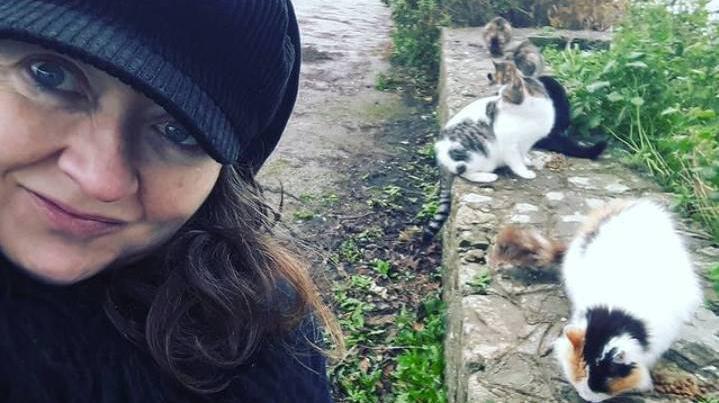
Kirsten Murray with some of the cats in Cobh, Co Cork.
While she works part-time as a dog handler, Kirsten Murray says people describe her as “a cat person”. The Cobh-based artist admits being fascinated by our feline friends, and recently launched an exhibition, Cats of Cobh and Other Stories, at the library in the Cork harbour town.
Murray has only ever owned cats. Her tabby cat was feral at first. “She found me and followed me home. She started camping out under my car and finally broke into my house. It’s kind of funny. Working with dogs pays most of my bills and goes towards feeding my own cat,” says Murray.
Not content to tend to her own cat, Murray has befriended a colony of six feral cats and they are depicted in her exhibition in which she has used ink, mosaic and silver point etching. The work explores portraiture and expressionism. “It weaves a tapestry of tales about art, music, people, place, cats, gratitude and wonder,” Murray explains. The cat art is done from photographs and video stills.
When Dublin-born Murray came to Cork 25 years ago, she studied at the Crawford College of Art & Design as there was an emphasis at the time on drawing. Having contracted Covid twice, she felt she couldn’t work with people anymore and left her job at Cork Art Supplies. She moved to Cobh to work with animals.
During Covid lockdowns, Murray visited the colony of cats in an area of Cobh known as the Holy Ground every day and regularly gave them food. “I think cats are beautiful. I like their independence and also, as a kid, I loved the magical thing of black cats and witches. There’s something very interesting and attractive about them. They’ll come and ask me for food. Unlike dogs that are constantly looking for approval, feral cats are wary. The ones in the colony have tough lives. They get fed by certain people but it’s not regular.”
However, the local fishermen are kind to the cats giving them cans of cat food and fish heads. “One guy lets them into his shed. Mostly, the cats live in little groups in the gaps between the fishermen’s boats. The fishermen probably encourage them because they keep rats away. I’ve even heard someone say that the cats can fish themselves. They go down to the water at high tide, near the herons, who are good fishers.”

Despite cats not generally liking water, a couple of the cats can apparently swim and catch fish at the water’s edge, says Murray. She says that nature abhors a vacuum, so if feral cats were taken out of an area, another colony would form. But if you neuter them as part of a programme and put them back into their colony, they will live for many years. The feral cats of Cobh have been neutered which is indicated by a clip to their ears carried out under anaesthetic.
Murray values her interaction with the cats. “I talk to them and pet them, depending on the cat. Some of them won’t let you pet them while some are more interested in the petting than the food. I like to hang out with them and give them treats. Some of them want you to stay longer with them.”
Even black cats are distinctive to Murray. “Cats all look different in my eyes. They can have different-sized gaps between their eyes, their jowls and their cheeks.”
Unlike dogs, cats don’t feel obliged to “placate or plamás” anyone. “But I don’t think it’s true that cats have no loyalty. Years ago, I had a cat in another house. I used to keep the bathroom window open. The cat would guard that window.”
Murray says that there isn’t a big difference between domesticated cats and feral cats. “It’s mostly just a matter of homelessness or having a home. Some feral cats get really friendly.”
There was a launch of the exhibition featuring balladeer Jimmy Crowley, who performed with his partner, Eve Telford. They are both Cobh residents and cat lovers. Crowley has a cat called Smudge. “Smudge is nearly a centre-fold now on Jimmy’s new album,” says Murray.
She sums up the colony of wild cats in Cobh as being beautiful and beat-up: “They thrive to a degree but they also live with hardship and sickness...With patience, care, slow movement and the right number of treats, they eventually become affectionate – or at least, less terrified.”