The Dymphna Altarpiece: Flemish artist portrayed a tragic Irish story 
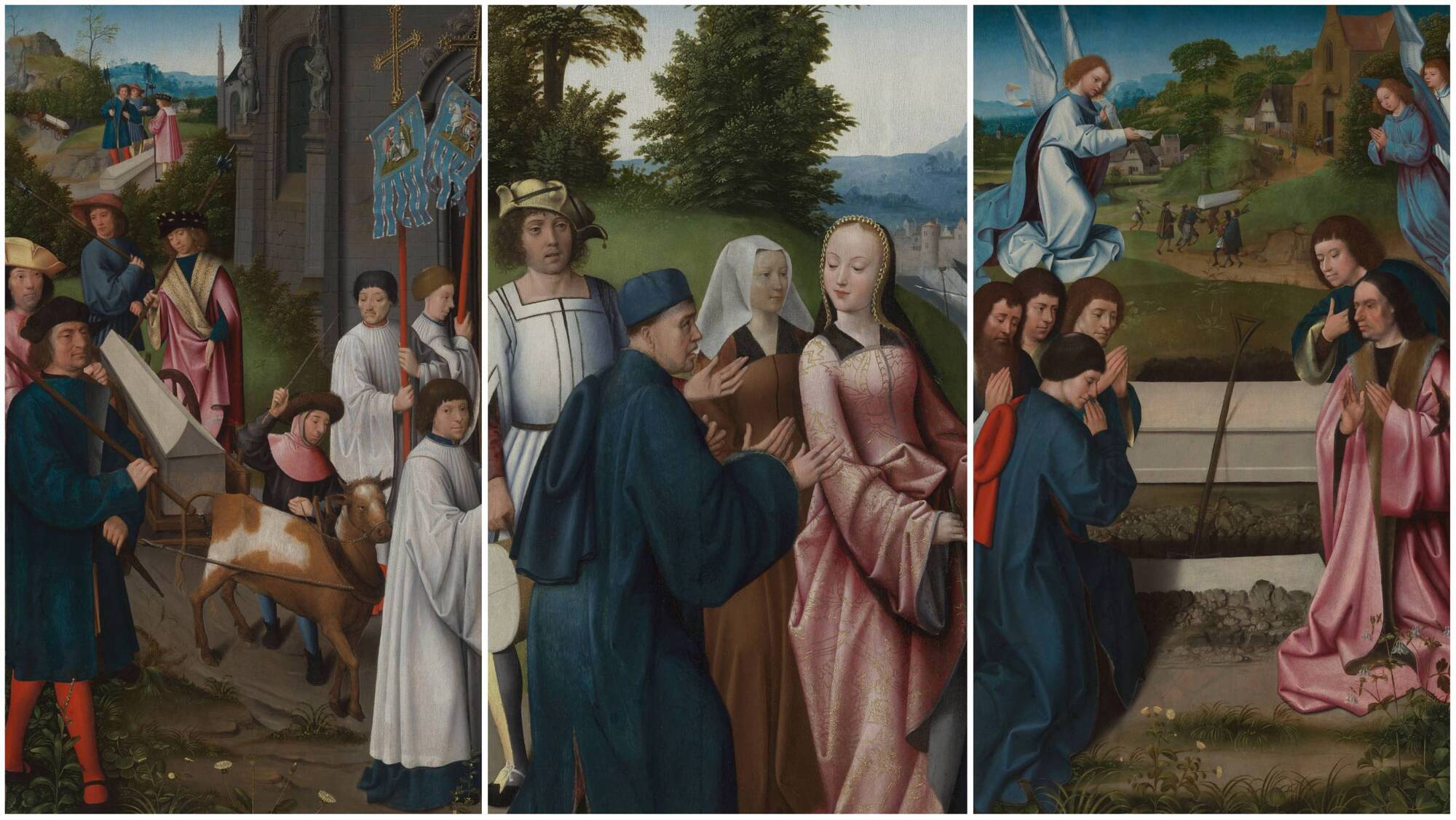
An exhibition at the National Gallery features the series of paintings by the 16th-century artist 
The Dymphna Altarpiece: Flemish artist portrayed a tragic Irish story 

Goossen Van der Weyden, Pictures courtesy of the Phoebus Foundation

St Dymphna was a 7th century Irish martyr who is now recognised as patron saint of the mentally ill and victims of incest. In 1505, the Flemish artist Goossen van der Weyden was commissioned by an abbey in Geel, in the Belgian province of Antwerp, to paint a series of scenes from her extraordinary life. 

His paintings - known as the Dymphna Altarpiece - are the subject of an exhibition, St Dymphna: The Tragedy of an Irish Princess, at the National Gallery of Ireland.

According to tradition, Dymphna’s father Damon was a king in what is now central Ulster. On the death of his queen, he decided that Dymphna – despite being their daughter - was the only woman beautiful enough to succeed her as his bride. 

Goossen van der Weyden, The Return of the Body of Dymphna to Geel. Pictures courtesy of the Phoebus Foundation 

When Dymphna fled his attentions, crossing the sea to Belgium with her confessor, Fr Gerebernus, Damon followed. He caught up with the two in the town of Geel and decapitated both with his sword.

Like many legends, the stories attached to St Dymphna appear to have at least some basis in fact. 

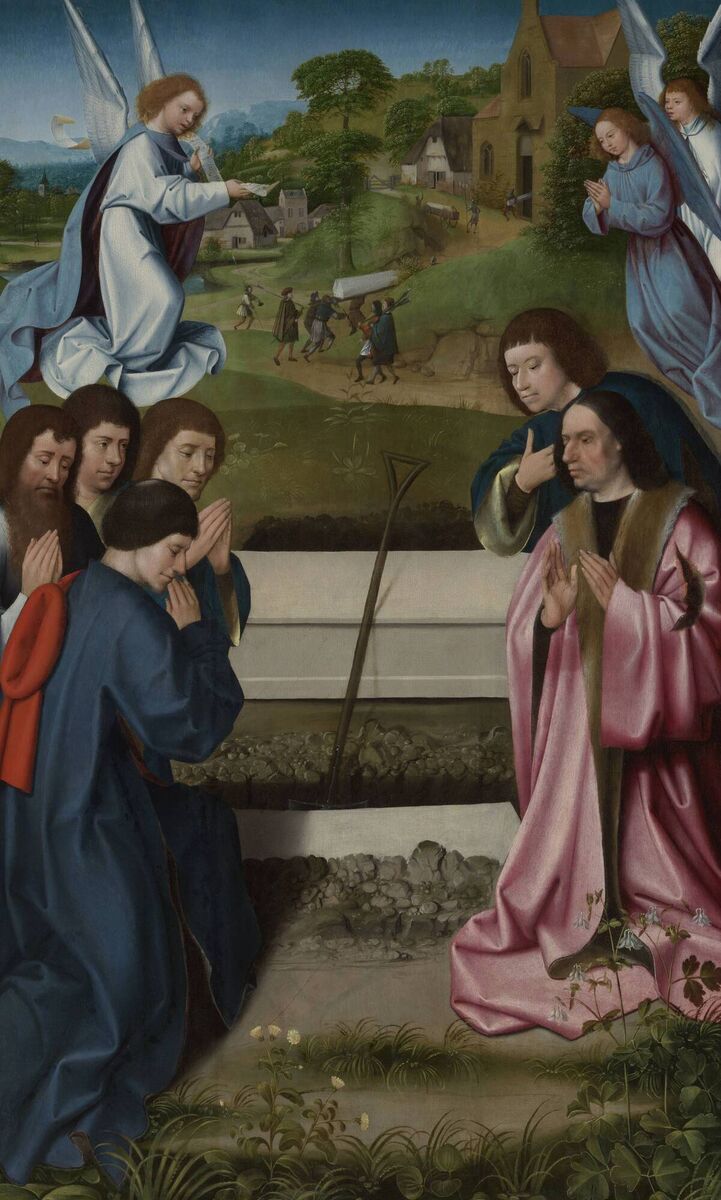
“Centuries after their deaths,” says Dr Lizzie Marx of the National Gallery, “a sarcophagus containing St Dymphna’s bones were discovered, along with a sarcophagus containing those of St Gerebernus. 

The inscription on a red stone discovered with the sarcophagus helped identify the remains, and researchers have been able to date the relics to around the year 800. 

St Dymphna’s bones are now kept in her church in Geel, while her crozier is in the collection of the National Museum of Ireland.”

Van der Weyden’s paintings, on a series of wood panels, were commissioned by Antonius Tsgrooten, an abbot of the Norbertine order, for the altar at Tongerlo Abbey, Geel. 

They remained in place for around 200 years before another abbot, Van der Achter, inexplicably had them removed and cut up. 

“The paintings’ edges were most affected,” says Dr Marx. 

“Banderols of text, narrating St Dymphna’s story in each scene, were displayed on the top or bottom of the panels. These are now unfortunately cropped or missing.”

After the French Revolution, the monasteries and abbeys within the territories around Geel were annexed, and the Dymphna paintings disappeared. 

Goossen van der Weyden, The Discovery of the Sarcophagi containing the Bodies of Dympha and Gerebernus Pictures courtesy of the Phoebus Foundation 

It was not until 1837 that seven of the eight were re-discovered, in the home of a librarian in Geel, who promptly donated them to the Tongerlo Abbey. The eighth – depicting the decapitation of St Dymphna – has yet to resurface.

“It’s unfortunate,” says Dr Marx. “This lost painting is the climax of Dymphna’s story. But it might have found use as a standalone work for an altarpiece, so we still hold hope that it will be rediscovered.”

The Dymphna paintings were sold in 1912, and passed through a number of hands before they were acquired at auction twelve years ago by the Phoebus Foundation, a philanthropic organisation established by the Katoen Natie international logistics company.

“Our primary objective is collecting and preserving Flemish art,” says Dr Katharina Van Cauteren, the foundation’s chief of staff. 

“So the panels by Goossen Van der Weyden were an exciting find. Goossen headed a large studio and had many prominent clients, including the patron of the Dymphna Altarpiece. That this polyptych had such a well-documented provenance only made it more fascinating for us.”

Restoring the panels, undertaken at the Phoebus Foundation’s conservation studio in Antwerp, took three years and involved ten specialists. 

“When the treatment began, the paintings were severely deteriorated and had a rather dull appearance, due to multiple layers of discoloured varnish,” says Sven Van Dorst, who supervised the project. 

“An extensive treatment was necessary to uncover the bright colours and refined details that make this artwork exceptional.

“We soon decided to have the restoration project go hand in hand with an art historical study. The results were extraordinary. 

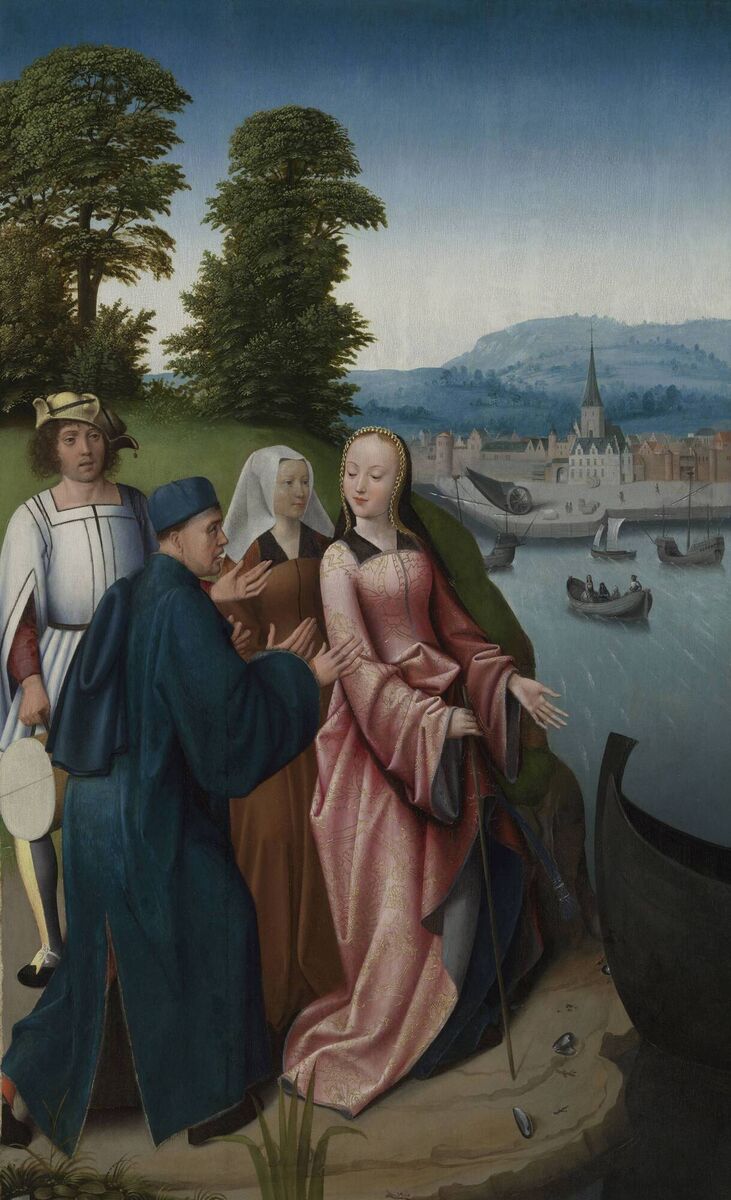
"For instance, we uncovered a young woman’s portrait painted on tin foil. The head was stuck onto the third scene, where Dymphna is fleeing Ireland.

Goossen Van der Weyden, Dymphna and her Companions about to Embark. Pictures courtesy of the Phoebus Foundation 

“The technique of painting portraits on tin foil was used for models who could not travel to the artist’s studio. 

"However, while his studio assistants were waiting for her portrait to arrive, they had already painted her body. So she is now stuck forever with an elegant little head, but remarkably large hands.”

There are various theories as to how St Dymphna became patron saint of the mentally ill. 

“Some people suggest that her beheading was connected to mental illness,” says Dr Marx, “or that Dymphna’s father’s grief made him ill, which led to him proposing to his daughter. 

"But the connection could have also developed later on, as the cult of St Dymphna evolved. Pilgrims may have visited her shrine with various wishes, but it soon became apparent that her relics were especially effective for people with mental illness.”

Over the centuries, thanks to its association with St Dymphna, Geel has become known for its unique treatment of people with mental health issues. 

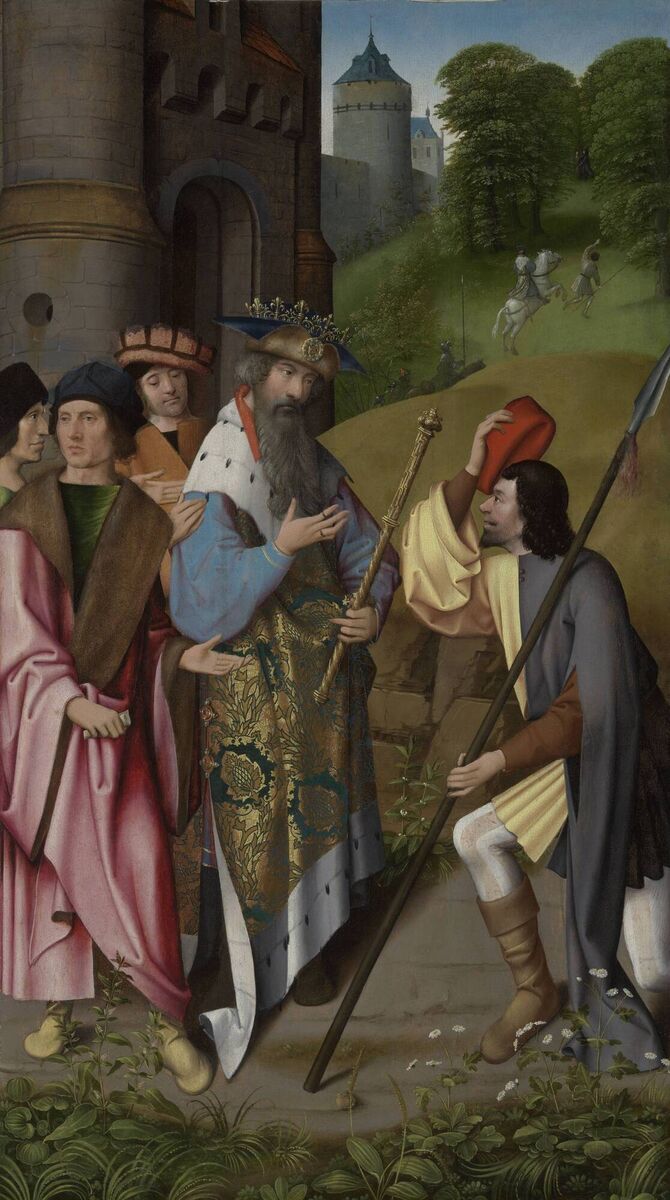
Goossen van der Weyden, The King's Spies Bring Him News of Dymphna's Hideout. Pictures courtesy of the Phoebus Foundation 

“As her cult grew, demand for lodgings increased in Geel, and the locals began playing host to pilgrims,” says Dr Marx. 

“This laid the ground for a tradition that has continued to this day, 800 years later.

“In Geel, people with mental illnesses can live in foster homes, in a family-based nursing structure. This has led to the establishment of OPZ Geel, the public psychiatric care centre. 

"The World Health Organization’s 2001 report on mental health named Geel as ‘one of the best examples of how communities can become carers of the mentally ill’. 

"The town is the oldest community mental health programme in the western world, and St Dymphna can lay claim to being the inspiration for this extraordinary initiative.”

  • St Dymphna: The Tragedy of an Irish Princess is curated by Dr Lizzie Marx and Dr Brendan Rooney and runs at the National Gallery of Ireland, Dublin until May 28. Further information: nationalgallery.ie


More in this section

Scene & Heard

Newsletter

Music, film art, culture, books and more from Munster and beyond.......curated weekly by the Irish Examiner Arts Editor.

Cookie Policy Privacy Policy Brand Safety FAQ Help Contact Us Terms and Conditions

© Examiner Echo Group Limited