Theatre review: Letters of a Country Postman, by John B Keane, at the Everyman, Cork
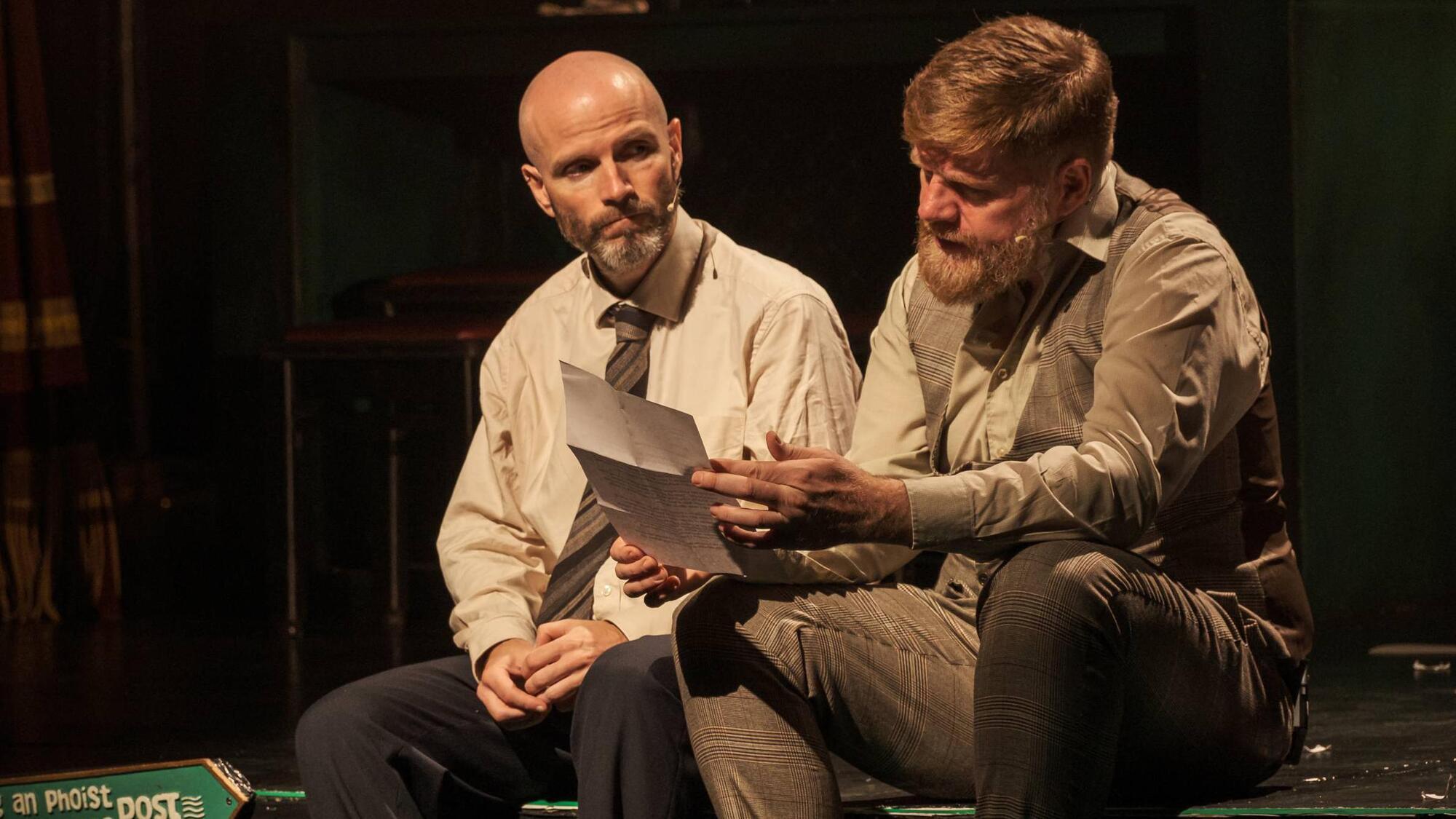
Tadhg Hickey and Danny O’Mahony in Letters of a Country Postman, at the Everyman in Cork. Picture: Marcin Lewandowski
★★★☆☆
“To be a successful postman you need the patience of Job, the sagacity of Solomon and the perception of Plato.”
The great lines keep coming in Letters of a Country Postman, the adaptation of the late John B Keane’s novella, staged at the Everyman in Cork and directed by the theatre’s artistic director Sophie Motley. Keane’s piercingly accurate sketches of rural life, leavened with sharp humour and insight, were groundbreaking in their time and still hold up.
In Letters of a Country Postman, Mocky Fondoo (Tadhg Hickey) is nearing retirement as he makes his rounds by bicycle in a bygone Ireland where the postmistress steams open letters, bottles of stout are drunk off the shelf and temptresses in dressing gowns wait to pounce. We can only watch in envy at the personal touch provided by Mocky and Co from the vantage point of today, as Amazon vans clog our streets and communication is more Snapchat than snail mail.

However, while the medium may have changed, the message remains the same — amid the messy reality of life, community and connection can sustain us. All human life is present in the postal district of Ballyfee as Hickey and fellow ensemble members Madi O’Carroll and Chloe O’Reilly perform the difficult task of portraying a wide range of characters with gusto. O’Reilly is particularly strong, providing the biggest laughs of the evening as the dissolute letter carrier Bugler McNulty.
Hickey, known for his comedic talents, mainly plays it straight, but the showman occasionally surfaces as he drops out of character to egg on the audience or his fellow performers. On several occasions he zips around the auditorium on his bike. Accompaniment from Kerry musician Danny O’Mahony on accordion nicely underpins the action throughout, and he also steps in for a poignant moment as Mocky’s penpal Hamish.

The production tries bravely to capture the antic spirit of Keane’s work but the gifted dramatist who gave us The Field and Sive among others wrote the ‘Letters . . .’ series as books, not plays, and the epistolary conceit eventually runs out of theatrical steam.
The denouement takes a surprising detour as the lights go up on the audience who are encouraged to join in a singsong with the actors. It is a somewhat jarring and unsatisfying end to a show in which the source material is most definitely the star.