Cork In 50 Artworks, No 41: The Progress of Human Knowledge and Culture, by James Barry
The work of Blackpool-born artist adorns the walls of London's Royal Society, and he is probably the only Cork person interred in St Paul's Cathedral
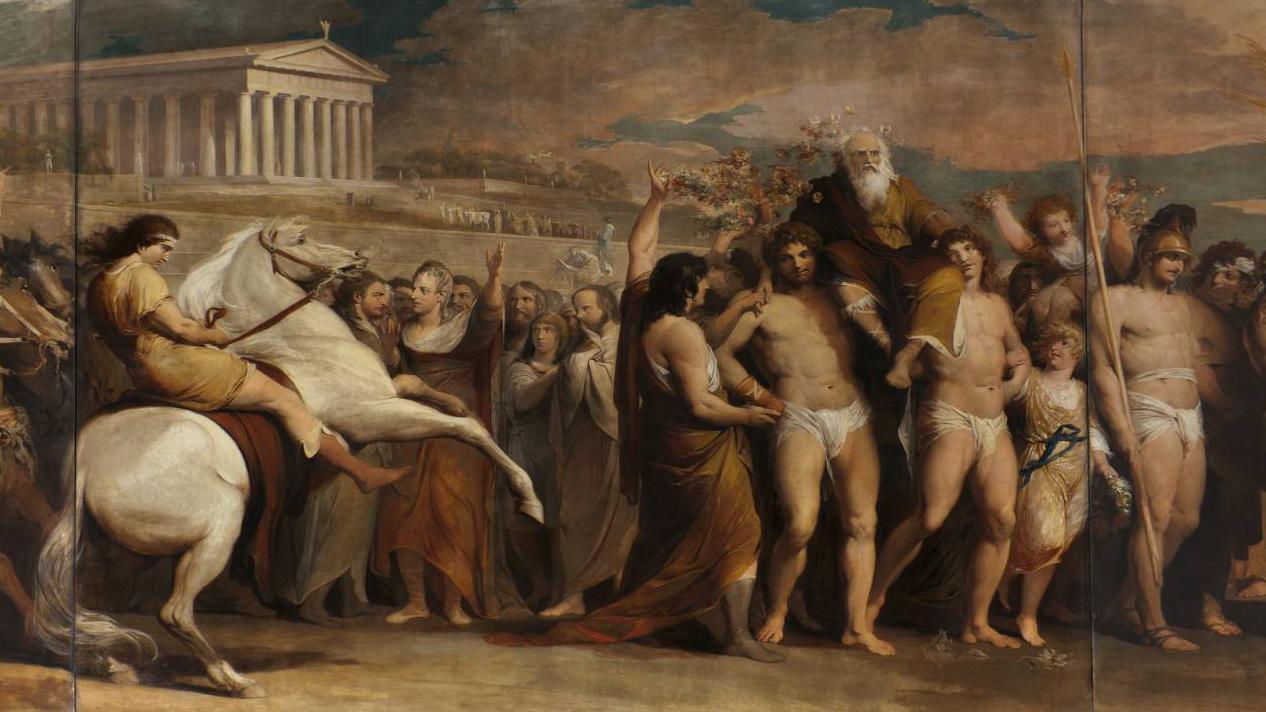
A detail from Olympics, one of James Barry murals. Image courtesy of the Royal Society of Arts, London

A detail from Olympics, one of James Barry murals. Image courtesy of the Royal Society of Arts, London

 James Barry’s The Progress of Human Knowledge and Culture is a series of six large historical paintings that adorns the walls of the Great Room at the Royal Society of Arts in London’s Adelphi. The art critic Andrew Graham-Dixon has described the series as Britain’s “late, great answer to the Sistine Chapel”, and it is arguably the most important cycle of history paintings in these islands.

Barry was born in Cork, in Water Lane, Blackpool – what is now Seminary Road – on October 11, 1741, yet few in the city were aware of his reputation until the Crawford Art Gallery, under its director, Peter Murray, organised a major retrospective of his work in 2005.


The exhibition, James Barry: The Great Historical Painter featured 170 of his pieces, many of them borrowed from collections such as those of Tate Britain, the Victoria and Albert Museum in London, as well as the Yale Centre of British Art in the US, along with a digital reproduction of his Royal Society of Arts paintings at 85% of their actual size. 

A major catalogue of essays and images was produced to complement the exhibition, and the project culminated in a conference on the artist, hosted in the Great Room at the Royal Society to mark the 200th anniversary of his death.

Commerce of the Thames, by James Barry. Image courtesy of the Royal Society of Arts

Barry’s achievements were extraordinary by any standards, says Murray, particularly as the artist, remembered now as one of the greatest painters of 18th century Britain, “grew up on the quays in Cork, and initially supported himself by painting bar signs.” 

 Barry’s first taste of success came when he moved to Dublin. His painting Baptism of the King of Cashel by St Patrick was shown to great praise in the city in 1762, when he was just 21. It was bought for display in the Irish House of Commons, and brought him to the attention of the great philosopher and politician Edmund Burke.

“Burke had also spent a substantial period of his childhood with his mother’s family in Cork,” says Murray. “They were the Nagles of Ballyduff. Nano Nagle, the founder of the Presentation Sisters, was his cousin. In fact, her portrait at Nano Nagle Place, though unsigned, is almost certainly by Barry.”

 Burke helped finance Barry in travelling to Paris, Rome, Florence and Venice between 1765 and 1771, where he studied the old masters. Returning to London, he produced a painting called Venus, which again brought him great acclaim.

On being elected a member of the Royal Academy, Barry offered to produce a suite of historical paintings to decorate the Great Room of the Royal Society of Arts. He asked that he be provided with materials, but otherwise worked for no pay. He began the project in 1777, and is reputed to have subsisted on bread and apples for the seven years it took to complete.

A bust of James Barry, by Joseph Panzetta. Image courtesy of Crawford Art Gallery

“They’re like an encyclopaedia,” says Murray. “They’ve got everything in them, from Ancient Greece to the Olympic Games, along with hundreds of contemporary portraits.”

 In 1782, the Royal Academy rewarded Barry with an appointment as Professor of Painting, on a salary of £30 a year. A man with more sense might have settled down and enjoyed the privilege, but Barry got swept up in the political turmoil of the day.

“His politics were formed by the year he spent in Paris," says Murray. "He saw the artist as a hero, leading political thought towards a better world. But his beliefs were more radical than Burke’s, and they soon fell out.” 

 Inspired by the French revolution of 1789, Barry was soon espousing the overthrow of tyrannical governments. He railed against the mediocrity of his contemporaries in the London art world, and slandered his colleagues at his college lectures, doing so again in a notorious letter to the Dilettanti Society, a leading artists’ magazine of his time.

In 1799, Barry became the first member to ever be expelled from the Royal Academy. He also lost his teaching position. “And after that, he became very disillusioned and isolated,” says Murray. “He lived in Castle St in London, and ended up afraid to leave the house. His outspokenness had made him so unpopular, it was like being cancelled today. He genuinely feared assassination.”

 His admirers raised a subscription of £1,000 to help him out, but he died on February 22, 1806, without ever seeing a penny of it. Given his unwavering belief in his own genius, he would surely have thought it only appropriate that his body was laid in state among his murals in the Great Room at the RSA. He seems also to have been the only Corkman whose remains are interred in St Paul’s Cathedral.

Orpheus, by James Barry. Image courtesy of the Royal Society of Arts

 “It was a major opportunity to focus on a local artist,” she says. “The publication produced for the exhibition is a fine document, and is still in circulation. Barry’s own writings show that he was ahead of his time in espousing a liberal democracy. In many ways, he had that kind of progressive character we associate with Cork, and a great ambition to put himself into the wider world. His murals at the Royal Society certainly achieved that.” 

The Crawford has a bust of Barry, by Joseph Panzetta, in its collection, along with two of his paintings, 'Portrait of Barry and Burke in the Characters of Ulysses and his Companion Fleeing from the Cave of Polyphemus' and 'The Prince of Wales in the Guise of St George', both of which are currently on view.

“They don’t come up for sale very often, but we’d like to acquire more,” says McCarthy. “Barry is a major figure for Cork, and the retrospective of 2005 played a large role in the Crawford acquiring its status as a national cultural institution.”

More in this section

Scene & Heard

Newsletter

From music and film to books and visual art, explore the best of culture in Munster and beyond. Selected by our Arts Editor and delivered weekly.

Cookie Policy Privacy Policy Brand Safety FAQ Help Contact Us Terms and Conditions

© Examiner Echo Group Limited