Cork In 50 Artworks, No 36: Statue of Christy Ring at Cork Airport
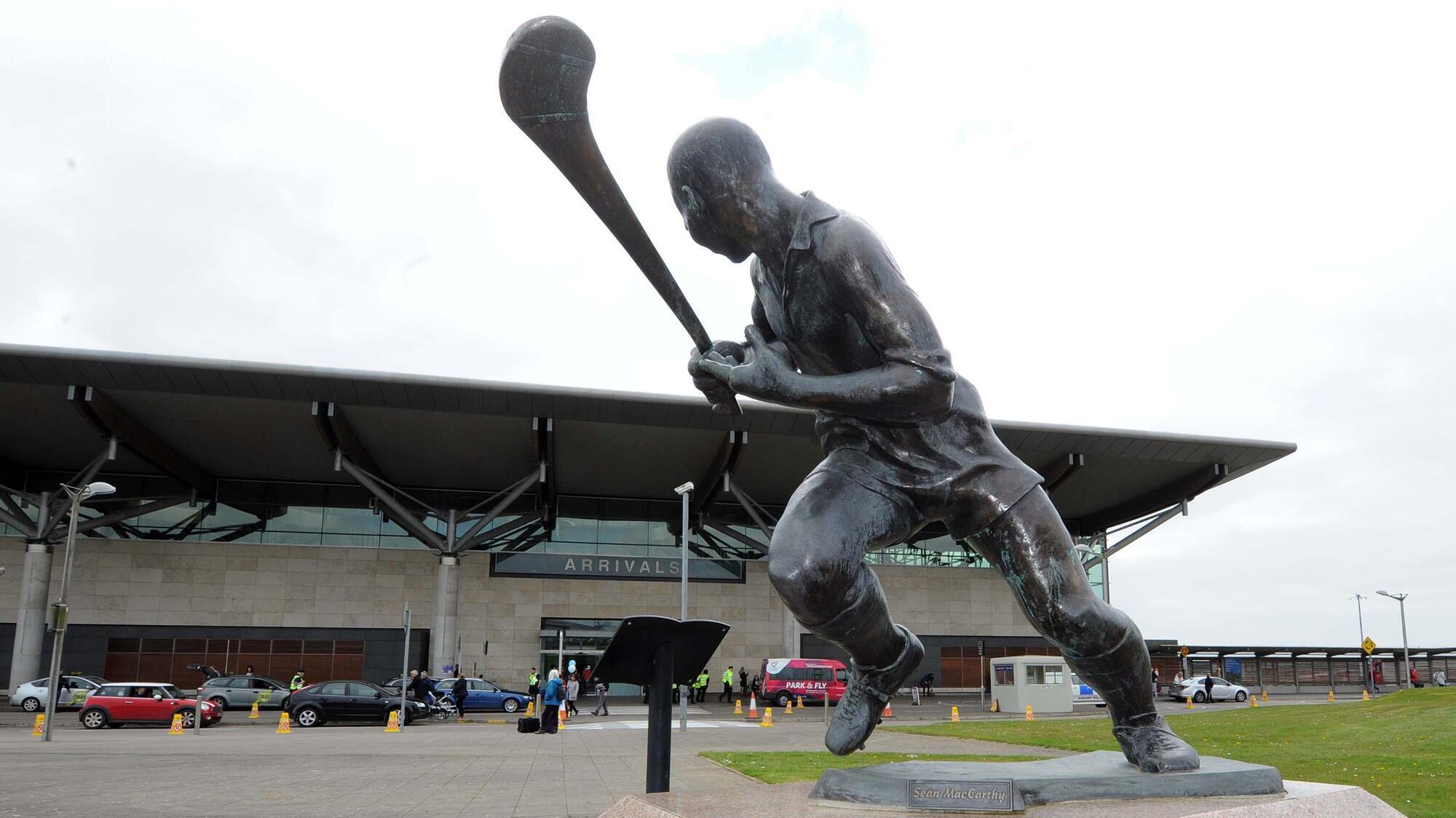
Seán McCarthy’s statue of Christy Ring at Cork Airport. Picture: Denis Minihane
Seán McCarthy’s bronze statue of sporting legend Christy Ring is the first artwork visitors encounter when they arrive at Cork Airport. It captures Ring in all his dynamism, clutching his hurley as he springs forward into action on the pitch.
Ring, a native of Cloyne, Co Cork, is remembered as one of the greatest hurlers of all time. He retired from playing hurling at age 46, but continued coaching and mentoring until his death, aged 58, in 1979.

The competition to design a statue to commemorate Ring was first advertised in 1992. McCarthy heard about it when he was home on holidays from England, where he was studying for a diploma in figurative sculpture in Stafford, having already completed a degree at Camberwell School of Art and Design in London.
“I went down to Garretstown for a spin with my girlfriend Miriam, who’s now my wife,” he says, “and by complete chance, we met the artist Vivienne Roche. She mentioned the competition, and when we got back to Cork, I got hold of the specifications for the project. I had about five days to get my first submission in. But I made the deadline, and weeks later, back in England, I got a letter to say I’d been shortlisted.”
When he was next home, McCarthy met with Cork Airport manager Barry Roche, who was the driving force behind the project. “Barry said, 'What you’ve done so far is good, but in your next submission, I want more beef. You never met Christy Ring. The animal ferocity of him, you’d have to have seen that live.’ But Barry gave me all the visual footage of Ring playing. I could freeze frame the footage, so I could better appreciate the vigour of the man.”

McCarthy was rooting for a way to capture Ring’s dynamism on the pitch when he remembered a book on the Italian artist Donatello he’d borrowed from Cork City Library as a youngster. “I thought his statue of David was the most exquisite thing. Donatello conceals his strength; he looks like a delicate fellow, but you know he could spring into action. So I resolved to do something similar with Ring; I had the famous study of him playing against Limerick, where he’s almost a superhero, but I softened that, and gave him an implied power. And that maquette won the final competition outright, as it had the vigour Barry Roche was looking for.”
Around this time, McCarthy moved back to Cork, where, having grown up in Glasheen, the fifth of 12 children of Ted and Betty McCarthy (his brother is the singer/songwriter Jimmy McCarthy), he had first studied art at the Crawford School of Art on Emmet Place.
“My mother was a painter, and she could see the artist in me,” he says. “The vicarious part of herself put everything in my way; she’d come back from town, and she’d have got me pencils, or she’d give me money to buy art books in Eason’s. She helped me get into the Crawford when I was just fourteen. I was technically too young to be a full-time student, but I had a good portfolio, and they let me in. John O’Leary was head of painting at the time, and he was like a father to me. It was a brilliant time of my life.”

Thereafter, says McCarthy, “I took to the roads, I was a vagabond character for a few years.” He found his way to England, where he eventually applied to continue his education at Camberwell. “I was three years there, and got a proper degree that would hold up anywhere.” He mostly studying painting, but a burgeoning interest in sculpture persuaded him to continue his studies at Stafford. “Stafford and Stoke are at the centre of the ceramics industry, and this course was put together largely by the ceramics people to develop skilled artists. I learned an awful lot in two years, just getting the basics right.”
While he was away in England, a number of Cork artists had come together to establish the National Sculpture Factory on Albert Road. This was where he completed his final model for the statue of Ring, before it was cast in bronze by a foundry in Dublin.
Ring’s widow Rita and children Christy and Mary were present when the Minister for Sport, Bernard Allen, unveiled the sculpture in the airport on 13th October 1995. He quoted from the former Taoiseach, and All-Ireland hurling medallist, Jack Lynch’s oration at Ring’s funeral: “As long as young boys swing their camans for the sheer thrill of the tingle in their fingers of the impact of ash on leather; as long as hurling is played, the story of Christy Ring will be told, and that will be forever.”

After work on the new airport terminal was completed in 2006, the statue was moved to a prominent position in the plaza outside, where it remains today. McCarthy remains grateful for the exposure the commission has given him. “Barry Roche and I had some rows, artist/client type things, but we both held the best line we could, and struck a great compromise. But this man changed my life; from the moment I got the commission, people began to hear my name.”
McCarthy has gone on to complete a number of significant public commissions, including his statue of former American president Bill Clinton in Ballybunion, and another of the hurler Ned Power near Tallow, Co Waterford. His future plans include a solo exhibition in July. “I’ve booked Ballymaloe Grainstore, and I hope to do some reasonably large sculptures for it.”
He has never regretted his career path. “When I was a kid, my mother said, I’m going to invest in you. I’ve always thought that was rooted in me, and I’ve kept ploughing away as an artist ever since.”