Book review: Philip Hook makes modern art understandable and accessible to us all

Philip Hook, author of ‘Art of the Extreme 1905-1914.’
PHILIP HOOK is clearly an art world insider, having spent 35 years valuing, selling, and appreciating great art up close. He has held key positions such as director of 19th century paintings at Christie’s and director of Sotheby’s modern art department. With Art of the
Extreme 1905-1914: The European Art World 1905-1914, though, he has opened the alleyway door and given the average person access to the whole world of art.
His unpretentious language and natural, authentic use of humour puts the reader at ease. He sets the tone early on, introducing the lighter side of artistic endeavour saying: “The art world — artist making art, critics criticising it, dealers selling it, collectors collecting it, museums acquiring it, the public misunderstanding it — has always been a rich source of material for the human comedy.”
To the neophyte it is funny to learn how modern masters were at first so poorly received. An important museum director of the time, Georg Swarzenski noted that: “Artist and public have never been so isolated from each other as they are today.”
This was a consequence of the social, political, philosophical, and technological transformations of the time impacting and playing out in the art world as well. Prior to the First World War, conservatism was still trying to hold tight to old social and political ways, though industrialisation and technology were shifting the paradigm into the modern era. Photography, for example, had replaced artists as the keeper of the visual historical record. Nietzche’s philosophy of connecting with instinct to release the exceptionalism of man was pervading social discourse and this liberated the artist to explore the creation of art as an expression of his inner self. Since this kind of exploration was not generally accepted and was not yet lucrative, only those at the forefront of the ‘battle’ had the will to push artistic boundaries. These new expressionist artists were therefore referred to with the French military term ‘avant garde’.
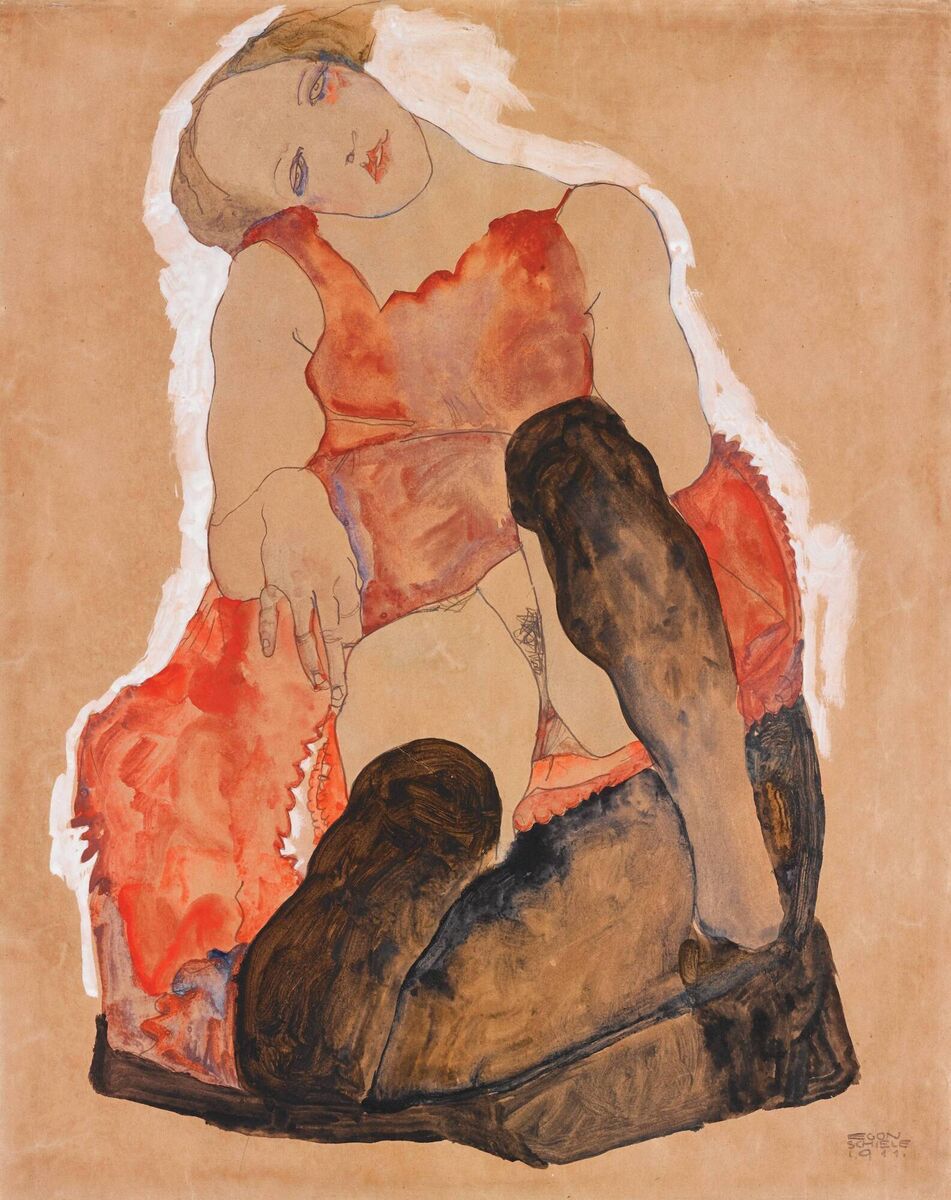
The book shows the artists of the avant garde very much as products of their time. There is a chapter on drug use and its impact on artistic vision. There is a chapter on works considered as pornography where nudes did not adhere with conventions of presentation and display, resulting in works being confiscated and artists being jailed. There is a section on libertine lifestyle and how relationships with women affected artwork. There is a section which discusses angst, neuroses, and the relationship between madness and genius.
Avant garde artists saw that the prior generation’s Impressionist painters had broken from conservative tradition and established an artistic style that eventually became accepted and even commercially viable. The avant garde formed their own salons from which to exhibit and gain exposure. Impressionism
focused mainly on the artist’s observations of the outside world, such as days in the park or nights in the bar, and kept to representations of known forms. Once avant garde artists turned their focus inward artistic conventions were shed and new schools of artistic style were created with the frenetic pace taking hold of all European society.
Fauvism was the first modernist style discernable from Impressionism. It still focused on known forms but attended less to the realism of the form and used brighter, more exaggerated colour to get to the subject’s quintessence. Critic Louis Vauxcelles viewed the works and said they had to have been painted by beasts, in French ‘les fauves’ and the movement happily accepted the moniker. Matisse’s Luxe, Calme et Volupte (1905) was a seminal example that shows knowable forms of people depicted with bright colour in a recognisably pointillist style. Expression of the inner self through colour, line, brushstroke, and abrupt application of paint became the way for a Fauvist artist to experience ‘the Absolute’.

In 1905 the Die Brucke school of expressionist painters held an exhibit in Prague and showcased their Norwegian hero, Edvard Munch. The differentiators for Die Brucke were philosophical as well as stylistic. The motive force for Die Brucke was angst and modernist neuroses, and this was expressed as jarring juxtaposition of fields of bold dark colour and line. Munch’s work was intended to portray the internal struggle. His most famous work, The Scream, shows the artist himself covering his ears against the ‘great Scream in Nature’; it is a revelation to learn that the agonised figure is hearing the scream, not screaming it. To Die Brucke manifesting the internal struggle is the artist’s role. Munch famously said that, “The camera will replace the artist only when it can visit heaven and hell.”
The purpose of art to the avant garde was to express a universal truth instinctively known in the most primitive part of man. In keeping with the philosophy of the time, a deconstruction and communication of experience or emotion directly was the most desirable thing. Light, shadow, texture and colour were considered by the avant garde to be the visual media for this direct communication. Colour, shape, and shadow were thought to relate to each other in the same way that musical notes did. Works of visual art, then, no longer needed to represent a specific form to make an experiential point. The natural progression for the avant garde artist was to an ultimate abstraction where the viewer knows, through the visual language, the experience being conveyed. Artistic schools arrayed along the abstract continuum included the Blaue Reiter, Jack of Diamonds, Futurists, Golden Section, and Vorticists. Styles of avant garde art advancing to the abstract included Fauvism and Cubism, and derivations of Cubism such as Orphism, Simultanism, Rayonism, Vorticism, Syncronism, Cerebrism, Effusionism, and even Musicalism.
Pablo Picasso was the pioneer and preeminent proponent of Cubism, and Hook says that his 1907 work Les Demoiselles D’Avignon, “…stands in the same relation to Cubism as the assassination of the Archduke Franz Ferdinand at Sarajevo in 1914 does to the First World War.” Picasso and his compatriot Georges Braque allowed private viewings but did not display their works, setting them apart from the so-called ‘Salon Cubists’ who frequently exhibited. Picasso and Braque’s work introduced multiple points of perspective and multiple sources of light and walked a fine line between portrayal of form and total abstraction. This is the result of the imposition of some control over unfettered, primitive instinct.

If these new forms and styles of art were so alien to the conservative art world then how did household names like Matisse and Picasso become household names at all? Hook provides the history of the business of modern art in this decade and explains how dealers work together with exhibitors and collectors to create buzz and manage prices upward. He shows how art dealers also functioned as talent managers, providing for their artists, managing their talent and nudging them toward creations that bolstered their reputations. The way Hook describes the dealers of the time shows that he feels they were artists in their own right. This book is filled with illustrations of the works Hook discusses. This provides an entirely new dimension to the text. The written arguments become immediate and apparent when there are two works of art side by side. When Hook describes a stylistic meme seen throughout a school’s body of work there are colour pictures of the works to show it. When he refers to a painting as ‘bad’ he provides you the means to judge for yourself. Hook describes some works as powerful, some as foreboding and some as having a strong sense of motion. In one case he poses the cheeky question, “…but is it art?”.
It is clear that his lifetime of proximity to works by great masters has made him a well informed afficionado, and one gets a sense of what he likes and doesn’t like. One also gets the sense it is his love of art that has driven him to write this work that makes modern art understandable and accessible to the rest of us. This easily readable, engaging book is a good way to get familiar with the foundations of modern art.
- Art of the Extreme 1905-1914 by Philip Hook
- Profile Books, £30.00