Cork In 50 Artworks, No 33: The Knitting Map for European Capital of Culture, 2005
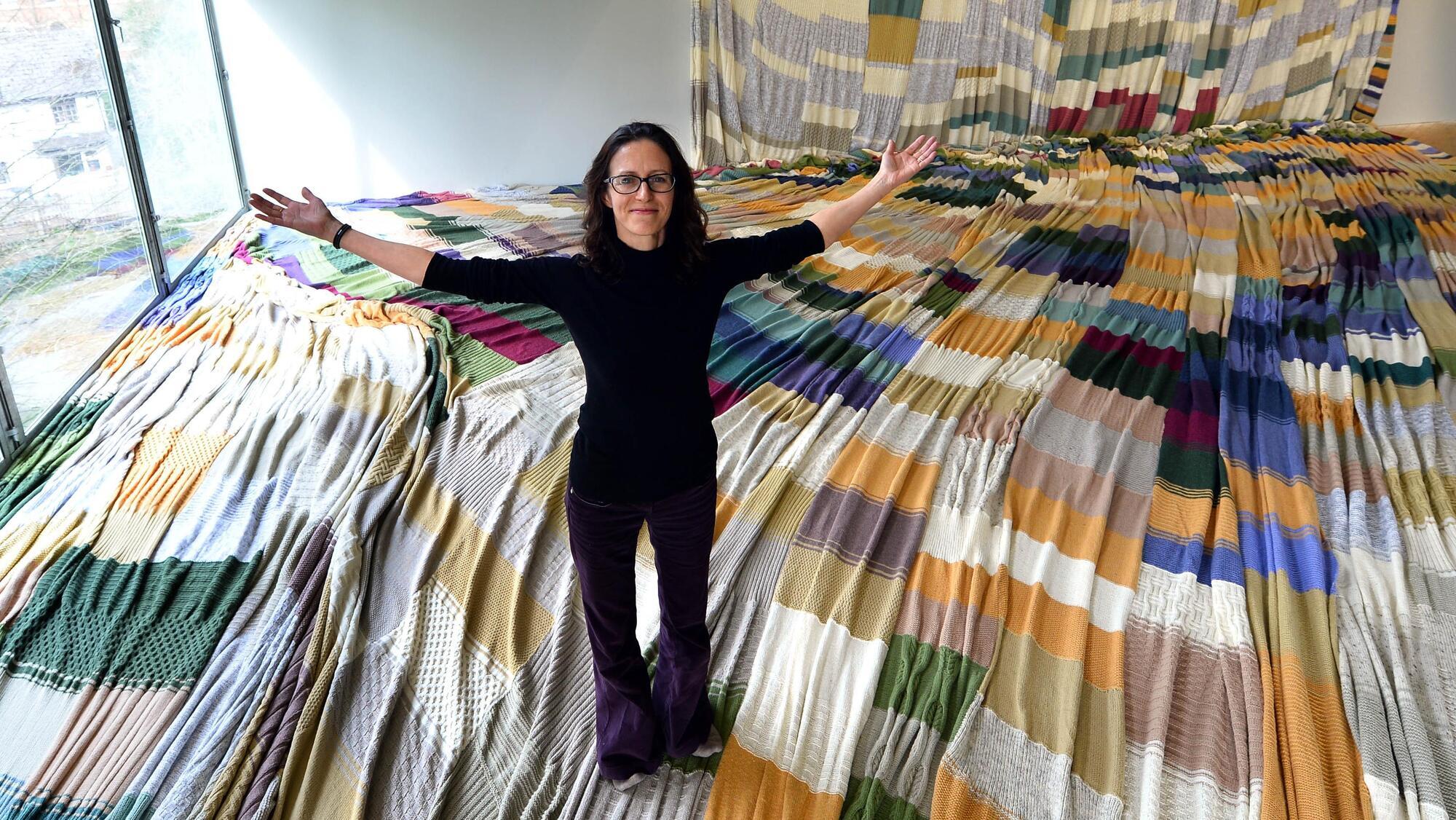
Jools Gilson with the Knitting Map when it went on display at the Glucksman Gallery, UCC, in 2015. Picture: Denis Scannell
Even now, sixteen years on, there's an opinion that Cork’s tenure as European Capital of Culture in 2005 promised much, and delivered little. But there was great excitement when, in 2002, it was first announced that Cork had won the designation. Staff were appointed the following year, and arts groups were duly invited to submit proposals for the programme.
Half/angel, an arts production company run by Jools Gilson and Richard Povall, were among the first to have their submission – for a project they called the Knitting Map - accepted. “We were commissioned very early on, in 2003,” says Gilson. “We actually made several proposals, and the Knitting Map was the one selected.”

It is not difficult to see how the project would have appealed to the Cork 2005 commissioners. Half/angel already had ten years’ experience of managing performance and visual arts projects, and the Knitting Map would involve hundreds, if not thousands, of volunteers coming together to produce an expansive piece of hand knitting, a humble - if skilled - activity rooted in the home. Everyone would be welcome to participate, irrespective of experience.

Throughout 2004, Gilson, who taught drama at UCC, drummed up interest through a series of performances around the city. Half/angel also ran a range of public outreach initiatives, which included running knitting workshops with the National Training Institute, asylum seekers, the aged, and a number of women’s groups.
Towards the end of the year, the project was established at the crypt in St Luke’s Church. Thanks to a computer software programme designed by Povall, it was arranged that the Knitting Map would reflect on the weather in Cork, and on the city’s busyness, over an entire year. Four CCTV cameras were set up around the city centre, and the data they gathered was fed through Povall’s programme. The busier things were around the town, the more complex the knitting map would be that day. Meanwhile, the colours – all in a muted palette – were determined by the data transmitted from a weather station at what was then CIT.
From the time the project kicked off, on January 8, 2005, there was no shortage of volunteers. “Most of the knitters – hundreds and hundreds of them – were older working-class women from Cork,” says Gilson.
“Many came back every day. We had relationships with all kinds of community associations. The Cope Foundation was just down the road, and a gang of their clients came every week. We had groups in from L’Arche and the National Council for the Blind. There was a school right next door, and the kids would come in the whole time.
"And because it was the only thing that was open literally every day of the year, if you came to Cork to experience Cork 2005, helping knit the Map was the one thing you could do.”

From the start, however, there was a marked hostility to the Knitting Map, particularly in the media. The poet Thomas McCarthy, one of the Cork 2005 commissioners, has phrased it thus: “What Cork had given in programme funding it withheld in affection.”
As early as March 2005, Katie Mythen, writing in the now-defunct Inside Cork, referred to the Knitting Map as “a useless monstrosity” and predicted it would be remembered as “our ‘rectangle of shame’, the Cork Calamity representing the utter waste one country can achieve, given enough funding and 365 days.”
In May, Dónal Lynch, writing in the Sunday Independent, referred to the “much-resented rug”, and quoted an unnamed local businessman as saying “we want the All-Ireland Final in Cork, and not a pack of oul’ biddies knitting.”
In December, Joe McNamee, writing in the Irish Examiner, allowed that “the size and colours of the knitted ‘map’ are impressive on first sight, but this is a momentary sensation – after all, there is only so much of one’s life that can be passed looking at a giant blanket. Frankly, an actual map would have been more interesting.”
Part of the problem was that the Knitting Map was known to have been awarded a large tranche of funding, but Half/angel were forbidden to discuss the figures. It was variously rumoured to have cost between €300,000 and €400,000.
In reality, Half/angel received €258,000 from Cork 2005, which paid a staff of five and rent on an office over a three-year period, along with the kitting out of the crypt at St Luke’s. In addition, Sirdar provided €60,000 worth of wool by way of sponsorship.
But the Knitting Map was always understood to be a flagship project for Cork 2005, which was itself intended to showcase the city as an international arts centre. The budget for Cork 2005 would finally extend to €21 million, and in this context, a quarter of a million euros was hardly an outlandish sum. It cost as much for Cork 2005 to install the Polish-American architect Daniel Libeskin’s Eighteen Turns pavilion at Fota Gardens for six months, without fuss or scandal.
Gilson believes there was also antipathy towards the very idea of making an artwork out of wool. “We were closer then to a time when knitting was closely linked to poverty, when people, mainly women, knitted through necessity. It was a way to clothe their families, and earn money. There wasn’t a willingness, in Cork or Ireland, to think of knitting as something that could be transgressive and poetic and could speak to women’s lives.”

In the end, 2,500 knitters from 22 countries participated in the creation of the Knitting Map. On completion, it measured 12m x 80m, or 960m squared, roughly the size of a tennis court. It had its official launch in the crypt in St Luke’s Church on New Year’s Eve, and was displayed again in the Millennium Hall at Cork City Hall during Cork Midsummer Festival in 2006.
The Knitting Map is one of the few projects commissioned by Cork 2005 that has had an afterlife. It was part of an exhibition at the Glucksman Gallery in UCC in 2015, and has been shown twice in the United States, most recently throughout this year at the Berman Museum in Collegeville, Pennsylvania.
It has also been the subject of two books, Kieran McCarthy’s The Knitting Map Speaks, and The Knitting Map: Textiles, Community and Controversy, which Gilson edited along with the poet and critic Nicola Moffatt.
Gilson has spent the last semester on sabbatical from UCC, on a Fulbright scholarship at the University of Colorado. Seeing the Map on display at the Berman Museum was, she says, “very moving. It has this incredible presence. In a very declamatory and moving manner, people came together to knit this one thing, in this discipline that’s always been associated with women and femininity. It’s an artwork with a story, and the controversy is part of that.”