Cork In 50 Artworks, No 32: The Burning of Cork, by Paul Mulvany
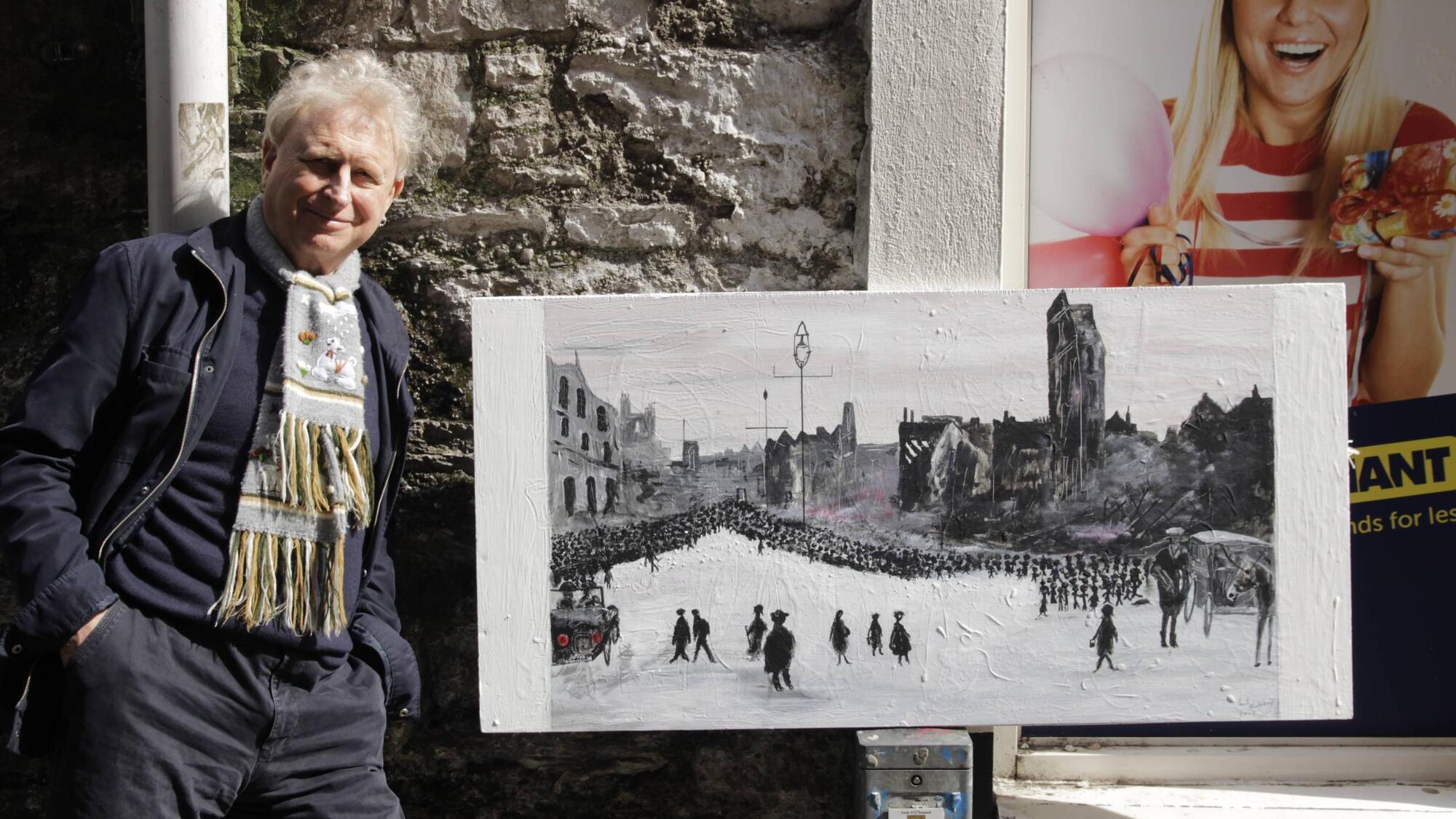
A familiar face from his shop in the English Market in Cork, Paul Mulvany is also a keen artist with an interest in history, writes Marc O’Sullivan Vallig
Cork In 50 Artworks, No 32: The Burning of Cork, by Paul Mulvany

Burning of Cork, by Paul Mulvany. Picture: Ciarán Hoare

Most people in Cork will know Paul Mulvany through his association with the English Market, where he has run the Rave Cave stall, selling Irish and music-themed t-shirts, for the last 38 years. But his interests are many: he has DJed, and sold records; he was a founder member of a book club he believes to be one of the longest-running in the country; and he combines a love of art with a deep interest in Irish history.

One of his paintings, The Burning of Cork, commemorates the events of the night of  December 11 1920, when British troops ran amok in Cork city centre, burning down the City Hall, the Carnegie Library, over 40 business premises and 300 homes.


“I based the painting on photographs of the period,” he says. “The view is of Patrick’s St, looking towards Patrick’s Bridge.” 

 The Burning of Cork was made as a companion piece to a painting of the GPO in Dublin that Mulvany completed in 2016.

 “I grew up in North Dublin, and attended the commemoration event at the GPO in 1966, on the 50th anniversary of the Easter Rising. I met about twelve of those who’d participated in the Rising, and even got them to sign the little diary I kept at the time. I’ve still got that, believe it or not.

“When the 100th anniversary of the Rising came around, I painted the GPO from memory. It was on display in Cork City Library for about a year, and then it was hung in the Farmgate Café upstairs in the Market for another year or so.”

 Mulvany’s interest in the history of the revolutionary period in County Cork is one he shares with his son Caoimh, a history graduate who has written on the subject. “I’d go to the Kilmichael and Crossbarry commemorations most years. I’ve gone on the odd 1916 march as well, even before it was politically correct, and the Special Branch would be watching.” 

 When the 100th anniversary of the burning of Cork was approaching, he thought he should commemorate that in an artwork as well. He created his painting The Burning of Cork in mixed media – pencil, charcoal and acrylic paints - and it hung in the English Market throughout 2020. Both that and his GPO painting are now in Mulvany’s own home in Ballintemple, along with any number of his other paintings and sculptures, and artworks by Irish artists such as Tony O’Malley, Mick Mulcahy, Michael Quane and Suzie O’Mullane.

Mulvany traces his interest in art to his great-grandfather, Francis Sangorski, a bookbinder in London. Among the works on his walls is a photograph of the elaborate cover Sangorski and his partner, George Sutcliffe, produced for a copy of The Rubaiyat of Omar Khayyam, which included more than 1,000 precious stones. The book – a legend among bibliophiles - was sold to an American collector, but was lost with the Titanic in 1912.

 “Francis Sangorski was supposed to sail on the Titanic, but didn’t,” says Mulvany. “But the thing is, he drowned in an accident just weeks after it sank.” 

Paul Mulvany at the Rave Cave in the English Market with Lord Mayor of Cork, Cllr Colm Kelleher. Picture: Brian Lougheed

 Mulvany is an entirely self-taught artist. Originally, he trained in architectural technology, but never pursued it as a career. “When I was young, I got involved in a number of businesses in Dublin,” he says. “We had go-kart tracks and roller discos and the like. Then I moved down to Cork to run the roller disco at the Arcadia Ballrroom for four or five years in the ’70s. I’d have a huge grá for Cork, I used to come down on holidays to Schull with my parents when I was a kid. I decided to stay on, and I’m here for more than half my life now. The humour in Cork is completely different to the humour in Dublin. I can’t put my finger on it, but it’s a different kind of wit.”

 When the interest in roller discos wound down, Mulvany cast around for another opportunity. “The English Market was pretty run down at the time,” he says. “Most of the businesses were run by butchers. I talked to someone at City Hall, this was around 1981, and they wrote me a letter of support when I applied to rent a stall. I ran different businesses in the Market after that. I sold costume jewellery for a while, then second-hand books and records. I used to go over to Manchester a lot to buy stock, and I’d come back with records like the Smiths’ This Charming Man and New Order’s Blue Monday.”

 Given his interest in music, it was perhaps inevitable that Mulvany would try his hand at DJing. He manned the decks in Sir Henry’s on several occasions in the 1990s, the golden era of the local dance scene. “I used to play hardcore techno, upstairs in the bar. I had a video camera, and I filmed about three hours of footage one Saturday night. I’m not sure anyone else would have got away with that, but I was probably ten years older than the rest of them, so they left me at it. That footage has been used in at least six different documentaries over the years.”

 He remains a dedicated gig goer. “I saw Bob Dylan in Dublin in 1964, and I must have been at thousands of gigs since. A few weekends ago, I was at the Sleaford Mods with my daughter Mooli, at the Olympia. They’re one of the most hardcore bands around, and they were brilliant. I went to the Fontaines DC in Brixton last year, and I’ve just booked to see them again, in Berlin in March.” 

 He has always been a reader, and remains active in his local book club. “We call it the Index Book Circle,” he says. “I’m the current president. We started off in Loafer’s bar, and it’s been running now for 32 years. From the start, we’ve had six men and six women, and we still have seven of the original twelve. We mainly cover modern literature.”

 He keeps fit by playing soccer, walking and cycling. “I love the football,” he says. “I don’t think I’ve missed Match of the Day in 50 years. When I’m away on holidays, I’ll have it taped.” 

Now semi-retired from business, Mulvany's travels have taken him all over the world.  He continues to paint, though he says he likes to take his time on pieces . Once he settles on a subject, he says, “I usually take two years to think about it, half an hour to sketch it out, and another six months to actually paint it.”

More in this section

Scene & Heard

Newsletter

From music and film to books and visual art, explore the best of culture in Munster and beyond. Selected by our Arts Editor and delivered weekly.

Cookie Policy Privacy Policy Brand Safety FAQ Help Contact Us Terms and Conditions

© Examiner Echo Group Limited