Cork in 50 Artworks, no 31: The Marriage of Strongbow and Aoife by Daniel Maclise
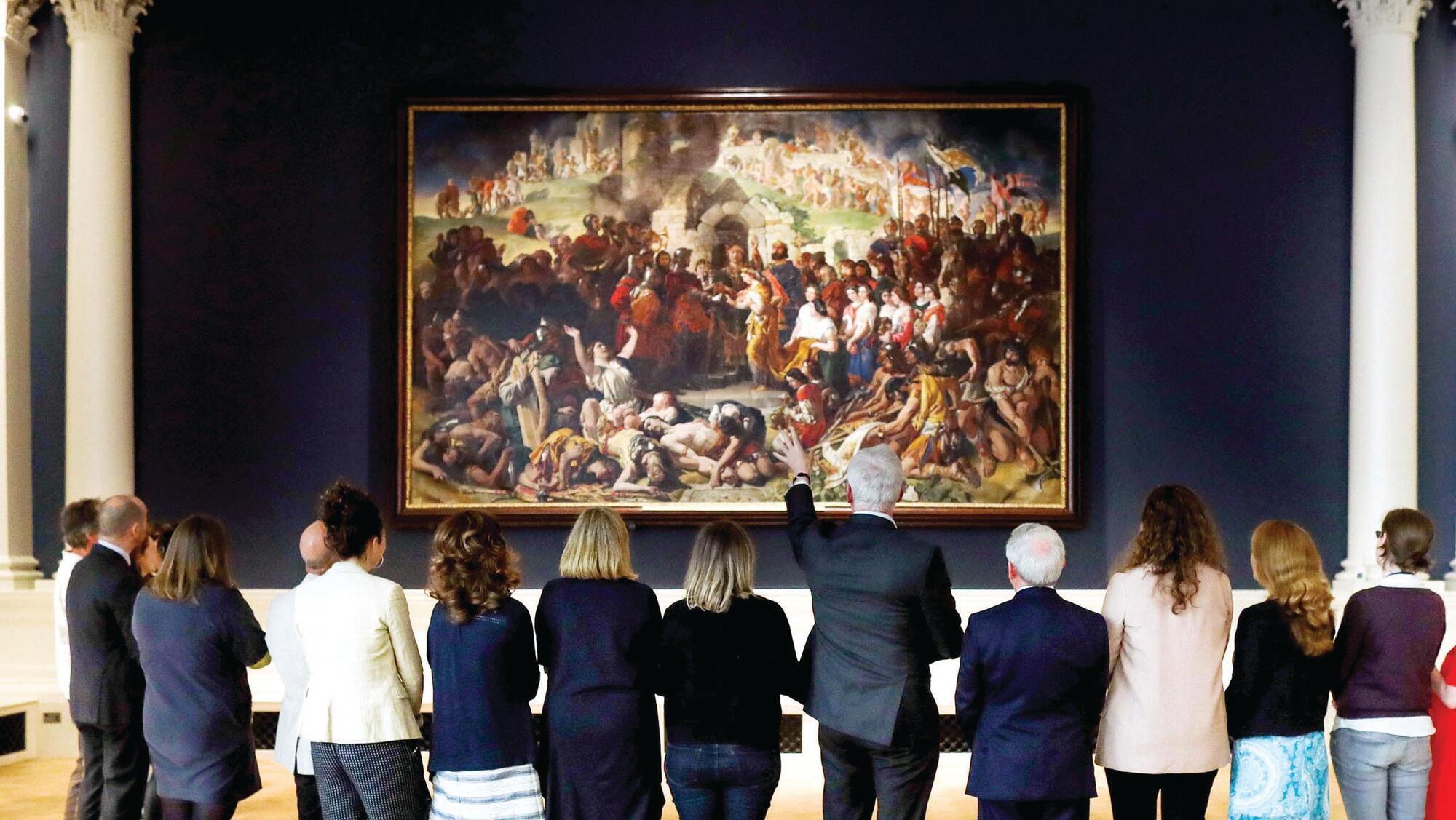
Visitors at the National Gallery of Ireland view The Marriage of Strongbow and Aoife
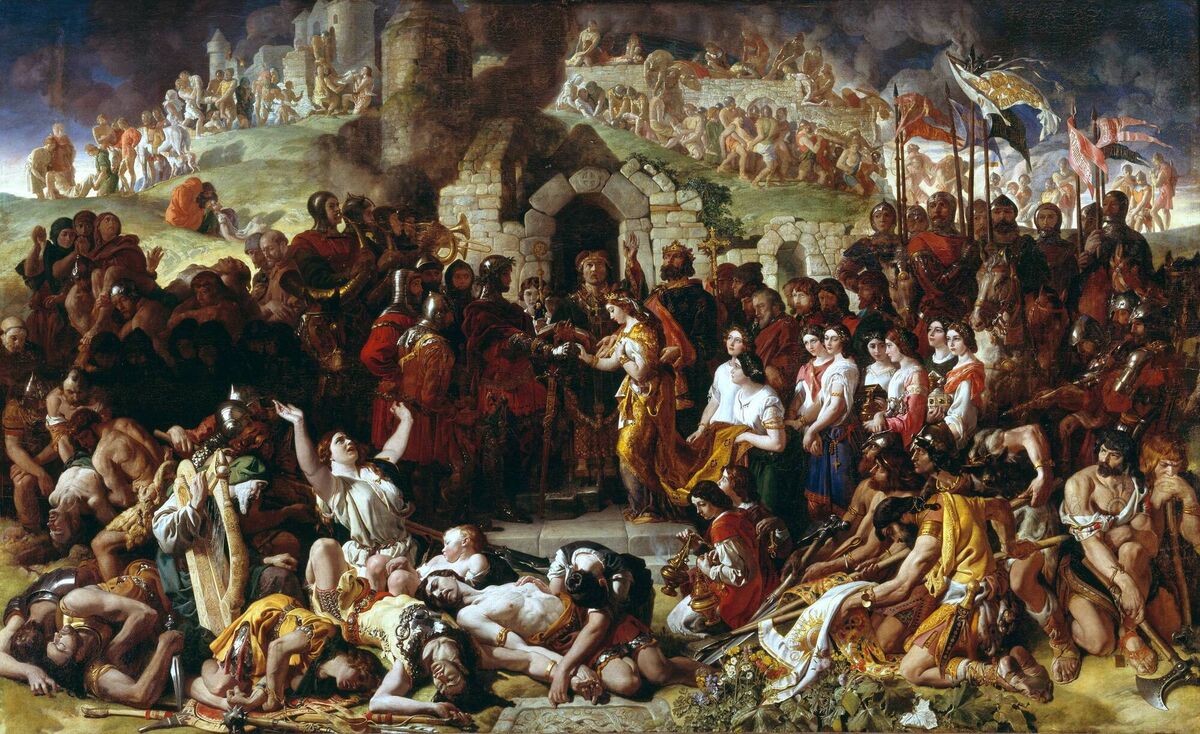
Most people know Daniel Maclise’s painting The Marriage of Strongbow and Aoife from their history books in school. The monumental artwork depicts the marriage - in 1170 - of the Norman knight Richard 'Strongbow' de Clare to Aoife, daughter of Dermot MacMurrough, in Christ Church Cathedral in Waterford. It was used to illustrate accounts of how control of the island of Ireland passed from the native High Kings to a succession of English royals.
Maclise, a native of Cork who found fame and fortune in London, produced the work in 1854, and it remains his masterpiece.
“People spend a long time looking at the painting, trying to decipher its meaning,” says Dr Brendan Rooney. “It’s a remarkable thing, a truly remarkable painting.”
The union of Strongbow and Aoife was very much a political arrangement. In 1167, Dermot MacMurrough had been ousted from his position as King of Leinster by Rory O’Connor, High King of Ireland. He solicited Strongbow’s support in retaking his lands and title by force, promising by way of reward his eldest daughter’s hand in marriage, which would allow Strongbow to succeed to the kingship.
On MacMurrough’s death in 1171, Strongbow became King of Leinster, and facilitated Henry II in taking charge of the country, thus precipitating English rule over Ireland for the next 800 years.
Given Maclise’s decision to depict a triumphant Strongbow planting his foot on a fallen Celtic cross, while an Irish harp lies broken to one side, and the vanquished natives lie dead in the foreground, it is tempting to conclude, as many have done, that the artist intended his painting to lament the passing of some sort of Gaelic Utopia.
But Rooney believes the painting is “wilfully ambiguous. In the schoolbooks, The Marriage of Strongbow and Aoife was presented as the signal nationalist piece of dramatic history painting. And that is certainly one way you can read it. But to do so, you have to put to one side that it was originally supposed to hang in the Palace of Westminster in London. Plus, you have to disregard Maclise’s own politics, or what we know of them anyway; he was a Unionist, a Tory, and he was suspicious of Daniel O’Connell. Like so many comfortable people of his generation, he could declare himself both Irish and British - there was no necessary contradiction in that - and he lived in London so long that he became what he himself called ‘a Cockneyfied Corkonian’. But to say all of that isn’t to say that he wasn’t sympathetic towards Ireland, because he obviously was.
“I think the painting is fundamentally theatre. Maclise turned the marriage of Strongbow and Aoife into this sensational artistic tableau, this frieze-like confection. Everyone’s facing outwards. It’s the theatrical stage, with all sorts of detail. And we are the audience.”
The story of how The Marriage of Strongbow and Aoife came to be in the National Gallery of Ireland, and to occupy such a prominent place in its collection, is almost as colourful as the painting itself.
Maclise was born in 1806 to a Scottish Presbyterian family of modest means. He attended Cork School of Art, and managed, through the sale of popular lithographs, to fund a move to London, where he continued his art education at the Royal Academy. He quickly made his name as a skilled portraitist and historical painter, and it was no surprise that his proposal to paint The Marriage of Strongbow of Aoife won the approval of the Westminster Fine Art Commissioners, the committee appointed by the House of Lords to manage the decoration of the new Palace of Westminster. It addressed the theme of “the acquisition of the countries, colonies and important places in the British Empire.”
From the beginning, Maclise disagreed with the commissioners over the medium he was to work in; they demanded he paint a mural, directly onto the plaster on the wall, while he insisted he should paint in oils on canvas.
Even while they argued, Maclise pressed on with the painting. His ambition was epic: the canvas is five metres wide and three metres high, and he employed scores of models to pose for his characters. Their costumes are anachronistic.
“The Normans are dressed in military uniforms that date from 200 years after the event. There’s no Celtic ornament, it’s all Hiberno-Norse or Scandinavian. Maclise didn’t concern himself with the accuracy in the way we do when we interrogate these historical events today.”
The artist included some objects that are, as Rooney puts it, “frankly daft. There’s a trombone, for instance. It won’t surprise you to learn that there were no trombones in 12th century Ireland, but it’s prominently displayed in the background. There’s also an African shield. These were props Maclise must have had in his studio, so he put them in.”
In 1854, Maclise exhibited The Marriage of Strongbow and Aoife at the Royal Academy, where it caused a minor sensation. Even so, the commissioners reneged on paying him, “and then the art collector Lord Northwick offered €4,000 for the painting, an extraordinary figure the exasperated Maclise could not really refuse.” When Northwick died, the painting was sold at Bonham’s in London. It passed to a new owner, and remained in a private collection until 1879, when it was purchased by Sir Richard Wallace at an auction at Christie’s. Wallace was a wealthy British landowner and art collector who had been appointed a member of the Board of the NGI in January that year, and he gifted the painting to its collection in July, saying, “I have always felt that this masterly painting of our great Irish artist ought to find a permanent home on Irish soil.”
The NGI collection extends to more than 16,000 works of art, and only a fraction is ever on public display. At some point, The Marriage of Strongbow and Aoife was put into storage, where it remained for decades.
“It was really only rehabilitated in 1966 [the fiftieth anniversary of the Easter Rising]. It was brought up from the bowels of the building and put on show again. The painting had only ever been known as The Marriage of Strongbow and Eva, but it was at this time that Eva was Gaelicised as Aoife. Maclise never called the painting The Marriage of Strongbow and Aoife, but that’s what everybody knows it as today.”
Maclise managed in time to overcome his differences with the Westminster Fine Art Commissioners, and won the contracts for two massive historical paintings, The Meeting of Wellington and Bucher after the Battle of Waterloo and The Death of Nelson. Both are still on view at the Palace of Westminster.
Sadly, the several years labour it took to complete the paintings undermined Maclise’s health; he died of acute pneumonia in April 1870, at his home on Cheyne Walk, Chelsea. He is buried in Kensal Green Cemetery.