Pride short story: The Mark of Difference, by Kel Menton
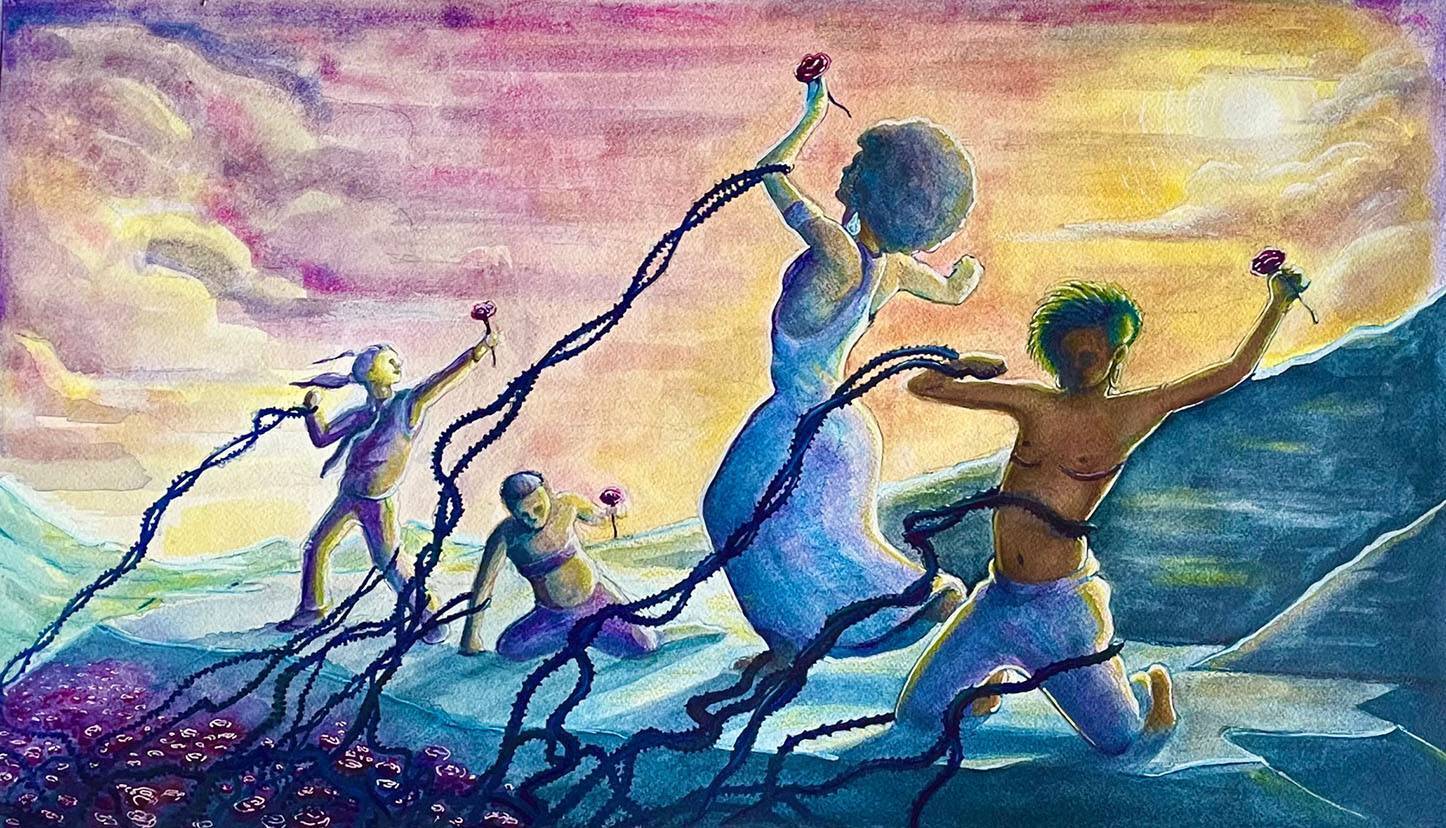
"There are moments when the claustrophobia constricts and the air leaves my lungs; this inescapable system that has contaminated every thought I have." Artwork: By Danny Foley, illustrating Kel Menton's short story 'The Mark of Difference'.
“I don't think I’ve met a trans person before.”
Mal paused for the briefest second. Ireland was waist-deep in summer, and to celebrate the few weeks left before they began their first year at university, Mal and their friends had decided to drink lukewarm beer and struggle to work a barbecue they had found in Lidl.
The sun was slowly disappearing, turning the sky into pink lemonade. Despite almost poisoning themselves with the sheer amount of bug spray Mal had covered themself with, midges dutifully nibbled at the exposed skin on their arms and legs.
They had gone to get a fresh bottle after their last one had turned into the final resting place for two unfortunate flies. They hadn’t heard Ruby follow them to the cooler box kept in the shade of a towering oak.
She was still watching their reaction carefully. She’d said it almost like a question. ‘I don’t think I’ve met a trans person before.’ What did she expect them to say? It wasn’t as though they were best buddies — more like friends of each other’s friends.
Mal cracked their beer open and took a quick sip before responding. “You’ve never met a trans person in the queer haven of rural Cork?”
There was a smile on Ruby’s face, words pressing at the back of her teeth. Say it. Say it. “I always thought I was the only one. The only queer, I mean.”
Mal’s soul exploded. They tried to smile without looking like a lunatic. “I’m here for your crown.”
Ruby laughed. It came from deep within her, from the depths of her belly, until she collapsed back onto the grass and beamed up at the sky. Queer. It didn’t feel like a dirty word when Mal said it. It sounded effing beautiful.
They hesitated for a moment. The conversation could be left there, one small shard of vulnerability in the evening. It wasn’t sharp enough to cut themself on, not yet. But it was a simple shard, and Mal had been yearning for a whole mosaic. They would scroll through their phone for hours, seeing mosaics made from shards of vulnerability just like this one, slowly at first and then all at once. The mosaics of queer friendships. Queer love. Queer art and literature and lives. They could feel their heart begin to ache, looking at Ruby’s goofy grin. Sure, they could leave it there, and return to the wider group as though nothing had happened. That was the safe option. But nothing would grow from it.
Mal plonked themselves down next to her.
“I didn’t know that you were–” They stopped, threw her a questioning glance. “Do you mind being called queer?”
Ruby shook her head. “No, no, it’s fine. Thanks for asking.” She plucked a blade of grass and twirled it between her fingers. “I actually prefer to call myself queer. I like the vagueness of it. Like I have room to breathe.”
The corners of Mal’s mouth quirked up. When they had found language for what they were – transgender, nonbinary, queer — it was the ambiguity of the words they had loved. It reminded them of a time when they were a child where gender had no hold over them. They loved fiercely and found no flaw in their body except that it could not reach high places, even on their tiptoes.
“Thanks for trusting me with that.”
They couldn’t look at each other. It felt easier to speak the words into the air, to the clouds, to the oak tree.
“I’d appreciate it if you didn’t...if this wasn’t…” Ruby waved her hands vaguely. Mal understood.
“I get you, don’t worry. I won’t mention it.”
“I just…” Her mouth screwed up, like she was rolling the words over her tongue. “...Avoid sharing some stuff, so that people don't trample all over me while trying to understand.”
Mal said nothing for a moment. “Am I the first person you’ve told?”
Ruby’s heart leapt into her throat. She nodded. “I haven’t said anything. I’ve never had a reason to. No one has ever been interested in me.”
Mal was silent. They downed the last of their beer, stood, retrieved another one, and returned to their spot beside her. Ruby thought that the conversation was over, but suddenly they spoke again.
“Coming out is overrated anyway. I learned that the hard way.” Their voice was light, but Ruby noticed a slight tremble to their fingers. “I told my parents and it was an instant disaster. Their straight daughter was suddenly a gay...thing. It was their worst nightmare.”
Gooseflesh puckered across Ruby’s skin. Mal had a look she had found on their face a few times before, one where they travelled to a space where they couldn’t be followed.
“I’m dead to them. My mam would show me pictures of me as a kid and tell me I murdered that little girl. I cut my hair and she stopped looking at me altogether.” Mal laughed, but there was no humour in it. “I tried to tell the school, and our guidance counsellor suggested I go to the North and get conversion therapy.”
Ruby’s mouth fell open. No words could find their way past the sob lodged in the base of her throat. She wanted to yank Mal into a hug. She wanted to cry. She wanted to pull the sadness out of them and throw it onto the coals of the barbecue.
“On the stroke of midnight on my eighteenth birthday, my cousin helped me pack all my things into his car and took me away. I haven't looked back.”
They stopped, their eyes raising again to meet Ruby’s. The universe was open above them, letting blood from old wounds seep away into the void. The corner of their mouth lifted.
“I always felt like I was going through life with a sign smack bang in the middle of my forehead that said different.” Mal tapped their brow for emphasis.
You do, Ruby thought. She could see it. It was the glitter in their eye, how their body interacted with the world around them. “Different isn’t a bad thing. I like it. It’s beautiful.”
.
The gratitude in Mal’s eye sent a pang through her. Did everyone feel like this? Grateful for the scraps of respect they could scavenge from the people they met? Her hand moved faster than her brain could think. Ruby brushed a stray curl from their forehead, her skin grazing against Mal’s, against the spot where their mark of difference might be. Electricity rocketed up her arm and suddenly, finally, she could see.
There was a certain peace to being a tiny speck in an infinite universe. Mal’s brain couldn’t even comprehend it, really. The earth did not feel their footsteps on its back, the sky did not feel their gaze prickle against its skin. They were too big, and they were too small. Mal had been shrinking with each year they grew older. When they were a child they were huge, the protagonist everyone had been waiting for. Mal would change the world, they were sure; they would save anyone who needed saving and when they were finished there would be no more bad guys. Time had not been gentle when it tore this idea from them.
The world changed so quickly they could still feel the sting of whiplash. They were a Hero and then suddenly they were a Girl, and they had to shave so they still looked like a newborn and their body started to menstruate like a woman and they painted their face until there were no more blemishes and they could never feel the sun on their bare back ever again because even fully clothed people would undress them with their eyes. They spent years and years unlearning it all, but even then Mal knew something was wrong. Even with the bells and whistles ripped off, they were not a Girl. They were not even a Hero, and the bad guys had multiplied tenfold. They felt ugly. They felt alone. Mal felt like a monster.
Ruby could see them in a doctor’s office now. They were unrecognisable, hunched and small, their expression far away, while a faceless doctor questioned them about sex and masturbation and their parents. Ruby felt rage swell in her stomach. They have been trans longer than their doctor has been a doctor. What does the doctor believe a trans person is? How could Mal convince their doctor to help them? They were non-binary but they would never tell a medical team that; all they said was ‘I’m not a girl’ and let people fool themselves into believing Mal was the only other option they could think of. They expected transness to be suffering, not beautiful, not something they celebrated.
To access healthcare they had to become a caricature, and guess what doctors thought a trans person looks-thinks-feels like, what they believed a trans person wants. Mal could not access many trans healthcare services in this country, forcing them to go abroad — a narrative Ruby was all too familiar with, one she had heard recounted over and over again — to suffer the expenses of private foreign healthcare, or even just self-medicating Hormone Replacement Therapy. Someday soon they would fly to Poland and undergo major surgery, to recover alone in a hotel room for a week before they could return home in a body that felt like their own.
The people who were supposed to care for Mal didn’t know what to do with them. No one knew how to care for the mental well being of a trans person, not to mention how non-binary people were seen as implicitly delusional. But Mal didn’t hate their transness, they adored it. That Christmas with their cousin, Mal kept the tags with their name on them. Sure, people were clumsy with their language but, Jesus wept, they were so thankful their tongues were not seeking to hurt them.
The image shifted again. Ruby took Mal’s eyes, placed one in her mouth, watched the landscape tumble into new focus. The world they lived in was not one made for the wellbeing of trans folk — yet. But she could see it, she could see the beauty of things beyond the confines of man/woman, even creeping further, beyond cis/trans. Mal envisioned a future decades ahead, beyond just themself, in which people have decolonised the gender systems of the West, leaving terms like cis or trans irrelevant. Part of them ached for that future, wished it was the present. But they were also thankful for the time they lived in now, for their transness, for their deep connection with it. Ruby had understood ‘trans’ as something medical, a ‘transition’ — but to Mal it was more like a transformation, a transcendence, a transgression. Somewhere, Ruby knew her lips had mouthed one word again: .
There was a vision of hope that sustained them.
She took one step towards it, then another, and another, until she was running towards that huge burning beacon of hope and light.
‘I am a gardener, a caretaker,’ Mal whispered. ‘I wrestle the weeds as best I can but sometimes I cannot see my fingers beneath the blood thorny briars pull from me. I let the moss drink up the fallen blood and lymph and then turn my attention to the softer touch of petals. I am not the first, I am not the only, I will not be the last. Many have shed more blood than I have or will. I try to remind myself to be grateful rather than guilty for their suffering. There are those who are heroes not for glory but for a better future, a garden like this for someone like me. I can savour this gift while bearing the responsibility of leaving it better than I found it, for the next caretakers.’
Ruby could see them. The other caretakers wrestled flowers from pits of thorns. They sang and danced and led younger, newer gardeners to the softest patches of wildflowers. Her breaths were full of the sweetness of pollen and honey and ripe fruit.
Mal’s voice sounded again. ‘There are moments when the claustrophobia constricts and the air leaves my lungs; this inescapable system that has contaminated every thought I have. Did my ancestors want this for me? Or was it my colonisers? I have transcended a system but it is not lost to me; I find it like an ex’s perfume, lingering everywhere. I will spend my whole life unlearning these lessons that divide me from others.’
Ruby startled. They were standing next to her now. They had two crescent moon scars on their bare chest, almost touching in the centre, like the hand of God brushing the fingers of Adam. Mal did not look at her, but instead over the garden, over the pit of thorns, over the wildflowers.
‘When will I matter to you? When will you care and do something about my suffering? When will my life expectancy be the same as yours? How many of us will die — by our own hands, by the hateful hands of others — before we are seen? It’s exhausting trying to explain why you should care about other people. I don’t know how to do it.
‘I will never understand what it means to inhabit a body gendered differently than my own. I will never know a life outside of this colonial binary — I am stuck here, doing my best to untangle myself from the threads of its web. It’s something I must radically accept, I suppose. I can do nothing about it.’
They turned to look at her now, their smile small but warm.
‘But I love and am loved in return.’
“Mal!”
They blinked back into reality, back under the oak tree, to the sounds of shrieking laughter and the last chattering of birds and the dull thump of music from a cheap speaker. Ruby’s hand still floated in front of their face. Her lips were parted slightly in surprise.
“Here, lads! Mal! Ruby! C’mere before Jack eats all the sausages!”
They were up like a shot, laughing though it didn’t quite reach their eyes. “Jackary, I’ve had just about enough of your shenanigans!”
Ruby opened her mouth to call them back, but they had already reached a hand down. She blinked at it, and then up at Mal. Their grin was slightly crooked, she noticed. Crooked and beautiful.
She took their hand.
- Kel Menton is an author, playwright and assistant facilitator at Graffiti Theatre Company in Cork, where they have delivered creative workshops on adaptation for the stage.