How the beach became a canvas for sand artist Seán Corcoran
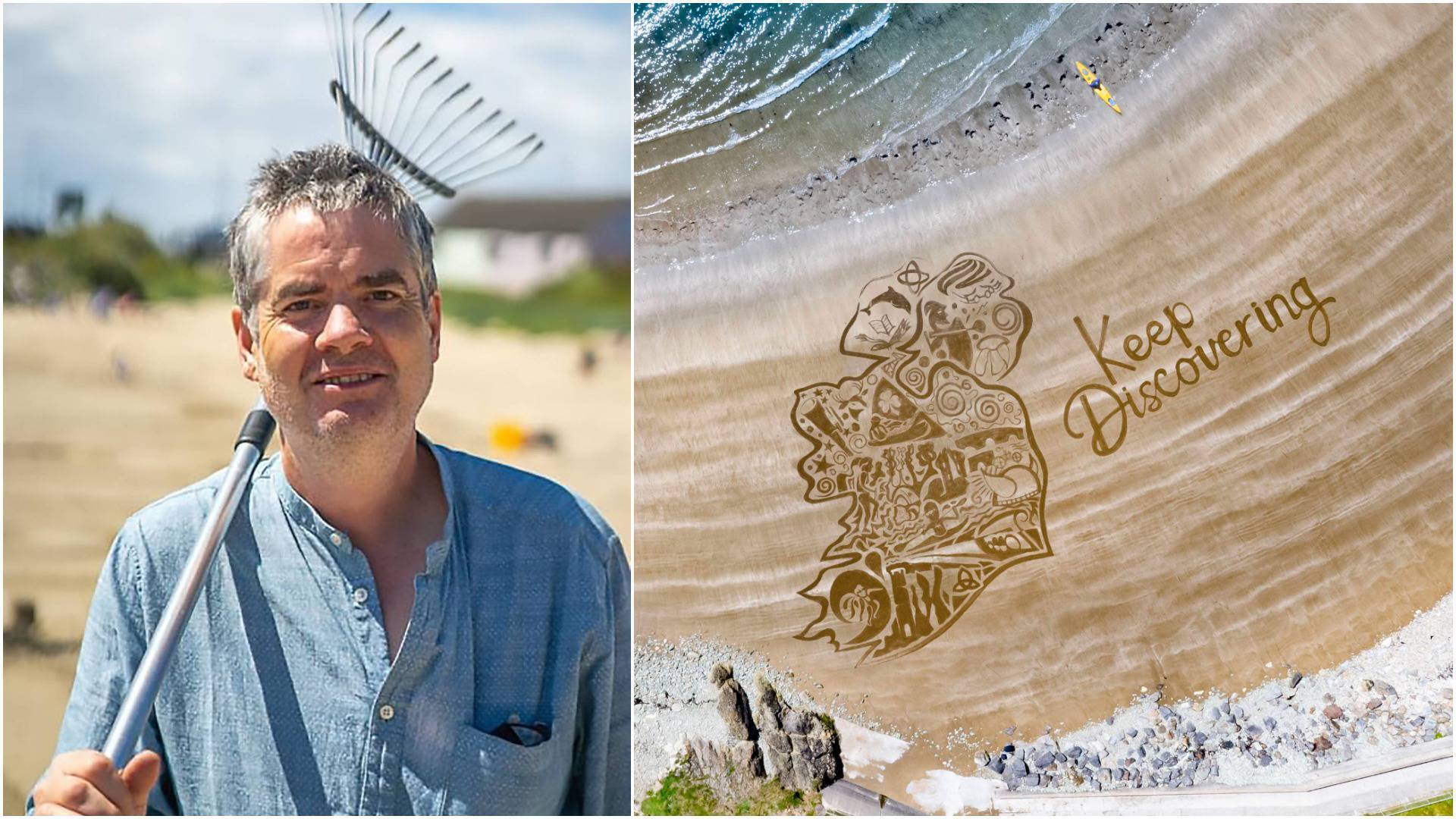
Sand artist Sean Corcoran and his piece for Fáilte Ireland at Kilmurrin Cove
Environmental artist Seán Corcoran couldn’t live in a better location when it comes to practising his craft. He and his wife Miranda run The Art Hand, an art gallery, studio and workshop situated halfway between Tramore and Dungarvan, in the heart of Waterford’s picturesque Copper Coast.
Corcoran has moved through different mediums throughout his career, from interior design using recycled materials to working with stained glass and mosaics.
Since moving to the coast in 2012, he has become best-known for his sand art, going viral again recently with his beautifully-detailed depiction of a map of Ireland for a tourism campaign, drawn in the sand at Kilmurrin Cove, near his home. The stunning beach is also where he had a revelation which led to him taking up sand art.
“When we moved here 10 years ago, I literally had an epiphany on the cliff overlooking Kilmurrin Cove one day. I was looking for my next art form, in terms of how was I going to be able to make a living in this beautiful place in the middle of nowhere.
"Just then, as I looked down, a horse was brought on to the beach on a lunge rope and his trainer led him around in circles. It left a beautiful impression on the sand that made me think, ‘how can I use the sand as my canvas?’. I duly proceeded home and brought back my rake. That was the start of my obsession with sand art.”
Corcoran uses various tools to create his sand art, from leaf rakes to ropes, to tools he has made himself. When working on projects with large groups, he uses wild bamboo, which he forages himself.
“For my own solo work, I have created a tool called the ploughman’s pickle, it is like a plough that you pull by hand, it basically leaves a furrow behind it as if you have planted potatoes. I have weighted it at one end, where it sinks. It enables me to drain the water off the surface of the sand so it is workable,” he says.
Corcoran uses drones to film his work but because of their limited battery life, he mainly relies on cameras mounted on modified giant tripods to create time-lapse videos. For the Discover Ireland video, two film crews were required, as Corcoran and his assistant Joe Lonergan worked to a tight deadline to create the detailed map.
“It was my most prestigious commission but also one of the most challenging. Once we had gridded it out, we marked the area with bamboo sticks when the tide was still around our ankles. As the tide dropped then, it took us six hours to complete the drawing.
"It wasn’t the size, but the icons we had to include, which were very detailed. We literally had six minutes to spare before the drone operator needed to get his final reveal shot. The tide was coming down through Ireland as we walked away. Three kayaks actually came into the shot in those six minutes, it couldn’t have been better.”
While hundreds of thousands of people around the world have seen Corcoran’s work virtually, he is often the only person who gets to see them in real life.
“Ninety-nine per cent of my drawings are solo drawings — I might be the only person to actually witness them. There are some amazing locations that are very remote, fields away from any road and I might have to climb a cliff to get down to them. They are undiscovered — and undisclosed — for now.”
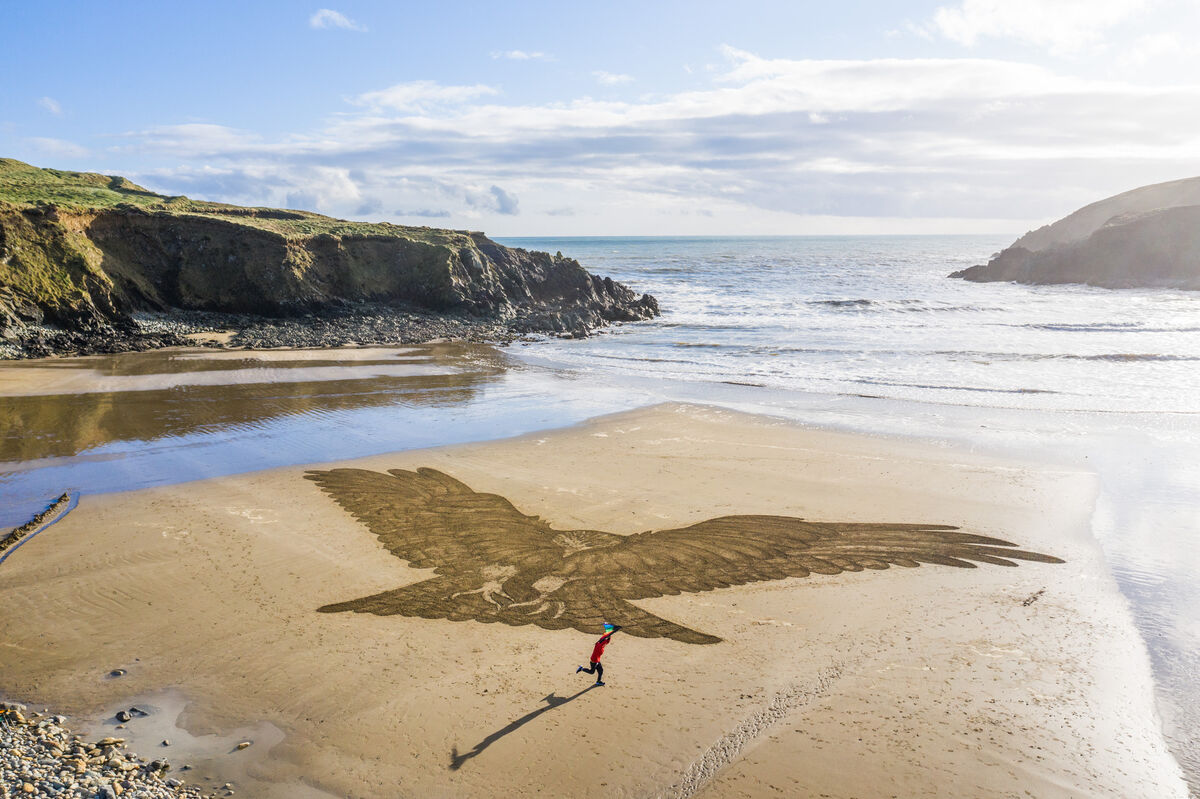
Corcoran is being kept busy with commissions from around the country. He has also borne witness to some personal and emotional moments in people’s lives.
“I have done maybe a dozen marriage proposals all around Ireland — some of them have ended up on TV. More importantly, with the ten or 12 I have done, I am glad that I have a clean track record - ‘yes’ was the answer in the sand in each case. It is quite an honour to be part of someone’s special moment. It can be emotional. Similarly, we do a lot of private memorials for families, it could be the name of a loved one on the beach or a family gathering a year or two later where they want to celebrate someone’s life.”
Corcoran says he is now keen to embark on some new challenges within the medium of land art. He has recently been collaborating on a multi-media project called Supersonic Sand, with Viking Promotions, which merges sand art with electronic music in a series of 12 video releases.
“People often ask me how I feel when the sand art is gone, that I have worked on it for so long. To be honest, it’s an uplifting and joyous experience. Whatever you put in, you give back to nature. The tide always returns to reclaim the sand.”
- Supersonic Sand can be found on YouTube