Book review: Inside the fractious relationship between Winston Churchill and his son Randolph
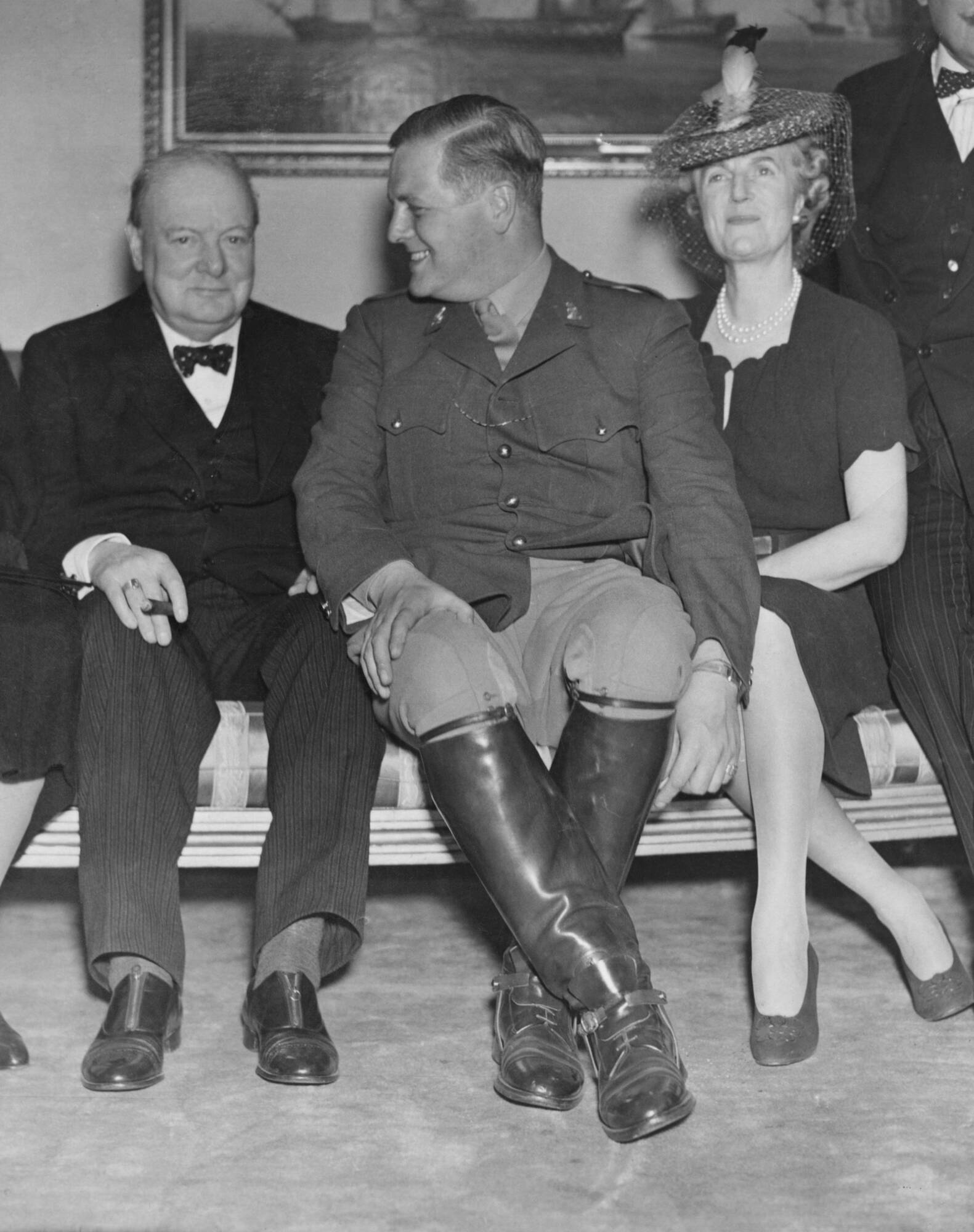
Randolph Churchill (centre), with his parents, statesman Winston Churchill and Clementine Churchill in 1939. Picture: Central Press/Hulton Archive/Getty Images
POPULAR leaders are frequently depicted in biographies as having lived near-perfect private family lives. Of course, people realise that this is unlikely, but there is frequently no serious questioning.
Winston Churchill is usually depicted as having saved Britain and the British Empire during World War II. He certainly deserves enormous credit for saving Britain, but serious questions could be asked about his role in saving the British Empire.

His mistakes over the years did much to undermine the Empire and Commonwealth. Josh Ireland writes that Churchill’s handling of relations with India in the 1920s and early 1930s was “wrong-headed, “and “made little moral or strategic sense.” But he does not go into this in any detail in the book.
I would be much more familiar with Churchill’s role in Ireland, and have long believed that he undermined the British Empire and democracy itself in Britain through his handling of relations with Ireland as British Secretary of War during of the Irish War of Independence, 1919-1921.
Churchill was essentially behind the Black and Tans and was the primary political inspiration for the establishment of the Auxiliaries, who trampled over Irish democracy and the human rights of Irish people. Of course, he probably believed he was acting in Britain’s interest, but that is certainly a debatable issue.
This latest book is not a broad biography of Churchill. Instead, the author explains that the work is the combined story of the lives together of Winston and young Randolph, “and how Winston built and broke his son.” It begins with Winston’s own neglected childhood. He was largely reared by family servants and generally ignored by his glamorous American mother. Although he described his British father, as “the greatest and most powerful influence in my early life,” he was actually no better.
Winston’s filial devotion was neither appreciated, nor returned. His father, Lord Randolph Churchill, had become famous in political life “for his stunning insolence,” and Winston was a frequent victim of this insolence at home, where his father essentially ignored him, other than to give him the cold shoulder or put him down with contempt.

Winston told a friend that whenever he tried to start a serious conversation, his father snubbed him pitilessly. “He wouldn’t listen to me or anything I said,” Winston complained.
“Few fathers have done less for their sons,” one relative noted. Indeed, Churchill’s father died at the age of forty-five, and the author pointedly concludes that “the best thing Lord Randolph ever did for Winston was to die young.” “Winston was afflicted by a feeling of worthlessness that was perhaps his father’s most enduring legacy,” the author concludes. As a result, Winston treated his own son, whom he named Randolph, very differently. “His son would not suffer the same neglect that had blighted his own childhood,” Mr. Ireland notes.
“Infatuated by his glorious, golden, chaotic son,” Winston devoted much time to him, especially to the boy’s questions. “You know, my dear boy,” he once told him, “I think I have talked to you more in these holidays than my father talked to me in the whole of his life.” This devotion to his only son, tended to undermine his relations with other family members. His wife Clementine, and three of their four daughters who survived beyond the age of three, tended to resent Winston’s blatant preference for their brother.
Their attitude was understandable because Randolph was developing into a somewhat obnoxious individual. Yet, the author contends, Clementine’s efforts to reproach this behaviour, only intensified Winston’s love of the boy. As a result, Clementine felt that she was vying with her son for her husband’s attention.
Winston actually encouraged and even rewarded his son’s outspokenness. Randolph exhibited supreme self-confidence, engaging “ in repeated displays of arrogance and astonishing rudeness,” according to Mr. Ireland, who added that the boy shared his father’s “flamboyant disregard for anybody else’s opinion.” He was living the highlife, drinking too much, gambling recklessly, and thus, seriously overspending.
“Randolph’s great misfortune, according to the author, “was that he inherited a full measure of his father’s ambition, unconventionality, and self-confidence, but not a fraction of his charm, self-discipline or sensitivity.” With the approach of the second world war, Randolph joined the British Army and married hurriedly, after a very brief relationship with Pamela Digby. He was compelled by the need for an heir in case he did not survive the war. It was later rumoured that Randolph had proposed to as many as seven different women, but this book does not deal with those.

Winston and Clementine were very taken by Pamela and frequently invited her to functions at Chequers, while Randolph was off serving with British Intelligence in the newly formed Special Air Service (SAS) in the Libyan Desert and Yugoslavia, establishing an admirable war record.
At one Chequers function, Pamela met W. Averell Harriman, who had been sent to Britain by the Americans to expedite their Lend-Lease aid to Britain. Pamela considered him “the most beautiful man she had ever seen,” and they began an affair. She later said “Winston made it easier for the two of us to see each other outside of London by inviting both of us to Chequers nearly every weekend.”
Ironically, Harriman was sent on a brief mission, during which he met Randolph Churchill, and they got on famously together. When Randolph got back to Britain, his marriage was essentially over and they quickly split up. The writer Evelyn Waugh noted that Pamela hated her husband so much, “she can’t be in the same room as him.” Randolph reacted by drinking too much and then lurching around London “spreading malicious inventions” about Pamela. The thing that hurt most, Randolph said, was that his parents “had condoned adultery beneath their own roof” by facilitating Pamela and Harriman at Chequers. He accused Winston of not only facilitating the affair but also of encouraging it in order to assist Harriman on account of the importance of Lend-Lease.
When Randolph met his family, his outspoken attitude led to real difficulties. One evening when he said his wife was a whore, his sister Sarah intervened, only to have Randolph slap her face and call his sister “a bitch.” Their parents both witnessed this.
Clementine thought Winston was going to have a heart attack before he called on the Marine guard outside to eject Randolph. After Harriman left Britain, Pamela continued to have affairs, with others, including the famous American broadcaster Edward R. Morrow.
Even Winston could not put up with his son’s excesses, but they were somewhat reconciled by his decision to allow Randolph to write his father’s official biography. The son outlived the father by little over three years, before dying of cirrhosis at the age of fifty-seven in 1968, so he did not complete his detailed and balanced assessment of the intense relationship between Winston and his himself.
Despite their intense rows, and his failure to meet his father’s expectations, young Randolph was the love of Winston’s life. This study provides interesting and balanced insights into both men’s lives, and is thus a valuable contribution to history.
- Josh Ireland
- John Murray, £20.00 HB