Cork's Greatest Records: John Spillane's Irish Songs We Learned at School
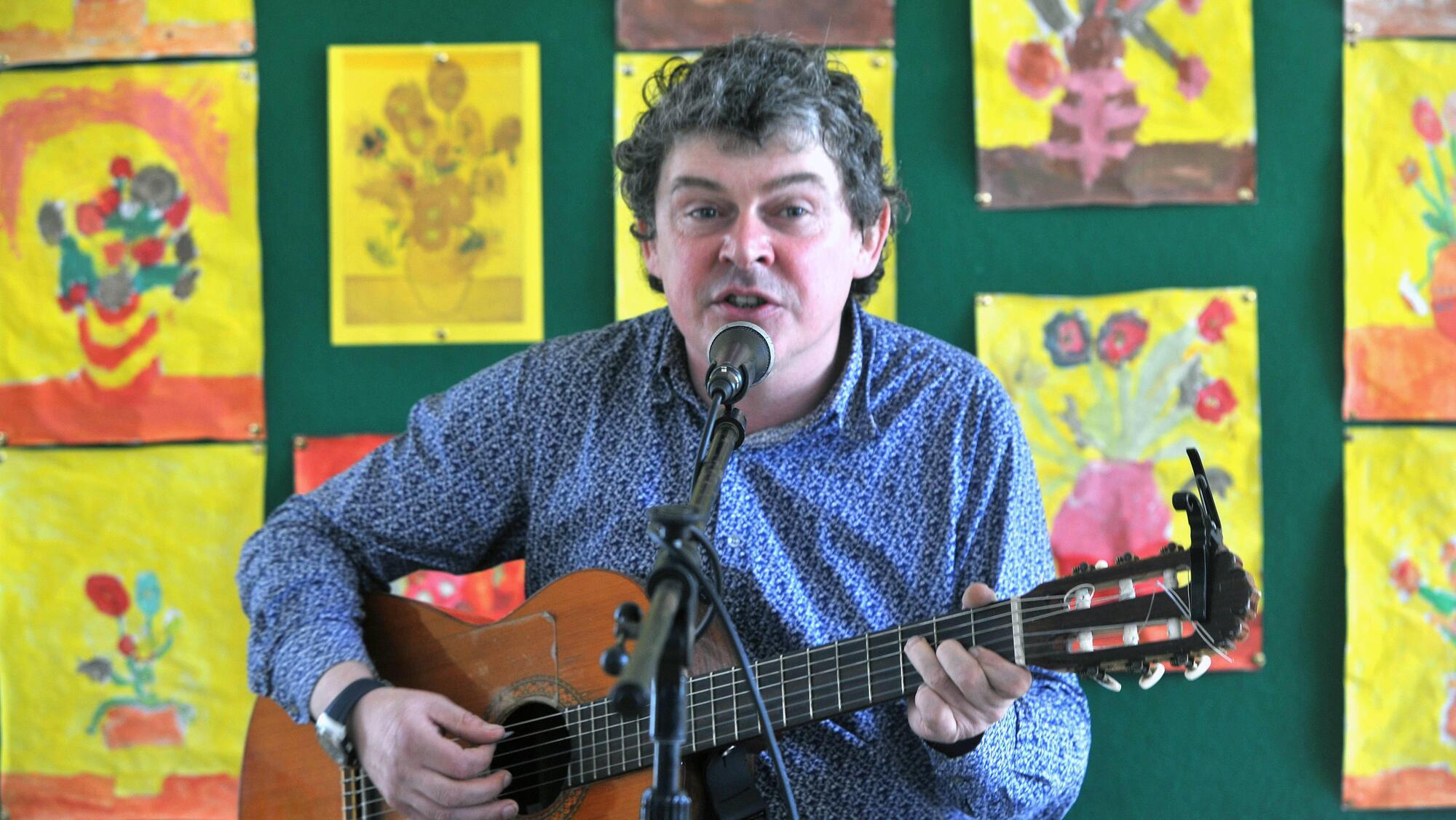
B-Side The Leeside: The singer-songwriter had huge success with the album of Irish classics he released in 2008
Cork's Greatest Records: John Spillane's Irish Songs We Learned at School

John Spillane's  Irish Songs We Learned at School sold more than 45,000 copies. 

There’s a certain irony in the fact that one of Cork singer-songwriter John Spillane’s best-known songs is 'Johnny Don’t Go To Ballincollig', his 1997 kick against Cork’s small-town provinciality, which has been covered by Christy Moore on two albums.

Because ten years later, when he was recording his fourth album in a five-album deal with now-defunct label EMI Ireland, Ballincollig was precisely where he went.


Spillane’s Irish Songs We Learned at School, recorded with first year music students in in Gaelcholáiste Choilm in Ballincollig, was released in October 2008 and enjoyed considerable commercial success.

It was number eight in the Irish album top ten for Christmas week in the year it was released and was the biggest selling album by an Irish artist that year, selling over 45,000 copies: a triple platinum success by Irish standards.

Spillane injects his characteristic combination of poetic lyricism and pragmatism into his contemporary consideration of the album’s success.

“I put it down to my mother, who died that month,” he says. “I think on her way to heaven, she waved her magic wand and got me a hit record.” 

But then: “There’s the nostalgia factor for the older people, and then there’s the educational factor for all the Gaelscoileanna, and all the kids learning the songs for the first time.” Featuring 13 tracks 'as Gaeilge' that would be familiar to anyone who had their education in an Irish school, including 'Óró Sé Do Bheatha Abhaile', 'Báidín Fheilimí' and 'An Poc Ar Buile', in their simplest possible arrangements.

As well as maternal intervention and nostalgia, Spillane partially credits the collection’s success to this simplicity.

“A group called Na Casaidigh had an album called Óró na Casaidigh in 1997 that was a similar idea,” he says. 

“But they had tried all sorts of different arrangements. I think people liked the simplicity on what we recorded.” 

Spillane laid down many of the tracks for the album in Sonas Studios in Killarney with local musician and recording engineer Tony O’Flaherty. 

Then, having rehearsed several times with the first years of Gaelcholáiste Choilm, Spillane brought O’Flaherty to Ballincollig to record the class.

The entire experience was a smooth one, in no small part due to the school’s music teacher, Catherine Frost: “She has since retired, but she was really the kind of person who could make anything happen. Nothing was a problem and everything was achievable.” 

For the youngsters, the learning experience of the recording process was enriched still further when Spillane and the class of 25 were invited to RTÉ to perform on chat show Seoige in the lead-up to Christmas.

John Spillane, with teacher Catherine Frost, engineer Tony O' Flaherty and the first year music class at Gaelcholá¡iste Choilm in Ballincollig during the recording  of Irish Songs We Learned at School. 

Spillane can’t take the credit for having come up with the concept for Irish Songs We Learned At School; it was EMI Ireland boss Willie Kavanagh who came up with the idea.

“Twenty years ago when I turned 40, I got signed to EMI, the greatest record company in the world, the same record company as my heroes, The Beatles.” Spillane says. 

“It was Willie’s idea to record this album. He said, ‘Put 'Óró Sé Do Bheatha Abhaile' on it, and do 'Trasna na Tonnta' and 'Poc ar Buile'. After that, I don’t care.’ He had an eye for the commercial potential in it.” 

As a musician whose career has been dedicated to refining and perfecting his own song-writing, Spillane takes a workmanlike approach to the album: he freely admits that it didn’t provide him with as much creative fulfilment as recording his own work, and he rejects any high-falutin notion that he has played an important role in keeping the music alive for future generations.

“The way I see it, I had all the skills necessary to do it,” he says. 

“I don’t see myself as an O’Riada or having any real importance as an archivist of Irish music or anything: I see myself as a musician who was trying to make a living.” 

But Spillane holds the songs on the album, which he calls “big, important, traditional songs”, in high regard. “Being a songwriter myself I think that gave me a real respect for the craft of them. They are amazing songs.” 

Not everyone has pleasant memories of school and some may hear songs like Séasmuisín with more than a tinge of creeping dread. Spillane acknowledges this.

“Yes, some people have negative memories of them; some hate them because they remember being hit in school and they have trauma associated with them,” he says.

“It’s a terrible shame and an irony that the English language was beaten into children with a stick 150 years ago and then the Irish language was beaten into children with a stick 150 years later.” 

Spillane wasn’t brought up in a household of Gaeilgeoirí himself, but fell in love with the lyricism and “romance” of the Irish language while completing an Arts degree in English and Irish in UCC as a young aspiring musician.

Following the success of Irish Songs We Learned At School, a follow-up, More Irish Songs We Learned At School, was recorded and released in 2009. When EMI Ireland went bust in 2013, the albums went out of print for three years, but were re-released as a double album on Universal Records, called Irish Songs We Learned at School Ar Ais Arís.

Irish Songs We Learned at School Ar Ais Arís can be bought at: https://johnspillane.ie

Memories from the making of the album 

Bringing in the big guns

When John Spillane recorded 'Poc ar Buile', he knew he needed to invite Seán Ó Sé, the 'Pocar' himself, who originally recorded the song in 1962, to appear on the recording, For good measure, he threw in Seán Ó Riada’s son Peadar Ó Riada, because the senior Ó Riada had also featured on the original record. So had Peadar Mercier, and so his son, UCC lecturer in ethnomusicology Mel Mercier was also invited along to play bodhrán on the track.

Mná na hÉireann

Spillane’s own favourite song from the collection appears on the second album. “I think 'Mná na hEireann' is a brilliant song but I also love the story behind it,” he says. “It was a poem for 150 years before Sean Ó Riada put an air to it. It was written in the 18th century by the Northern poet Peadar Ó Dóirnín.” 

Christy joins in

“I’d had the heavy-hitters in for the first album, so on the second album I got Christy Moore to come and record,” Spillane says. “He had recorded Cúnla with Planxty many years ago and so for me it was a natural thing to ask him. He had been a champion of my own songs for several years and was at that time very enamoured of a song of mine called Gortatagort, about the names of the fields in Bantry and he wanted to record it.”

x

More in this section

Scene & Heard

Newsletter

Music, film art, culture, books and more from Munster and beyond.......curated weekly by the Irish Examiner Arts Editor.

Cookie Policy Privacy Policy Brand Safety FAQ Help Contact Us Terms and Conditions

© Examiner Echo Group Limited