The bald facts: Shedding the stigma of hair loss
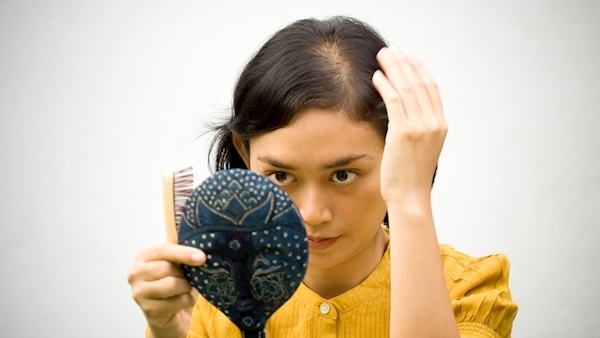
Female hair loss at a young age can be a shock for those who find their locks coming out in their fingers. investigates.
Getting ready for bed one night, Sarah*, a 33-year-old Waterford-based retail worker, froze. She was putting her hair in a ponytail and noticed a bald patch on the right side of her head. “I thought ‘what is that??’”
Then 28, Sarah was heading off early next morning for a hen party and decided to park the problem for the weekend.
“But in the shower over the weekend it was all coming away on me. I said to a friend ‘something’s going on’. She said ‘oh my hair’s always falling out’, but my gut feeling was something’s not right.” Sarah had really long thick black hair that had never given her trouble.
“Everyone used to comment on my hair, how amazing it was, how healthy. I wore it down a lot. As a woman, my hair gave me a sense of my feminine side — getting my hair done, getting dressed up. I found my hair a sense of comfort.”
All that changed as over the following weeks, 80% of Sarah’s hair came away. “I was looking in the mirror, so distressed, thinking ‘what is looking back at me?’ ”
She went to her doctor but didn’t see her usual GP. “I came out with websites and some numbers to ring for counselling, but I didn’t want to talk to anyone about it — I wanted to know what was going on.”
She saw her own GP, who was shocked (“she knew my hair”), said it was alopecia, and referred her urgently to a dermatologist. “I went but didn’t feel I got much. It was so frustrating — you’re running around for answers and in the end it’s your autoimmune system attacking the hair follicle or it’s stress or the doctors don’t know.”
Feeling she couldn’t watch it fall out anymore, Sarah went to a family friend who’d had cancer and asked her to shave it off. “I just felt like ‘get it away’.” She got a wig and had abittersweet relationship with it, grateful it let her go more-or-less unselfconsciously to work, yet hating to put it on because “it was a reminder every time of what I’d lost”.
At home, she’d wear woolly hats.
I coped by doing a lot of running. It helped me unpack the stress of losing my hair — I was afraid if I was stressed it wouldn’t grow back.
Thankful she hadn’t lost her eyebrows or eyelashes, she prayed to get her hair back and attended a clinic in Waterford three times a week for six months where she got DermaHeal HL injections and UV light therapy. About eight months after she’d noticed the first bald patch, she got a light regrowth and within a month or so had a pixie hairstyle.
“At work they were saying ‘oh you got your hair chopped off’. I felt like saying I hadn’t but instead I went along with it. At least I got to see what I was like with short hair!”
Today, Sarah’s hair is long again and she can’t pinpoint why she ever lost it. “I was very content in my job. I’ve had two bereavements in the last two years and thought ‘oh my hair’s going to go’ but it hasn’t. Losing people close to me has made me see what’s really important in life, but I would never dismiss how distressing hair loss is.”
According to the American Academy of Dermatology, 40% of women have visible hair loss by the time they’re 40. Two years ago, Loose Women panellist Nadia Sawalha posted an emotional video online in which she talked about losing her hair — she said a doctor told her she had the balding gene.
Cork GP and health blogger Dr Doireann O’Leary says female hair loss can arise for many reasons: Stress and autoimmune conditions (immune system attacks cells); extreme dieting/exercising and weight loss; or an underlying deficiency or medical condition. Even how we style our hair — in tight ponytails/braids — can put prolonged traction on the hair follicle (‘traction alopecia’).

She urges people to report hair loss to their doctor. “Conditions like long-standing iron deficiency, underactive thyroid gland or Polycystic Ovarian Syndrome can be at play. Skin conditions like lupus, dermatitis, fungal skin infections and psoriasis affecting the scalp can have dramatic effects on hair.
“Scalp psoriasis is a very common cause of hair loss. Dermatitis can lead to patchy distribution of hair loss or alopecia areata – quite dramatic and upsetting, but follicles aren’t damaged so there’s scope for it to grow back,” says O’Leary, adding that the most extreme case of hair loss she’s seen was caused by scalp psoriasis, untreated for months — almost 90% of the hair had been lost.
Some medicines can contribute to thinning hair/hair loss. “It’s always useful to review any over-the-counter or prescription medicines you’re taking. Chemotherapeutic agents can cause hair loss but more routine medicines can too – for example, some acne and blood pressure medicines.”
Hair loss solutions depend on the cause. “Maintaining healthy diet and BMI are important for overall health, as well as hair health. Managing stress requires a personalised approach.
"Good places to start are ensuring you’re getting enough sleep, getting regular exercise and talking to your doctor and/or pharmacist about over-the-counter products,” says O’Leary, adding that Zenflore, a food supplement and probiotic developed by scientists, can help reduce stress.
“In an age when hair extensions are deemed a normal part of female grooming and there’s so much pressure to look perfect, it’s little wonder hair loss is so upsetting. Women experience feelings of negative body image, poor self-esteem, loss of sense of control over their lives — it very much impacts on quality of life.”
Cork-based schoolteacher Liz, 40, has hair loss affecting the crown of her head. “It’s moderate — not so severe people would stop and look. I have quite a lot of hair fortunately and I can cover it up.”
But she’s self-conscious about it.
Any body issue, you’re hoping it isn’t too obvious. You’re concerned about your underlying health too – hair can be an indicator of health.
A mum of three young children, Liz says she’s no more stressed than any other working mother of three. She experienced hair loss after her first two pregnancies but it grew back — after the third it didn’t.
“My doctor said it could be thyroid insufficiency or vitamin D deficiency. My vitamin D was very low, so she has me on triple the usual dose.
"I don’t think it’s working. My hair picked up over the summer but in the last few weeks it has gone light again. I might go on stronger vitamin D for six months to see if that makes the difference.”
With long blonde curly hair, Liz is a “tie it up and go” girl. “In my 20s and 30s, my hair was a priority. I looked after it. It was in great condition, a point of pride. I’d spend money on getting my hair done rather than on clothes.
"The overall condition has got much poorer since I had kids. I don’t prioritise it, but hair loss forces you to be more mindful of the products you use. I used to straighten it twice a week — I’d be slow to do that now.”
Liz’s big concern is that, as she gets older, the alopecia will progress to other areas of her head. “I really want to future-proof it now,” she says. *Name changed
Visit alopeciaireland.ie ; precisionbiotics.com/ie/what-is-zenflore















