Jodie Whittaker: The welcome new face of Doctor Who
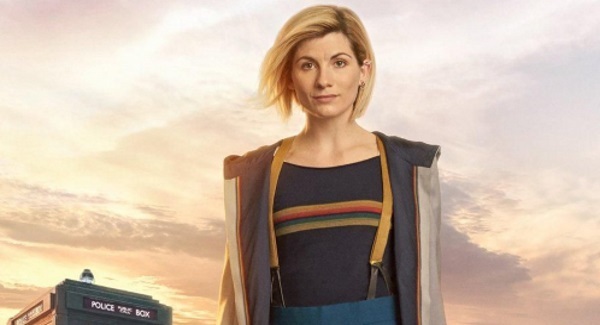
Dr Who returns this weekend with Jodie Whittaker as the first female Doctor. welcomes a new heroine to the longest-running science fiction show in the world
I first met the Doctor when he was, to quote author Neil Gaiman, “a tall madman with a bag of jelly babies and a ridiculous scarf”. Now, as the world’s longest-running sci-fi serial turns 55, a new generation meets the Doctor when she is a young woman with a Northern-English accent and a glorious smile.
We couldn’t get the BBC in my house, but in the late 1970s, Doctor Who Weekly featured a comic-strip based on the adventures of Tom Baker’s Doctor. He travelled through time and space in the Tardis (“Time and Relative Dimensions in Space”), a ship bigger on the inside, and stuck disguised as a 1950s police telephone box. Eccentric and non-violent, the Doctor, with his companions — usually attractive young women — fought alien monsters, and always saved the day.
You couldn’t hear Tom’s deep, fruity tones in comics, but you might glimpse his Harpo hair, his flashing eyes, his crazed, beaming smile. I was hooked.
In those days before the internet and DVDs, I went to Fermoy Library and read Doctor Who novelisations. In those past adventures, the Doctor was described variously as a cranky old man with long white hair, a Beatle-fringed vagabond, and an imposing patriarch with bouffant hair. Baker was the Doctor, but there had been three Doctors before him.
In time I learned the show’s mythology. Real name unknown, though probably not ‘Doctor Who’, the Doctor is an alien, hundreds of years old, with two hearts; a renegade Time Lord from the planet Gallifrey. When dying, he can regenerate into a new form, played by another actor. Occasionally he can meet earlier Doctors.
Doctor Who began at teatime on November 23, 1963, the day after JFK’s assassination. William Hartnell — looking older than his 56 years — played a sinister old man living in a junkyard. His granddaughter, Susan, attended the local school, where her teachers, Ian and Barbara, became suspicious at Susan’s anachronistic knowledge. Following Susan home one foggy London night, they stumbled into an adventure in the Stone Age.
A month later, the show’s second serial would make Doctor Who a sensation. The show’s principal creator, Sydney Newman, had decreed Doctor Who would not feature “bug-eyed monsters”. Ignoring him, producer Verity Lambert, a trailblazing young woman in the old boys’ BBC, approved a story featuring genocidal aliens in pepper-pot mini-tanks.
Lambert’s gamble paid off. Doctor Who cracked the winning formula which would send generations of children scurrying behind sofas.
The Doctor would accumulate other foes, like the emotionless Cybermen, and the Doctor’s fellow Time Lord and psychopathic Moriarty, the Master (recently regenerated to female form as Missy), but no villain would define Doctor Who so much as the Daleks. The show became a phenomenon, inspiring two spin-off movies starring Peter Cushing, but by 1966 it had a problem.
After three gruelling years as the Doctor, the cantankerous Hartnell was suffering from arteriosclerosis and couldn’t remember his lines. Rather than recast a lookalike, the producers decided the Doctor should change completely. They couldn’t know, but they were granting Doctor Who effective immortality.
For three years, Patrick Troughton’s impish “cosmic hobo” had a lighter, comical touch. Jon Pertwee, succeeding Troughton, played a Bond-like dandy. Tom Baker’s crazed bohemian, from 1974 to 1981, became, for many, the definitive Doctor.
The Doctor is balanced by his companions, and never so perfectly as by Elisabeth Sladen’s Sarah-Jane Smith (1973-1976). A feminist journalist, Sarah-Jane was the antidote to Pertwee’s pomposity and Baker’s lunatic whimsy.
Leaving the role, a tipsy Baker joked that his eventual replacement might be a woman. (A year later, in Yorkshire, a girl named Jodie Whittaker was born.) Peter Davison’s earnest, cricket-loving Doctor lasted three years. Audiences dwindling, Colin Baker’s bombastic Doctor never had a chance, and he was fired. Sylvester McCoy’s crafty conniver followed, but airing opposite Coronation Street, the end was nigh. Doctor Who was effectively cancelled in 1989.
In 1996, Paul McGann’s young, romantic Doctor starred in a US co-production, but that attempted reboot failed.
The Doctor stayed alive in memory, in novels, in audio-plays, until 2005, when the programme was revived under showrunner Russell T Davies.
Christopher Eccleston’s Doctor was fantastic, his showman’s bravado hiding a terrible grief. A year later, David Tennant — who had dreamed as a child of playing the Doctor — redefined the role for a new generation: Energetic, charismatic, and funny. Doctor Who was now a global brand. In 2010, under new showrunner Steven Moffat, Matt Smith became the youngest Doctor, clumsy, ancient, and child-like.
Smith starred for the show’s 50th anniversary, with a returning Tennant joined by John Hurt, playing a forgotten, secret Doctor.
Since 2013, Peter Capaldi’s ferociously Scottish 12th Doctor has been acidic and brilliant, but viewership fell. Some thought Moffat’s stories too complicated, too self-referential. Moffat and Capaldi are gone now, and Broadchurch’s Chris Chibnall takes over as showrunner.
Doctor Who faces its most important regeneration since Patrick Troughton sat up in the 1966 Tardis.
Jodie Whittaker, a fine actor, is the 13th Doctor. Some fans are outraged, of course, but for a show defined by change, it’s about time that girls too can dream of becoming the Doctor. Tom Baker, 84 now, says if Whittaker plays the Doctor as a benevolent alien, “she’ll be marvellous”.
A decade after first meeting the Doctor, I visited a comic shop in a gloomy London warehouse, up dirty, wooden stairs. It was closed. That didn’t matter. Outside was the Tardis.
A police box, blue paintwork bubbling and shabby. I tapped the opaque window glass, and reached up to trace the letters on the sign. “POLICE (PUBLIC CALL) BOX.” I tried the doors (they were locked). I went on my way, to my adult life, smiling.
Sadly, not all Doctor Who stories have happy endings. William Hartnell was born in London in 1908 to single mother Lucy, never knowing his father. He made a career playing hard men, starring in Carry On Sergeant (1958). Fired from Doctor Who, he appeared in the 1966 pantomime Puss in Boots. Interviewed in his dressing room, a frail Hartnell was asked “Why do you think children like you? You’re rather a grumpy sort of person.”
Applying his make-up, Hartnell bristled. “Children see me as a cross between the Wizard of Oz and Father Christmas.” The interviewer asked if Hartnell saw his future in pantomime. “Oh no, I’m legitimate. I’m a legitimate character actor. I’m legitimate.”
Very ill, Hartnell returned for pre-recorded scenes in 1973’s The Three Doctors. He died two years later, aged 67.
We last saw the Doctor at Christmas, when Capaldi, worlds-weary and hearts-broken, gave one final Tardis-storming speech, setting out for his replacement a statement of intent. (Amazingly, no one called it Whosplaining.) “Never be cruel, never be cowardly!” Dying in a storm of golden light, he channelled Bertrand Russell. “Remember, hate is always foolish, and love is always wise. Always try to be nice, but never fail to be kind.”
Suddenly, standing in the Doctor’s tattered clothes, was a young, blonde woman. Seeing her own reflection in the Tardis console, she smiled with pure delight.
“Oh brilliant!” grinned the Doctor, just as her Tardis exploded and she was sent plummeting through the night sky towards the city far below.
To be continued…















