A walk down memory lane
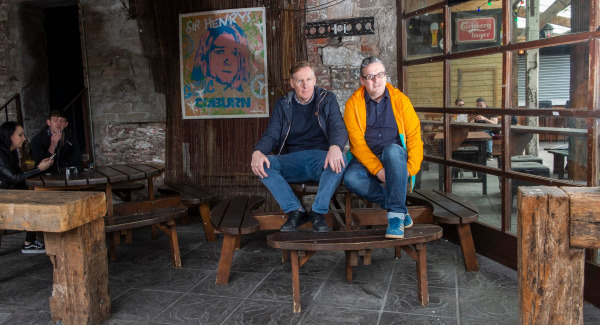
The Young Offenders introduced The Frank & Walters to a whole new audience, so much so that next weekend they headline Cork’s Right Here Right Now festival. From Sir Henry’s to their old rehearsing venues, the band marks the event by taking on a walking tour of the city that made them
On a stroll through Cork with the Frank and Walters, there’s a surprise around every corner, a memory down each and every lane. In a yard off South Main Street, Paul Linehan and Ashley Keating, the group’s surviving original members, spy an abandoned shopping trolly and can’t help themselves.
“Now you have your ‘off their trollies’ headline,” whoops Paul, pretending to climb in and have Ashley push him around. Later, in the English Market, a well-wisher poses for pictures and foists complementary strawberries upon the duo.
There’s another polite scrum for selfies around the corner, at their old rehearsal space at the city’s Unitarian Church, where Linehan and Keating are swamped in man-hugs from the minister and his crew, naturally all huge fans.
The gregariousness, the wry humour, the surreal parade of characters – all will be familiar to fans of The Frank and Walters’ singular alternative pop. Cork has always been an inspiration and, observing the city through their eyes, the depth of that connection becomes clear.
A case might be made the Franks, who play with orchestral accompaniment at Cork’s Right Here Right Now festival in June, are Leeside’s unofficial laureates. Nobody, it could be argued, has better captured the Cork spirit than the Franks, with songs such as Happy Busman – a celebratory valentine to a bus driver always with a smile– and Michael, inspired by an old Cork character who, as per the lyrics, would whizz around town cheerfully honking at passers by.
The Franks never quite fell out of fashion and have always had a diehard following, both at home and overseas (fans in London and on the Continent are especially loyal). However when their biggest hit, After All, featured in key scene at the end of RTÉ/BBC comedy Young Offenders recently, the impact was unmistakable.
“The kids who maybe didn’t know about us suddenly knew about it,” explains Linehan, to a well-wisher at the English Market, who tells them that students around Cork have been singing ‘After All’ on their school tours overseas.
Paul and Ashley have noticed a similar uplift in their fortunes. In Germany for a show recently, they were surprised to hear church bells ring out the opening notes of the song.
Today’s itinerary includes the site once occupied by Sir Henrys, the nightclub and venue where the Franks played many of their earliest shows. The building was demolished in 2003 and is now a paved-over outdoor storage area. We access via a beer garden, pausing at a mural celebrating Kurt Cobain of Nirvana, who played Sir Henry’s in 1991.
The Franks themselves staged a memorable gig here in October 1992. They had become music press darlings in the UK and Henry’s was their home-coming. A few months later, ‘After All’ was in the British charts and they were on Top of the Pops.
“The first time we played Henry’s would have been a charity show in 1990,” says Ashley. “It was part of a 10 band bill. We were on pretty early. The first time we played a packed Henry’s was in in January ’91, supporting Senseless Things. That was a huge show for us. We played really well and had just done a (Dave) Fanning session, so people knew some songs. From that gig onward we started to have a following, which was a huge shock. I remember flying over to do Top of the Pops,” says Linehan.
“These were back in the days when you could still smoke on planes. I’d requested non-smoking. But there was smoke all around me. I asked what was happening and it turned out my seat was at the very end of the non-smoking zone.”
We also call on their old rehearsal space at what was then a Christian Brothers School along Sullivan’s Quay. Today the courtyard where they would take a break to play soccer is a beer garden and the practice rooms are occupied by Cork Institute of Technology.
“It’s like being in Spain,” says Paul, taking in the acres of outdoor seating and the vast flat screen television. Rehearsing at Sullivan’s Quay CBS was a milestone for the Franks, who grew up in suburban Bishopstown. They practiced alongside other Cork bands (including the Sultans of Ping) and for the first time had a sense of being part of something bigger.
“We had been playing music for a few years but had nowhere to practice so the whole thing had sort of fizzled out,” Keating remembered in a piece he wrote several years ago. “We asked could we go up and have a look and on the third floor we found local punk legends the Suburban Rebels flaking through a song at 100 miles an hour.
“Morty McCarthy, later of the Sultans of Ping, was their drummer and Paul had been in a band with him a few years earlier – the 3355409s. After discussing the latest music happenings in Cork – a conversation of about 20 seconds – Morty suggested we ask the Brother [Cusack] for a room to practice in. We worked up the courage and to our amazement the Brother said yes. We were suddenly a band!”
Another important stop off is the Long Valley, a historic Cork pub and a place where they forged some of their earliest music industry connections. Colm O’Callaghan, a noted scenester in the early Nineties, would drink there and it was through him that they got in contact with Keith Cullen of London-based label Setanta. He in turn encouraged them to move to the UK and take a tilt at the music scene there.

Keating and Linehan are classic opposites. Linehan, who writes all the band’s songs, is softly spoken, if not quite shy, and is generally happy to let Keating do the talking. His drummer bandmate is more stereotypically rock ’n roll, arriving for the photoshoot in a bright orange windbreaker and generally living up to the cliche of the indie-pop elder statesmen.
Outside of Cork, the Franks have been caricatured as ‘quirky’. That’s an unfair simplification, glossing over the melancholy has always run through their work. Yet it is undeniable that they are in the tradition of outré Cork bands that includes contemporaries The Sultans and goes back to the Seventies and Eighties and group such as Nun Attax and 5 Go Down to the Sea.
Ironically, however, much of their early success was in the UK, where they were based through the early Nineties and were championed by the local music press. Yet Linehan, in particular, never warmed to London. Suffering something of a creative crisis after the impact of their first album, 1992’s Trains Boats and Planes ( a success they never saw coming) he brought the Franks home, hoping to find himself again as a songwriter.
This led to the Unitarian Church, where they rehearsed and recorded solidly through the darkest days that preceded their second LP, Grand Parade. Released in June 1997, the record is regarded as a classic and is arguably their masterpiece. Alas, by that time Britpop had taken over and, in Britain at any rate, the Franks were yesterday’s news.
The church wasn’t on our original itinerary – but a visit to a cake stall in the English Market triggered a rush of memories. “Every day we’d come down and have cake for our lunch,” says Keating. “I’d have a Russian Log . Dave Couse [of A-House] was producing and he couldn’t believe it. ‘You’re having cake for your lunch – every day?’” This sets them to reminiscing and it’s suggested we swing past the Unitarian Church. We tap on the door and invite ourselves in. Some sort of event appears to be ongoing – lots of people are sitting at tables, going through paperwork. Nonetheless, the band are made instantly welcome, with the minister appearing from down a flight of stairs and explaining that he’s a huge fan.

Pictures are snapped and, a little overcome, Linehan explains how he was inspired to record one of Grand Parade’s best songs, ‘Little Dolls’, when a rush of feeling seized him at his home in Bishopstown.
“I came in here on my own and recorded it,” he says. “I had to get it out. I thought I was losing my mind.” Such moments of pathos are woven into the Frank’s music and belies their reputation as pop’s shiny happy people. But their more carefree side is also revealed as we amble through the city. In the quiet area of Crosse’s Green, in the shadow of the old Beamish Brewery, they recall summer evenings drinking outdoors – “bushing” in local parlance – and its influence on their writing.
“When we were in our twenties we would come down, “ says Paul, taking in the view. “I didn’t even drink but I would still come along.” “There were about eight of us who used to hang around,” chimes Ashley. “None of us smoked. Back then, you could still smoke in pubs. Just being out in the fresh air was great. A lot of the early songs would have been inspired by people we met here.” “We had a track called Laurence Olivier,” adds Paul. “It was about a guy who would turn up and have a different personality on each night. Sometimes he’d come as Marlon Brando, other times has Robert de Niro – we wrote a song about the fact that that he had to be someone other than himself.” There’s a pause in the conversation and, as if on cue, a man rambles past sipping a can of lager. Linehan smiles and then points to a nearby tree. “There was another song, Mrs Xavier [from Grand Parade] – it was about this woman who turned up from over there.
“She was drinking and crying. She’d lost her husband and was telling us about our kids. I didn’t think about writing a song about her there and then. It emerged afterwards when I was at home with my guitar. She came back to me at that moment.”
CONNECT WITH US TODAY



Be the first to know the latest news and updates

















