Too close for comfort? Debate on bed sharing with baby continues
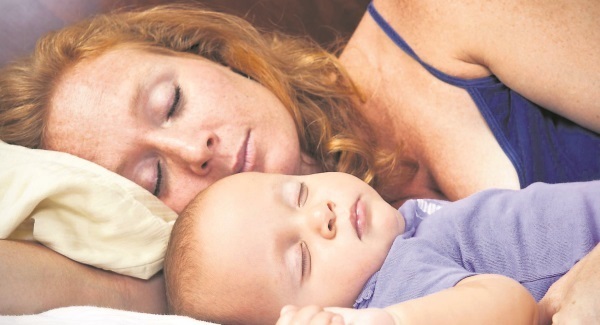
Just because Kourtney Kardashian does it, doesn’t mean you should too. Attachment parenting, and bed sharing in particular has its critics, writes
DO you want to keep up with the Kardashians? If so, you’ll have to practise attachment parenting.
Kourtney Kardashian, a mum of three, is the latest celebrity recruit to this parenting style which involves keeping your child physically close at all times.
This means breastfeeding on demand, substituting the buggy for a sling, and sharing the same bed as the child at night time.
Devotees of attachment parenting believe bed sharing is beneficial for babies. So does Dr Nils Bergman from the University of Cape Town in South Africa.

His research claims bed-sharing babies sleep better and establish a stronger emotional bond with their parents. He believes their brains develop more optimally, leading to fewer behavioural problems in later life.
Consequently, he believes babies should sleep on their mothers’ chests for the first few weeks of life and share their beds until age three.
What’s confusing for parents is that this is at odds with guidelines relating to sudden infant death syndrome (commonly known as cot death).
Parents are advised not to bed-share if babies are less than three months old, were born prematurely, or were born weighing less than 5.5lbs. They are also told not to bed-share if they smoke or on occasions when they consume alcohol or drugs. All of this is to minimise the risk of the child being smothered in their bed.
My son Milo is 13 months old. Shortly after he was born, midwives showed me how to place him to sleep in his cot. The public health nurse reiterated this on her home visits, insisting that he never sleep in my bed.
My partner was even more adamant. A big man who tosses and turns a lot in his sleep, he was terrified of what he might do to a small baby. He made me promise not to have our son in our bed.
I didn’t need much convincing. Approximately 30 babies die from SIDS in Ireland every year. I wasn’t going to do anything that might increase the risk of such a tragedy befalling our family.
Now Bergman’s claims have made me reassess my thinking. Babies love physical closeness. I’ve seen Milo wince when I’ve removed him from the warmth of my arms to put him in his cot. Would it have been better for him to stay with me?
A study from the seems to think so. It says children who share beds with their parents receive higher evaluations for their behaviour from their teachers and are under-represented among psychiatric populations.
But researchers from the London School of Hygiene and Tropical Medicine came to a different conclusion. In 2013, they analysed data from studies involving 1,472 cases of SIDS and 4,679 controls and found that 81% of SIDS deaths in infants under three months could have been prevented by not sharing a bed with their parents.

With such conflicting advice, what should parents do? Sleep consultant Lucy Wolfe thinks that’s for parents to decide.
“You have to make an informed decision about what feels right for your family,” she says.
“Skin-to-skin contact is important. So is being available and responsive to your baby but parents shouldn’t come under pressure one way or the other regarding how they choose to sleep.”
Up to 80% of Wolfe’s clients share a bed with their babies. “For many, it’s the only way they can get any sleep at all,” she says.
Wolfe shared her bed with her four children, now aged 15, 13, 10, and seven. “It was a nice close environment for us and it made breastfeeding a lot easier.”
However, she urges parents to be careful. “Bed sharing increases the risk of SIDS, which is why I say parents need to make an informed decision. Your bed is not made with a baby in mind so you have to make it safe for them. Mind any gaps between the bed and the wall. Watch out for loose bedding and always make sure the baby is lying on a flat surface and not on a pillow.”
Eugene Dempsey, a professor of paediatrics at UCC and a principal investigator at the Infant Centre at UCC and a consultant neonatologist at CUMH, has a firm view on the issue.
“All of the international advice dissuades parents from sharing a bed — full stop,” he says. “It’s an identifiable risk factor for SIDS and it’s the most preventable one. It’s not something I would ever, ever advise. The current advice is not to have a baby in your bed for the first three months but I’d go so far as to say not to do it for the first six.”
Prof Dempsey realises it’s not always easy to maintain this hard line in the middle of the night when you’ve got a crying baby. “I live in the real world, I know people do it, especially breastfeeding mums, but if you do, you have to remain awake and once the baby is asleep, place the baby back in the cot beside your bed.”
He believes the risk is just not worth it. “You could roll over the child. They could be smothered by the duvet.”

There will always be conflicting advice and parents will choose the option that works for them. What’s important is that they do so in an informed and safe way. “Whatever you do, make a conscious choice and prioritise safety,” says Wolfe. “Sharing a bed is nice and close but so is a Moses basket or a co-sleeper at the side of the bed. These co-sleepers are cots that are open on one side and attached to your bed. They are just one of the many ways of staying attached and available.”
Safe sleeping guidelines
Sudden infant death syndrome (cot death) is the unexpected death of a baby in its sleep. It can happen anywhere the child is sleeping, not just in a cot, but there are steps you can take to reduce the risk of it happening.
- Always place your baby to sleep on their back.
- Create a smoke-free zone. Don’t let anyone smoke in your home, car or around your baby.
- Bed-sharing can be dangerous, especially if parents are smokers, if they have been drinking or taking drugs, if the baby is premature or if it’s less than three months old.
- Babies should sleep in a cot/co-sleeper/Moses basket in your room for the first six months.
- Baby’s feet should be to the foot of the cot so they can’t wriggle down under the covers.
- Tuck covers in loosely but securely and no higher than your baby’s shoulders.
- Make sure baby’s head and face are uncovered while they sleep.
- Keep the cot free of soft objects such as pillows, duvets, bumpers, toys or other items that could suffocate or smother a baby. All that’s needed is a sleeping bag or blanket to keep warm.
- Make sure baby’s cot is in good condition and properly assembled. The mattress should be clean, firm, and flat, with no tears and it should fit the cot correctly, leaving no gaps.
- Don’t let baby get too hot. The room should be heated to between 16C and 20Cand as long as it’s adequately heated, there is no need for lots of blankets or heavy clothes.
- Remember that it is normal for baby’s hands and feet to feel cold.

CONNECT WITH US TODAY



Be the first to know the latest news and updates

















