Mater Private: Understanding blood flow is at the heart of the matter
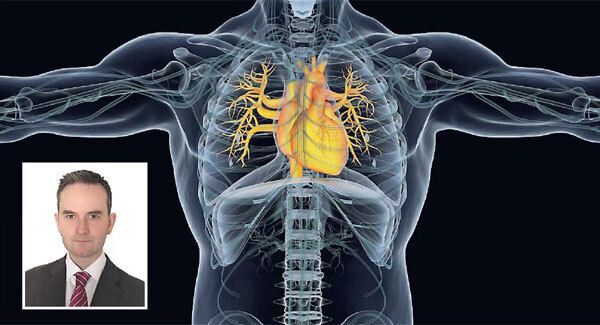
He has worked in several hospitals in Ireland mastering the art of interventional cardiology and is returning home, after four years in Scotland where he researched and performed many of the latest pioneering advances in the treatment of heart disease.
He describes how his speciality developed through the endeavours of pioneering doctors and physiologists: Heart disease is the most common cause of premature death in Ireland.

However interventional cardiology has advanced our knowledge and ability to manage heart disease to such a level that many lives are saved and the need for surgery often prevented.
Today specialist heart doctors called cardiac interventionists practice techniques that have developed over recent years.
A commonplace technique is to make a very small incision in the wrist of an awake patient and pass a long thin tube (catheter) through the body via blood vessels to the heart and inject a special solution called contrast, which makes the hearts arteries opaque or visible to x-ray.
The images taken by this technique make it possible to see and treat the narrowings or blockages that form in the artery that can potentially lead to angina or heart attack. This technique is called cardiac catheterisation.
There are several people historically that we can directly attribute these advances to.
The first was in 1844 when a French physiologist named Claude Bernard used a catheter made of glass to examine an equine heart. It was Bernard who coined the phrase ‘cardiac catheterisation’.
More than 80 years later in 1929 a young German doctor named Werner Forssmann cut through the tissue of his elbow exposing the artery and passed a catheter normally used for collecting urine from the bladder into his own heart and x-rayed the chambers to prove that this technique was safe to do in humans.
This self–experimentation got Forssmann dismissed from his job. However in 1956 along with two of his colleagues he was awarded the Nobel Prize for medicine for his groundbreaking achievements in cardiac catheterisation.
On October 30, 1958 an American physician named Dr Mason Sones was using Forssmann’s technique to take x-ray images of his young patient’s heart valve when his catheter accidentally slipped into the coronary artery and the contrast was injected.
Although accidental this was the first coronary artery x-ray taken via a catheter.
Sones famously said: “I knew that night that we finally had a tool that would define the anatomic nature of coronary artery disease”.
By 1977, pioneered by Dr Andreas Gruentzig, doctors were able to pass a catheter into a narrowed artery and inflate a tiny balloon compressing the plaque into the artery wall to reopen the narrowed vessel, treating the disease and relieving the symptoms of angina.
This technique was called ‘angioplasty’.
However, in many cases, the narrowing would close down again months later and the symptoms would return. To counteract this, several more advances were made starting with the evolution of the coronary stent.
Dr Julio Palmaz and Dr Richard Schatz developed the first approved stent in 1994. This tiny slotted tube made of stainless steel was inserted into the blockage to keep the newly opened artery from closing again.
Over the next two decades and still today the stent has continuously improved by several methods, including applying a special coating that helps prevent the stent itself from developing plaque.
Millions of patients are treated by these methods spending as little as a few hours to a night in hospital and returning to healthy lives without the fear of heart attack once they modify their lives through smoking cessation, diet changes, exercise and take some necessary medication such as aspirin.













