Facing up to the big questions at the Cork French Film Festival
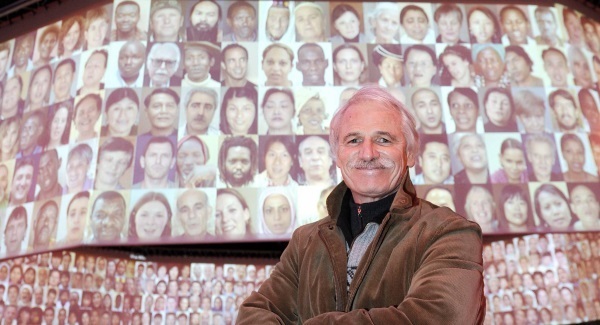
YANN Arthus-Bertrand has spent much of his career taking a bird’s eye view. He founded an aerial photography agency, and his book Earth From Above sold three million copies before finding its filmic expression in Home, in 2009.
But such a perspective, increasingly, does not shrink the human population out of sight, but rather exposes in dramatic ways the impacts of humanity on the planet: the pollution in rivers, the scars of open-cast mining, deforestation, urban sprawl: all these are testament to a species reaching its ecological limits and, in the process, greatly damaging its only home, and destroying the habitat of its fellow creatures.
It raises urgent questions for our time, about what it means to be one of 7 billion-plus human beings. It also throws up the paradox of our age: while so many humans represents a problem for the planet’s wellbeing, the individual human is still a rare light of consciousness in a dark, uncaring universe. A single life is, despite everything, a unique story: a triumph, a tragedy, a comedy.
It is this paradox that lies at the heart of Arthus-Bertrand’s Human, his near-three-hour film based on interviews with 2,000 people all over the world.
As Arthus-Bertrand tells it, Human is literally a coming down to earth for him as a filmmaker. While tells the story of flying over Mali, and being forced to land in a village, and waiting there for three days due to a problem with his helicopter.
“They were what you call subsistence farmers,” he says. “They were not selling anything, they were working only to feed themselves and their family. I stayed for three days with this family and I was amazed about what they told me about their life. We were very close: we feared death, we wanted a good education for our children. They were like me. But, in fact, our ambitions were so different. I was a photographer, going to do cover shoots for National Geographic or Paris Match, and their ambition was only to feed themselves.”
This commonality and difference prompted Arthus-Bertrand to send a team of interviewers around the world, asking the same 40 questions to people in 60 countries. “You can’t understand the planet if you don’t listen to people,” he says. “So, for that, photography was not enough. We need to listen to the heart of the people. Not the brain, but the heart. To understand why we are still fighting like the Middle Ages, why we cannot forgive, why we tolerate poverty, why there is homophobia, why we do not accept the refugees coming. Everything was in question.”
Human is a stark cinematic experience. Face after face greets us, talking directly against a dark background. Interspersed, occasionally, are some of the sweeping aerial shots Arthus-Bertrand is known for. The film was premiered at the United Nations and is available on YouTube, part of Arthuse-Bertrand’s nonprofit motive for the film.
Of course, there are no definitive answers to the questions posed by Arthus-Bertrand’s interviewers, centred as they are on love, loss, and experience. The film, he says, is, instead, like a mirror.
“It’s about us, it’s about what you are like yourself. The people talking are you talking. It’s a chance to understand maybe what is this life, what does it mean to be human — these questions. This movie is not about answers, but it extends your life a bit listening to all these people. It’s an experience if nothing else.”
Arthus-Bertrand’s aerial films give a perspective that makes one think differently of our world — as an interconnected, delicate place. Does Human succeed in making us see ourselves differently? That is for each individual viewer to judge, but the cumulative effect of the film’s succession of faces and stories is to see people more sympathetically than is perhaps habitual. As a species we have always been more accustomed to ranking our concerns for our fellows in concentric circles, of family, friends, countrymen and so on. Human is a timely reminder that we now live in the age of the global village.
The problems and opportunities represented by that are accepted by Arthus-Bertrand. After all, he says, we have no choice.
“We have to accept we are going to be nine billion together. And we have to try to understand how we are going to live together as nine billion. We can’t fight against it.
“The problem is not the nine billion,” he says “The problem is we don’t want to share. I am living in one of the richest country of the world, in paradise. If you live in Mali, Niger, you have a dream to live in such paradise. We have education, democracy, welfare. In many countries you don’t have this. But the problem for our civilisation is that we cannot keep growing like we do now forever. We have arrived at the limit of growth.”
Arthus-Bertrand says everybody knows these facts, but we live in denial.
“We go towards the unknown. No one knows what will happen. Perhaps the future won’t be so catastrophic. The thing is, it’s too late to be pessimistic. We have to ask, what can I do myself? And that is what Human is talking about. What is the meaning of life? Because life has no meaning apart from what you give it. It’s your decision. And that is what this movie is talking about.”
- The Lord Mayor’s Screening of Human is at the Gate Cinema on March 6 as part of the Cork French Film Festival. The event is free but ticketed. Yann Arthuse-Bertrand will give a masterclass at UCC on March 6. Admission free.
- See corkfrenchfilmfestival.com
Cork French Film Festival: Other highlights
The festival opens with Jerome Salle’s acclaimed and spectacular film about the adventures of Jacques Cousteau.
Manal Issa, one of the rising stars of French cinema will be in Cork to her film about a Lebanese immigrant arriving in Paris and trying to make her way in the French capital.
Watch the Catherine Frot comedy, based on the story of Danièle Mazet-Delpeuch, the private chef for François Mitterrand, and follow it with a four-course dinner based on the food in the film.
A classic French silent movie will be accompanied live by Ray Scannell on piano and Kate Ellis on cello. The pair will play a new score by Scannell commissioned by the festival.

This Oscar-nominated animation is somewhat quirky, but still manages to deal with serious subject matter.
CONNECT WITH US TODAY



Be the first to know the latest news and updates









