Why the bones of Guatemala's civil war dead may bring the justice they deserve
ONE afternoon in 1994, during his senior year in college, Fredy Peccerelli sat at an anthropology conference in Atlanta and stared at the man onstage.
Peccerelli had seen the renowned bone detective Clyde Snow before, but only in a textbook. Snow, who was in his 60s, leaned forward at the lectern, speaking in his genial Texas drawl about blindfolded skulls and bodies dumped in clandestine graves. He wore his usual attire of an Irish tweed jacket, cowboy boots, and a fedora.
In his career as a forensic anthropologist, Snow had travelled much of the world. His work had helped to identify the Nazi war criminal Josef Mengele, victims of the serial killer John Wayne Gacy, and members of the Seventh Cavalry Regiment, which fell with George Custer at Little Bighorn.
More recently, he had found a burgeoning movement in Argentina, Chile, and Guatemala, training local teams to exhume victims of Latin America’s “dirty wars”. At the conference, Snow charmed Peccerelli and the rest of the room with tales of his adventures in Kurdistan, on horseback, searching for the missing.
“He glowed,” Peccerelli told me. “He seemed like a character someone had dreamt up.”
Snow’s colleague Karen Ramey Burns also gave a talk that day. It was about a recent exhumation in Guatemala, the country Peccerelli’s own family fled during the civil war 14 years earlier.
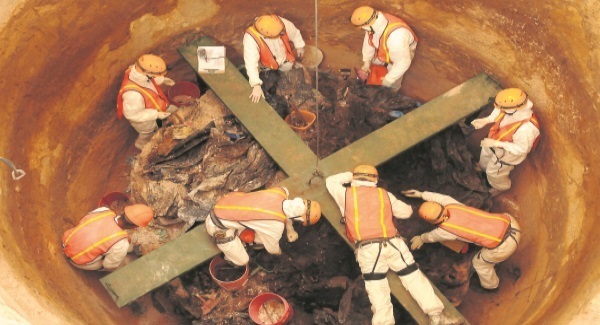
The first slide in Burns’s presentation showed the inside of a grave from a military massacre site. Several forensic anthropologists, all trained by Burns and Snow and none of them much older than Peccerelli, were using paintbrushes and chopsticks to whittle away at dirt embedded in eye sockets, skulls and femurs.
It was, Peccerelli would say later, his “struck-by-lightning moment”. He signed up for a class in Guatemala City the following January. For three weeks, Burns and members of the forensic team taught Peccerelli how bones can reveal signs of murder: the mark of a machete, for example, or the slice along a vertebra that indicates a slashed neck.
At the end, the team offered him a job for $250 a month. Peccerelli flew back to New York and drove his pickup truck from Brooklyn to Guatemala. He planned to stay for one year.
Now, more than two decades later, Peccerelli heads one of the world’s most sophisticated forensic-anthropology labs in one of the hemisphere’s most desperate countries.
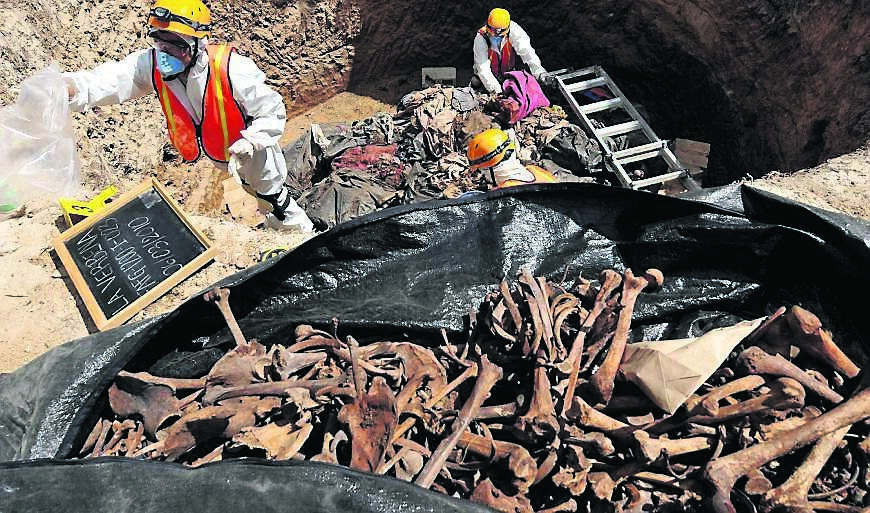
He and his staff have uncovered more than 10,000 bodies — from villages, from wells, from under church tiles, from 80ft-deep bone pits in a cemetery. The team’s goal is to pinpoint causes of death, identify the bodies, and bring the remains back to families who have been searching for their mothers, fathers, sons and daughters for decades.
“We had a chance to give voice to the dead in a way no one else could,” Peccerelli told me.
“It’s not the same when someone says ‘I heard a shot’ or ‘I saw them shoot him’ as when you take a skull and see the entry gunshot wound. If you know how to interpret that evidence, that constitutes truth — truth that can be used in court. And in society: to teach, to give people peace, to return the bodies to families.”
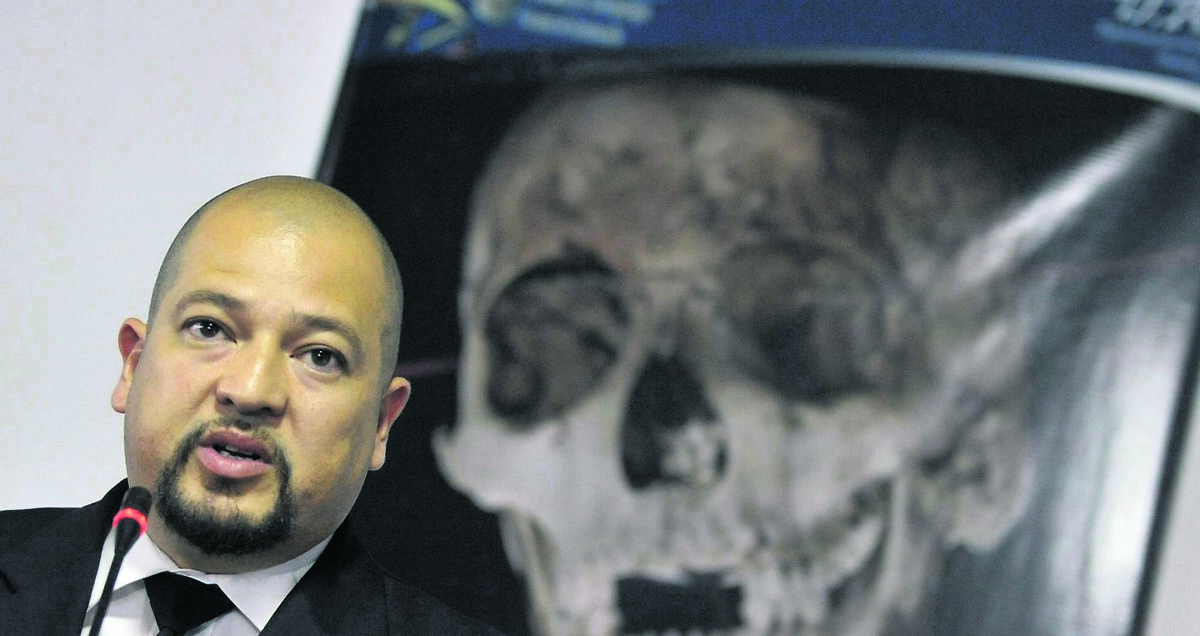
This year, Peccerelli’s work has become the centre of an unprecedented legal case. On June 7, a judge ruled that eight of Guatemala’s top former military leaders will stand trial for massacres, torture and disappearances they ordered or helped orchestrate at a military base in the city of Cobán between 1981 and 1987. (Prosecutors also hope to bring charges against other military officials in the case, including a sitting congressman and eight fugitives, some of whom may be in the United States.)
Unlike most war trials in Guatemala, the accused are not foot soldiers but high-ranking officials — more than have ever been prosecuted at one time. “There has never been anything like this in Guatemala,” says Jo-Marie Burt, professor of political science at George Mason University and a transitional-justice expert.
The bulk of the evidence comes from exhumations Peccerelli and his group, the Guatemalan Forensic Anthropology
Foundation, known as FAFG, undertook at the former military base, where they uncovered 84 graves and 565 bodies.
As Snow often told Peccerelli, bones make excellent witnesses. “Although they speak softly,” Snow said, “they never lie, and they never forget.”
FREDY Peccerelli’s family fled Guatemala in 1980, when Peccerelli was 9, as the civil war between the military and leftist guerrillas raged. Around that time, paramilitary death squads with names like Eye for an Eye and White Hand crisscrossed Guatemala City in unmarked white vans and jeeps, snatching people off street corners, from their workplaces, from their houses in the middle of the night.
Bodies were often left mutilated along the roadside or strung up from trees. The military targeted leftist organizers, Catholic priests and nuns, teachers, university students, trade unionists, and the indigenous Maya — anyone deemed affiliated with the left.
In August of that year, Peccerelli’s father received a death threat by mail. Perhaps the military focused on Fredy Sr, who was president of Guatemala’s Weight Lifting Federation, because he had travelled to the Communist USSR, as a delegate for the Olympics team.
Or maybe it was because six years earlier he was a law student at San Carlos University, which was at the forefront of community organizing and opposition to the military. Fredy Sr wasn’t especially political, but it didn’t take much for the military to threaten or “disappear” people.
Young Fredy immediately moved with his siblings and parents into the house of his great-grandmother. After Fredy Sr flew to New York City to look for an apartment, another letter arrived, this one addressed to his wife, María: “We know Fredy has left,” María remembers reading. “The day he sets foot in Guatemala, he is dead.” By Thanksgiving, the entire family had moved to the Bronx.
Fredy Jr, a round-faced, cautious boy, struggled to speak English. He longed for his grandparents and missed playing marbles in the dirt streets. His parents were no less homesick. The Peccerellis struggled to keep up with the news in Guatemala. The press was censored; phone service was poor, and even when it improved, Guatemalans were cautious about what they said. The military’s orejas, ears, were everywhere.
By the time he was in high school in Brooklyn, Peccerelli barely thought about Guatemala. He’d become a Yankees fanatic, a baseball player, a competitive swimmer.
But then, during his junior year at Brooklyn College, in a cross-cultural-studies course, he read I, Rigoberta Menchú: An Indian Woman in Guatemala. Menchú is a Mayan activist and Nobel Peace Prize winner whose father was murdered while occupying a building in protest of military occupation in 1980; her mother was tortured, raped, and killed.
Like most middle-class children from Guatemala, Peccerelli had known little about the Maya, who tend to live in the remote highlands and have suffered centuries of discrimination. But Menchú’s descriptions of Maya culture and the atrocities they suffered made Peccerelli want to go back to learn more. “I had these naïve dreams about becoming the Mesoamerican Indiana Jones,” he told me in one of our many conversations over the last 18 months.
That naïveté, though, bumped hard against the reality of Guatemala when he returned to begin his career in forensic anthropology. His first exhumation was deep in the tropical Ixcán region. Five men and five women, all in their 20s, travelled 12 hours by truck across rocky dirt roads that chewed up tires, another two hours on foot and about half an hour wading in chest-high water across the Xalbal River.
Then they finally hiked for three hours through the forest to the village of Cuarto Pueblo. Of the group — whose members came from Germany, Brazil, the United States, and Guatemala — Peccerelli was the least experienced.
He had majored in anthropology and taken a class in osteology, as well as the three-week class in forensics. But otherwise he had the training of a Brooklyn Boy Scout. He carried a backpack with 50lb of gear, including his rubber water shoes. He wore new Patagonia khakis and $200 hiking books.
“It was as if George from ‘Seinfeld’ had landed in Cuarto Pueblo,” he told me. “I hit the floor running and fell on my face.”
He was also a source of constant amusement at the local river, where some 15 children would surround him as he bathed, touching his face, poking his arms. “They had never seen anyone that fat,” Peccerelli says.
A Guatemalan legal rights organisation had asked the group to find the dead and interview survivors of a massacre in Cuarto Pueblo on March 14, 1982. It was the same month that Efraín Ríos Montt, an army general, seized power in Guatemala and unleashed what would become the dirty war’s most brutal scorched-earth campaign, in which, for the next year and a half, tens of thousands of civilians were killed.
On the morning of the Cuarto Pueblo murders, about 400 soldiers surrounded the market, the health clinic, the school. It was a Sunday, and the soldiers blocked parishioners from leaving the church, then set the building on fire.
Survivors told Peccerelli that soldiers macheted men and women who tried to flee and captured and gang-raped others. They pointed to a concrete pillar against which the military smashed babies.
Finally, after ordering local men to dig ditches, the soldiers threw in wood and bodies and doused them with gasoline. The entire village — and some 350 bodies — burned for days. That first night, a survivor reported, the air was full of “smoke and the smell of burnt flesh”.
Listening to the families relive these horrors devastated Peccerelli. At night he slept in a tent just a few feet from the pillar and dreamed of pools of blood. He also suffered through dengue fever, malaria, giardia.
Still, he said: “I’d never met people who had managed to survive and still maintain their humanity by welcoming us and trusting us.” He didn’t know how long he’d stay in Guatemala, just that he wanted to understand more about the war and its victims.
At the end of two months, the team took 40 coffee sacks full of teeth and bone fragments back to the Guatemala City lab for forensic analysis. The anthropologists couldn’t determine how many people were killed, let alone their identities.
“We could only prove that it happened,” Peccerelli says. “And that the remains were human.” A year later, they returned the remains to Cuarto Pueblo, where families held a mass funeral, placing 12 coffins of charred bones inside a sky blue concrete tomb.
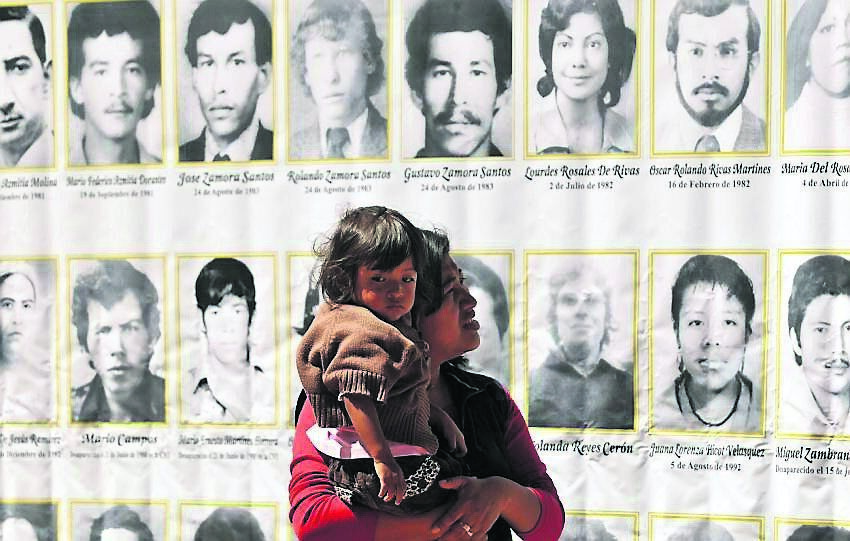
IN THE next few years, Peccerelli and the team got a clearer sense of how many massacres like Cuarto Pueblo had taken place — and how much work lay ahead. A 1999 United Nations-commissioned report estimated that at least 200,000 people were killed or “disappeared”, the vast majority of them Maya.
The military and related paramilitary groups were responsible for 93% of the human rights abuses, including acts of genocide. The report also pointed to the role of the United States: The CIA staged a coup in 1954 to overthrow President Jacobo Árbenz of Guatemala after his land-reform policies ran afoul of the powerful American-owned United Fruit Company.
The United States then installed the first in a long line of military dictators and, on and off for the next four decades, provided regimes with money, weapons, intelligence support, and counterinsurgency training. When the war ended in 1996, the military had committed 626 massacres against the Maya. Cuarto Pueblo was just a microcosm of the slaughter.
The former Cobán military base sits six hours north of Guatemala City, in the highlands region. Today it is known as Creompaz, and the United Nations trains peacekeepers there. At the metal front gate, soldiers stand with rifles on their shoulders. A narrow road leads over a bridge and up a hill to the low-slung, whitewashed main building. From roughly the 1970s through the 1990s, the military ran intelligence operations — and for at least some of that time, prison and torture facilities, prosecutors say — from the complex.
Archaeologists had long been prohibited from excavating on most military bases. The military rejected any talk of exhumations and refused to turn over meaningful documents from the war. Then in 2000, an organisation called Famdegua, dedicated to finding the war’s missing, interviewed two witnesses (now in a witness-protection programme) who saw civilians taken to the Cobán base. Local authorities initially wouldn’t approve the group’s request to find the bodies, but more than a decade later, in 2012, a judge granted a search warrant, and exhumations began.
By then, Peccerelli had gone from stumbling through his first exhumation to, five years later, heading a 44-person organisation. His fluency in English meant Peccerelli could interact easily with American forensics experts and international funders. But also, like Snow, who became Peccerelli’s close friend and mentor and often flew to Guatemala to advise and work with the team, he combined ambitious ideas with an outsider’s fearlessness.
For years, the team had focused on “closed context” cases, massacres that took place in villages where witnesses could help identify bodies through dental work, childhood fractures, a distinctive piece of clothing.
But without a DNA lab, identifying most of the 40,000 forcibly disappeared, like those found on military bases, was near impossible. How could the anthropologists link bones disintegrating in the ground for 30 years to Maya families, many of them illiterate, reluctant to trust outsiders and scattered in isolated mountains?
After a decade spent planning a lab, training a staff and verifying results, Peccerelli’s lab produced its first genetic matches in 2010 — two years before the exhumations at Cobán began.
From February 2012, when the archaeologists first arrived at the base, until December 2013, they worked seven days a week, uncovering more brutality than they’d ever seen in one place.
One grave held 64 men and boys, pressed helter-skelter into a still life of death: Skulls face down, broken into pieces; a tangle of pants and legs akimbo, some with thick ropes encircling their ankles.
Just yards away, in another grave, lay 41 women with 22 children under the age of 4. The work was delicate: Skulls can fracture. The earth shifts. Move the dirt too roughly, and it swallows bones into its folds and mixes them with other bodies. An errant stroke can brush away a remnant of a blindfold, a piece of rope, a cranium fragment with a bullet hole, the bullet itself: The criminal evidence needed to prosecute a murder.
The archaeologists boxed every set of remains and drove them to FAFG’s anthropology lab in Guatemala City, where an assistant would drill a small sample from the femur.
That sample would then be sent to FAFG’s white nine-room DNA lab, which is protected by bulletproof doors and two armed guards out front. It could take months before one sample yielded results. A technician ground each bone to a flourlike powder, then added enzymes and other chemicals to extract and isolate strands of DNA.
Next, a machine created thousands of copies of the DNA segments, and a technician ran them through a genetic analyser. Finally, the copies were compared with DNA samples in the lab’s database — there are now 13,000 — each one given by a person searching for someone who was missing.
The rest of the bones remained in the main anthropology lab, in a modest two-storey house in a residential neighbourhood. There, some 2,400 boxes the size of minifridges are stacked three, four, and five tall. They line the entire second floor and parts of the lab. Each one is marked with the location where the bones were discovered — Estrella Polar, Santa Avelina, San Juan Cotzal, Cobán — and an individual case number.
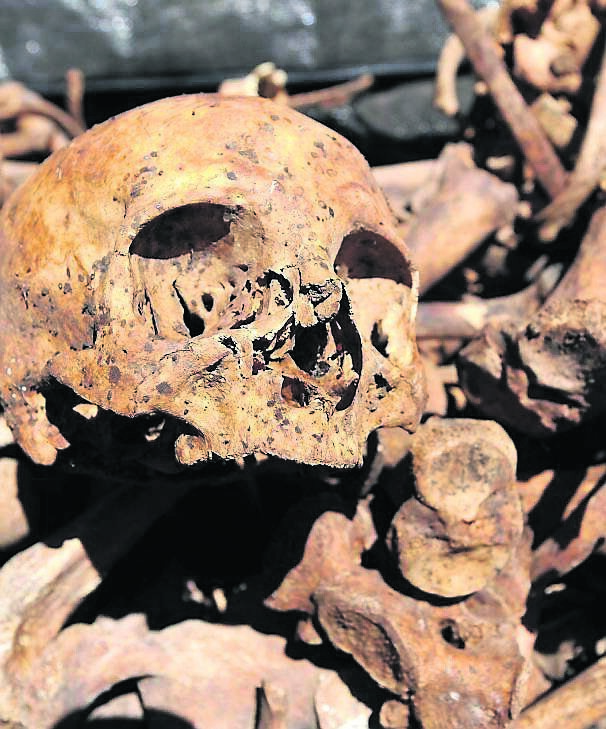
On the day I visited, two assistant anthropologists cleaned bones with toothbrushes and water. Near them, a skull sat on a plastic lunch tray, with an army green blindfold tied around its eye sockets. Another tray held more than 50 fragments of a cranium, shattered like glass.
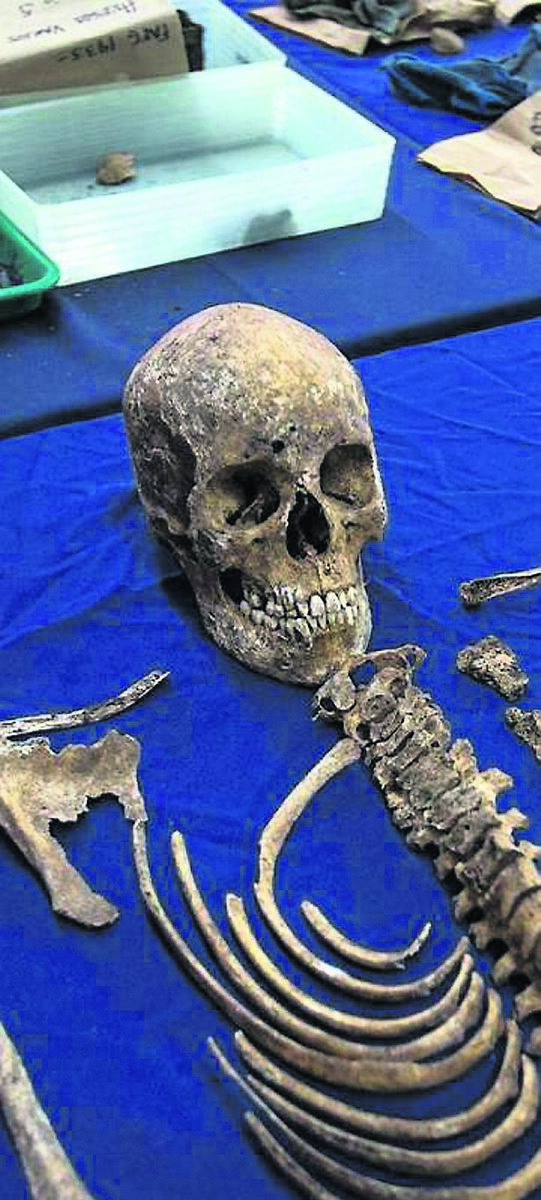
In the back half of the room, dozens of skeletons had been carefully reconstructed, bone by bone, and lay atop 30 plastic folding tables covered in blue cloth. Few of the bodies have all their 206 bones and 32 teeth.
Finger and toe bones disintegrate; bones commingle and decompose on top of one another. The goal, always, is for the anthropologists to uncover a story. How old was the person when he or she died? (One of the pelvic bones doesn’t completely fuse until between ages 20 and 23; clavicles as late as 25. Bones start to show signs of deterioration by the early 30s.)
Was the person male or female? (Men have thicker, heavier skulls; women have wider pelvises.) What was the cause of death: a bullet? (An X-ray may reveal a bullet and possibly entrance wounds.) An axe to the throat? (The cuts may reach back to the vertebrae.) A machete against the skull? (Certain fractures indicate blunt-force trauma.) On one table lay the remains of a victim from Cobán.
He had been discovered in Grave 63 with 25 other men and women — all the bodies blindfolded or with their hands bound. On another table was a teenage boy. Next to him, the reconstructed bones of a young child, or what remained: Parts of a skull about the size of a fist, most of the vertebrae, one leg bone and a smattering of ribs, each no bigger than a twig.
Guatemala City is one of the most dangerous cities in the world, ravaged by drug and gang violence, much of it a direct consequence of the war and its aftermath.
Under the 1996 peace accord that ended the conflict, neither the military nor the guerrillas were held accountable for war crimes. Instead many of the commanders, police officers, detectives and death squads simply traded one type of power for another, becoming ringleaders in money laundering, human smuggling, and extortion along with the drug trade that has devastated Guatemala.
Stop at a red light in Guatemala City and men, doubled up on motorcycles, may wield a gun and demand your mobile phone, your wallet, your life. In some areas, lynchings by vigilantes replace formal policing.
For the cost of a few pounds of coffee, you can buy a hit man’s services — and most likely get away with the murder. About 7% of murders in Guatemala City go unpunished, according to 2012 figures.
For decades, lawyers, judges, journalists, and human rights workers who have tried to uncover Guatemala’s shrouded past have faced intimidation and, not so infrequently, kidnapping, torture, and murder.
The death threats began for Peccerelli and his staff in 2001, when a fellow anthropologist at another organization received a letter listing 11 targets, including Peccerelli and several others at FAFG.
“For 10 years we have known who you are and let you be,” the letter said. “Now it is time to settle accounts.”
A couple of times in the field, locals — presumably military sympathisers or former collaborators — have intimidated FAFG archaeologists, throwing rocks at them and wielding machetes and canisters of gasoline, threatening to burn them alive. In 2006, the Inter-American Court of Human Rights required the Guatemalan government to protect Peccerelli and his colleagues. He has a bulletproof SUV and bodyguards around the clock.
They accompanied his children to school and to friends’ houses until two years ago, when Peccerelli sent his then 17-year-old daughter to college and his 16-year-old son to boarding school in the United States.
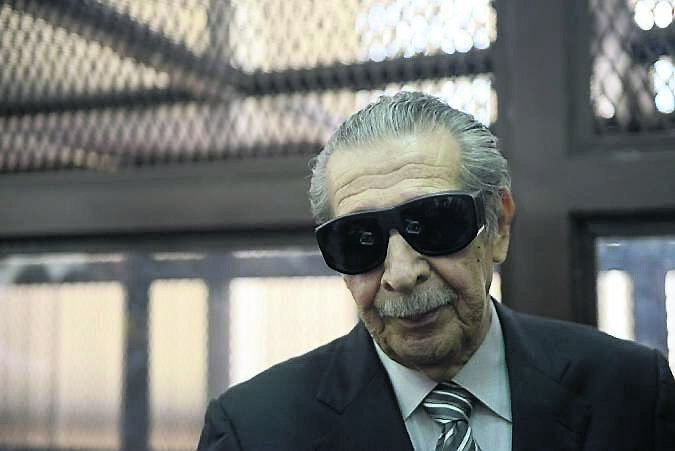
Not surprisingly, intimidation escalates during war trials in Guatemala. When Ríos Montt was prosecuted in 2013 for genocide against the Maya Ixil, the first time a former head of state faced such charges in his own country’s court, Peccerelli and his staff were among the dozens of witnesses and experts to testify.
The conservative elite and former military officers wrote op-eds in newspapers denouncing the trial. Anonymous opponents of the trial also distributed a six-page circular titled “The Faces of Infamy” which featured photos of Peccerelli, attorney general Claudia Paz y Paz, who prosecuted the case, and others, labelling them “traitors”. Though Ríos Montt was found guilty, the verdict was overturned 10 days later in a split decision by the constitutional court. A retrial began this spring.
In February, just weeks after attorney general Thelma Aldana announced arrests in the Cobán case, Peccerelli told me: “I knew it would rain on me. In Guatemala, you find the truth, then you kill the messenger.”
WE WERE on a train riding from New York City to Washington. Peccerelli had come to the United States to talk to supporters about opening an American office, in order to raise money and also connect with Guatemalans here who still have missing family members. With the impending trial, the trip had instead turned into strategy sessions with lawyers and heads of nonprofits about how to best protect FAFG’s staff and the case’s evidence.
In newspapers and on social media, right-wing organisations with ties to former members of the military have denounced Peccerelli as a fake scientist and “the son of a guerrilla”.
One military advocate, whose father was a commander at Cobán and who himself was kidnapped by guerrillas during the war, has filed a lawsuit against Peccerelli and his colleagues, accusing them of obstructing justice, taking bribes, and abusing authority.
Several months ago, someone in the prosecutor’s office leaked FAFG an email warning that former military members were reportedly looking for hit men to kill someone in the prosecutor’s office and at the organisation. Peccerelli has since told his staff to vary their work hours and their routes home and remove any personal information from their mobile phones.
His fiancée, Jessika Osorio (Peccerelli and the mother of his children separated years ago), who is also the head of FAFG’s investigation team, now refuses to leave the house without Peccerelli’s bodyguard.
And even Peccerelli, typically unflappable, seems worn down. “It’s changed me,” he said recently. “I love exhuming; I love telling families we found their loved ones. But the justice part has meant a lot of painful things.”
These tactics are intended not only to intimidate but also to divert time and money from his work. As it is, Peccerelli has been forced to cut his staff in recent years to 63 from 150; funding has dropped to $1.9m this year from a peak of $3.5m in 2013, when USAID was among FAFG’s supporters.
The Netherlands, the biggest FAFG funder, shut its embassy in Guatemala a couple of years ago for budgetary reasons and took its financial backing with it. Although the United States’ state department provides some money, many Guatemala experts believe the United States needs to do more.
“Hundreds of millions of dollars in US aid flowed to Guatemala’s military over decades,” notes Kate Doyle, director of the Guatemalan Documentation Project at the National Security Archive.
“The least the United States could do today is underwrite FAFG’s efforts to repair some of that damage for the victims.”
In the past decade, though, the country has moved, in its slow and halting way, toward judicial progress. The last two attorneys general have aggressively prosecuted war crimes and corruption, aided by a 2006 deal between the United Nations and the Guatemalan government that created the International Commission Against Impunity in Guatemala, funded in part by the United States, to help repair the broken judicial system.
Last spring, tens of thousands of Guatemalans began turning out for protests, demanding the resignation and prosecution of then President Otto Pérez Molina, yet another war commander, for his involvement in a major fraud scheme and to denounce other corrupt government officials. (Pérez Molina stepped down and has been indicted.)
For a country that has long been defined by terror, Doyle says, it’s been “the first steps toward a real Guatemalan Spring”. Nevertheless, Guatemala’s right wing retains fierce power. And some observers worry that because of the stakes in the Cobán case, threats against FAFG will intensify.
Over the years, weary of the intimidation, a handful of lawyers, judges and human rights workers have fled Guatemala. Peccerelli has continued to hang on. “This is a guy who came of age in the U.S. and had every opportunity to do whatever he wanted,” Jo-Marie Burt, the transitional-justice expert, says. “He could have gotten up and left any time.”
I asked Peccerelli recently if he considered returning to the United States. “I contemplate leaving here every day,” he told me. “But I’m not throwing away 21 years of work. Not many people were lucky enough to get on a plane and leave during the war. This is me paying back. I want to be here to tell the story.”
In the early months of the Cobán exhumation in 2012, Delfina Xol traveled by bus for two hours from her village, Campur, in the Alta Verapaz region of the highlands, to Cobán, with her sister-in-law and one of her daughters. Delfina had heard radio ads that aired in the two most prominent indigenous languages of the area, Poqomchi’ and Q’eqchi’, announcing that FAFG was stationed at a nearby Catholic church, taking DNA samples and interviewing anyone with missing family members in the region.
It had been more than two decades since her husband, Roberto, disappeared from the village where he grew up and where he and Delfina fell in love as teenagers. They had four children together, and Delfina was pregnant with their fifth when he vanished. Roberto owned a small shop; he helped build a local school. He was outgoing, an affectionate dad who loved taking his kids to the river and playing soccer with friends.
On July 13, 1988, Roberto Xol awoke at 5am, skipped breakfast and dressed in the clothes his 11-year-old daughter, Filomena, had picked out, as she often did: jeans, a Coca-Cola T-shirt, a pressed button-up shirt.
He was walking toward the bus stop to get supplies for his store when a man wearing sunglasses and driving a white car stopped him in the street. The car, a witness later said, looked like a jeep. Darkened windows, no license plate. The driver motioned to Roberto: Get in.
That afternoon, his younger children ran back and forth to the bus stop waiting for their father to return, while Filomena tended to the store. By nightfall, Delfina feared the worst: She knew what had happened to men in her town. Roberto’s cousin had disappeared, as had at least 40 others in the community.
When he didn’t come home after a couple of days, Delfina gathered her children and travelled by bus to the military base in Cobán. Had he been arrested? Forced into service? A soldier at the entrance gave her no information, just a warning: “Don’t return here again, or you will die here.”
She went to morgues, jails, hospitals. Without his income, the family — once well-off by local standards — soon lost everything. Delfina had to sell the shop, the house and Roberto’s construction tools, one by one. She cut corn and picked coffee beans, but it wasn’t enough. She couldn’t afford the books and uniforms required for her children to attend school. They begged on the street. For weeks at a time, the family lived on tortillas.
Over the years, Delfina hoped that somehow Roberto would return. She never remarried. She dreamed about him often. Perhaps he was living as a refugee in Mexico, like some who escaped Guatemala’s civil war. Or he had amnesia and would recover soon. Rumors had circulated in the Highlands about a large house where the military imprisoned the disappeared.
At the Cobán church, an investigator asked Delfina if Roberto had distinguishing marks that might help identify him — dental work, bone fractures. Next, he took swabs from inside the cheeks of one of Roberto’s daughters and his sister, and sent them off to the DNA lab.
A year later, two FAFG investigators, Freddy Muñoz and Diane Manuela Xiloj Cuin, arrived in Campur with news for the family. The lab, they said, had a potential match. But they would need samples from the other daughters before they could confirm it.
Months went by; the lab had an enormous backlog of cases. Then, one day in July 2014, Muñoz and Xiloj Cuin told the family they were returning to Campur with more information. Filomena walked three hours from her village, which is inaccessible by car and has no mobile phone service, to join her mother and her sisters. As they gathered in the youngest daughter’s living room, Xiloj Cuin explained how the DNA process works. Muñoz then told them FAFG had been able to match the daughters’ DNA to a skeleton found in Grave 45, known as case No. 1433-XLV-1, one of the more than 560 bodies exhumed at Cobán.
Delfina and all her daughters were weeping by then. Roberto hadn’t run off to start a new family. He hadn’t moved to Mexico. Instead, he was kidnapped by the military, possibly tortured. He was murdered and dumped into a hole in the ground on a base just 50km away. And he lay there, alone in the cold earth, for more than 20 years.
Four months later, Peccerelli headed from Guatemala City to Campur for Roberto Xol’s funeral. As dawn broke on the drive into the highlands, the air smelled of dew and wood smoke from open-fire cooking. Mist clung to the mountains.
For several hours, the road wound past one-storey houses of adobe, concrete or wood, many with tin roofs, no plumbing, no electricity. Pickup trucks stuffed with men, women, children shared the narrow dirt roads with women walking to markets and men and young boys descending from the mountains, hunched because of the stacks of wood on their backs, almost as big as their thin bodies.
By the time Peccerelli arrived in Campur, Freddy Muñoz was there, carrying a large cardboard box from his truck. The box was labeled 1433-XLV-1. “They are bringing my grandfather!” a few of Roberto’s 14 grandchildren shouted. “Grandfather is coming!”
A hundred or so people filled the mud yard, and another 75 pushed into Roberto’s second-eldest daughter’s two-room concrete house, no bigger than 400 square feet, which she shares with her three children and Delfina. Smoke and the smell of incense filled the room.
A bucket of water rested below the coffin to call spirits. On the right side of the coffin sat a bowl wrapped in a Mayan textile. On the other side lay a new toothbrush, toothpaste, soap, a comb — things Roberto would need on his journey in the next world.
At the head of the coffin, Delfina and her four daughters huddled together, all of them under 5ft tall, with black hair pulled into buns or ponytails, dressed in skirts and huipiles, or Mayan women’s shirts, embroidered with flowers. One of Roberto’s daughters, Mayra Arely, was 4 when her father disappeared.
She had to drop out of school by age 10; at 14 she married, and until recently, she had a job cleaning houses. Only the baby of the family, Norma, now 27, a mother and a teacher — with whom Delfina was pregnant when her husband disappeared — finished school, because of the generosity of relatives.
As Peccerelli opened the coffin, Muñoz took out a white shirt and black slacks the family bought for Roberto. Then, standing at either end of the coffin, Peccerelli and Muñoz worked quietly and quickly, pulling bones out of lunch-bag-size paper bags to reconstruct his body.
Muñoz slid femurs and pelvic bones into the pants and lay Roberto’s foot bones below, while Peccerelli lined up the vertebrae inside the shirt. Next, he reconstructed Roberto’s rib cage and his arms before placing his hand bones on the outsides of Roberto’s pants pockets.
Peccerelli sweated from the heat beaming off the tin roof and the crush of people around the coffin. His eyes watered from the smoke of the incense. If he put a few rib bones out of order, no one would ever know. But it mattered to him. This was often the moment during funerals when Peccerelli felt emotional, but he swore never to cry in front of families.
After all the exhuming and forensic analysis, there was finally this: a family’s goodbye for someone missing for so long, and a set of bones that had become, once again, human.
Having set all the bones just right, Peccerelli placed the skull against a white satin pillow in the coffin; no sign remained of Roberto’s broad cheekbones. No hint of his charcoal eyes or the handsome face that was said to break women’s hearts. The only things that reminded Delfina of her husband were the two gold crowns on his teeth, the remnants of a long-ago bar fight.
Before Peccerelli closed the coffin, there was one last thing to do. From a plastic bag on a table in front of the coffin, Muñoz pulled out a pair of pants, a Coca-Cola shirt, a striped button-up shirt and a pair of shoes — the clothes Roberto was wearing the day he disappeared, now encrusted with the dirt of more than two decades.
Mayra Arely recognised them immediately: the last outfit her sister chose for their dad, the outfit her sister had described in detail for years. She crouched down in front of the clothes, her face buried in the remnants of her father. “Papa, Papa,” she cried as the room fell quiet, “you’re back, you’re back.” Moments later, Filomena was there, weeping, too. And Delfina, her head bowed, gripping a black shawl around her shoulders.
After a few minutes, Muñoz picked up the clothes and laid them inside the coffin. Then, together, he and Peccerelli closed the lid.
Maggie Jones is a contributing writer for the ‘New York Times’ magazine and a visiting assistant professor at the University of Pittsburgh
CONNECT WITH US TODAY



Be the first to know the latest news and updates

















