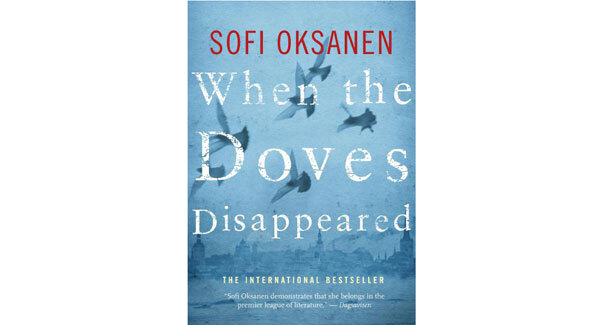
Book review: When The Doves Disappeared
Sofi Oksanen
Translated by Lola M Rogers
Atlantic Books, €16.99; ebook, €10.20
SHE has often been referred to as the ‘Finnish publishing sensation’, but writer Sofi Oksanen is having none of that.
The proud owner of multi-coloured dreadlock hair extensions that shake every time she moves her head, Oksanen may be one of Finland’s most awarded writers (European Book prize, Swedish Academy Nordic prize, French Prix Femima, to name but three), but she knows she doesn’t write just to win the literary world’s equivalent of the Golden Globes.
There is a positive to being heralded as a wonderful writer, says Oksanen in typically technically precise English, in that it helps to establish a loyal readership in different countries.
“And it also helps for the translation of the books.It encourages publishers to have faith in you as a writer, and that it’s worth publishing your next book, as well. So that’s good.”
Of course, with such distinctive features running in parallel with her relative fame in her home country, Oksanen is easily recognised. Thankfully, she is ready for her close-up.
“Let’s put it this way,” she remarks, “when I step out of my door I consider myself at work. I’m at the service of the public! Some people may laugh at that, but there is a certain level of responsibility on my shoulders. Coming to somewhere like Ireland is very relaxing, although Swedish, Estonian and Finnish tourists know who I am!”
Oksanen has been to Ireland several times before, having visited Donegal, Connemara, Kerry, northern Ireland, and more.
“It’s a cosy place,” she says, as the wind howls outside.
“The scenery is amazing, it’s very sociable, and the weather is great, because I don’t like weather that is too hot. And it takes me away from work, which is what I need now and again.”
The implication is that Oksanen is something of a workaholic, but we think she’s so well-known in her homeland that she just likes to take a breather from being recognised so much. That said, she can only blame her skills as a writer.
For starters, she is one of the very few Scandinavian writers that has broken through commercially — so much so that she, and her work, is (erroneously) likened to Sweden’s Stieg Larsson. Crime writing, however, is far removed from Oksanen’s core work of historical fiction.
“I think the crime writing tag is only for the UK market,” she says with a healthy dose of pragmatism.
“There aren’t too many Finnish authors whose work is translated into English, so that‘s one of the reasons — particularly when you have other writers such as Stieg Larsson selling so many books. Perhaps publishers feel it’s a selling point, and is therefore easier to get booksellers to take books for their shelves.”
Do the marketing conceits put in place to shift copies of her books impact on her creativity? Again, Oksanen’s answer is sensibly business-like, another trait, perhaps, of her background.
It’s different, she avers, because only a small percentage of books written in languages other than English are translated — and over the past 10 years, a mere 50 or so Finnish novels have been translated and made their way into the UK/Irish/American marketplace.
This means, she imparts, “that translated books aren’t read by a sizeable audience. Looking at it that way, I understand why publishers and booksellers want to maximise the money end of things.
"Another aspect is that translated literary books are not selling well, so that’s one more factor for their reasons of marketing such books in the way they do. Am I happy with that? Yes, I am.”
Oksanen’s latest book (her fourth novel), When The Doves Disappeared, is yet another success story. When it was first published in Sweden and Finland in 2012, it went straight to number one in those country’s respective book charts.
This month, the same book — now translated by Lola M Rogers — is published in almost 30 countries around the world. Unusually for a work of historical fiction, it
cleverly blends (across two timelines — 1941 and 1963) romance, war, crime, thriller and psychology into a determined effort to get to the truth.
“It’s very difficult to determine what is and what isn’t truth. Truth means different things to different people, doesn’t it? I’ve always been interested in history in general, especially the history of Estonia, and the history of Europe. So the books are a platform to deal with many issues.”
And her work revolves around not wanting to forget the past?
“Yes of course. People have to be aware that eastern European history was written with a Soviet narrative for over 50 years, so in that way such a narrative was the propaganda one, and dominated for a long time.
"Eastern European countries need to write and define their own history. Irish people understand that very well — what would Irish history be, for instance, if it had been written exclusively by the English?”
How does one filter distorted fact from the crystal clear? Access to research, the research itself, and oral history, Oksanen states.
“All of that gives a lot of valid material to an author. Before, it would have been getting information from memory, but that is getting more and more difficult as people grow older and die. Writing historical fiction is all about combining oral memory with good research.”
One of the more gripping elements of When The Doves Disappeared is the human story connecting its three main protagonists — freedom fighter, Roland, collaborator Edgar and his sexually frustrated wife, Juudit. The devising of such characters complement the well-researched history that in itself acts as a narrative glue.
“I knew that I wanted to write about the shift between the German and Soviet occupations,” explains Oksanen.
“Everything happened very fast, and collaborators flourished. Of course, people just wanted to stay alive and so they did certain things that they had no choice over. Some people, I discovered, wrote propaganda for both sides.”
Sexual politics also surges through the book — was it important for her to highlight this as well as the historical nuts and bolts? As Oksanen nods her head, the dreadlocks shake.
“We tend to forget that it wasn’t too long ago when people didn’t divorce. You stuck together no matter how bad a choice of partner you made. That was something I wanted to explore, because it’s more recent past than ancient.
"Also, marriages way back then – and perhaps even now, to a degree — were one way for a woman to survive. Some people, mostly women, managed to survive, despite their background, by marrying the right person.
“In that kind of era such strategies seem fair enough to me; men also had different kinds of survival strategies. Marriages were ways to make your life better, and that even happens now, of course. But that’s for a different conversation!”
CONNECT WITH US TODAY



Be the first to know the latest news and updates









