Vintage View: Tut-tut
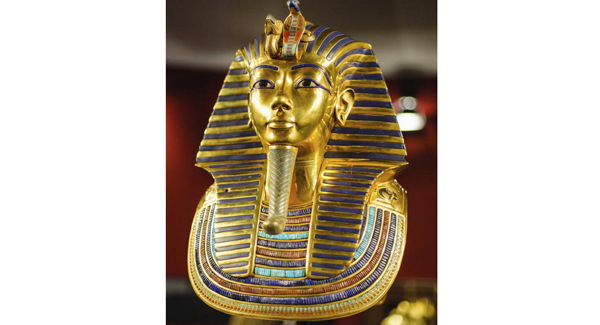
The last of the Thutmosid family line and son of Akhenaton and his sister, (Tut went on to openly wed his own half-sister), Tutankhamun (1341-1323 BC) rose to the throne of Egypt at the age of nine.
He was relatively tall for the time at 5’11, with buck-teeth, a club-foot and scoliosis of the spine significant enough to require a cane. Given the cleft palette found when his stripped remains were fully examined, he presumably talked with a marked lisp.
None of these challenges held him back and he worked tirelessly with his adult advisors as Pharaoh, repairing diplomatic relationships with a number of neighbouring dynasties and assuring his fortunes in the next life by restoring the cult of of the god, Amun.
He died, not as urgent pseudo-scholars have tried to suggest at the hands of a demented sister, but most likely due to the combination of congenital problems, malaria and complications from a broken leg found during scientific exploration through his pickled corpse.
Tutankhamun’s tomb is relatively small for a ruling deity and in cultural and political terms, he’s not exactly the big-man of the Valley of the Kings.
What makes him special is the completeness of the relics shrouded with him as darkness closed around his life, and the popularity of the touring exhibitions surrounding the artefacts in the 1970s.
He was buried in 1323 BC. During the erection of other tombs, stone and sand was heaped onto the site, eventually disguising its position, except for a single descending step.
In 1922, after 15 relatively fruitless years in the Valley of the Kings funded by Lord Carnarvon, Howard Carter had the entrance cleared, discovering a sealed anti-chamber littered with treasures.
He took a respectful three months to excavate and open the burial chamber KV62 and found the boy king himself.
The exhibition at the Museum of Cairo stages the most fabulous of the pharaonic antiquities unearthed by Carter and his team. The story of one night at the museum when a bumbling herd of staff mahandled the death mask is almost beyond belief.
A team was changing a light bulb illuminating the mortuary mask in its bulletproof case. The fabulous 11kg artefact was held to one side during the job. Whether it was insufficiently supported or struck something, the plaited style beard was at least, partially detached.
What should have happened at that point, was the logging of the incident by the upper reaches of the conservation staff.
Specialists from other parts of the world, who do nothing but tenderly handle ancient artefacts in a very particular combination of materials, might have received an e-mail from the museums’ board.
Instead, from the huddle of sweating brows, some trembling hand produced a tube of epoxy-based adhesive. Epoxy glue is ideal for a VEC craft class, but not designed to beautify a deity of Amun.
Tutankhamun’s three and half thousand year old, sacred beard was pressed back into a wonky position, with a few scuffs appearing on the royal chin (the moment was immortalised by a passing tourist snap). I imagine the staff then shuffling off for sweet tea and Jammy Dodgers — collective ‘phew’.
Unfortunately, the blobby glue, not being an archival quality addition to one of the world’s most priceless antiquities, was spotted in amateur photographs. Uncomfortable question were asked.
Well, I became very worried after reading all this. Were all museums so casual about their aged treasures?
What if the 8th century Ardagh Chalice (even its fabulous replica) was knocked from its ebony plinth, bouncing across the Connemara marble floor of the National Museum on Kildare Street, spraying enamel bosses?
Dr. Nessa O’Connor Head Keeper Grade I, at the Irish Antiquities Division of the National Museum, torn from her real work, reassured me completely.
‘We have a huge duty of care to the pieces in the collection, and procedures for the handling of objects. To be honest we avoid handling the major pieces unless absolutely necessary.
“If something did happen, any damage would be immediately assessed by the conservation officer and his staff. The incident would be investigated fully and a risk assessment made to ensure such a thing never happened again.
“When the Museum is operating, the conservation laboratory is equipped to deal with all of our artefacts.”
Back at the Museum of Cairo, the Head of Conservation, Dr Elham Abdelrahman, was steered off to a less exalted position.
She had strenuously denied to the Antiquities Ministry knowing anything about Tut’s beard being ever broken free, but bravely acknowledged the presence of visible glue.
Today, her responsibilities extend to the 19th carriages and stuffed horses at the Carriage Museum.
*














