Vintage view: perfume bottles
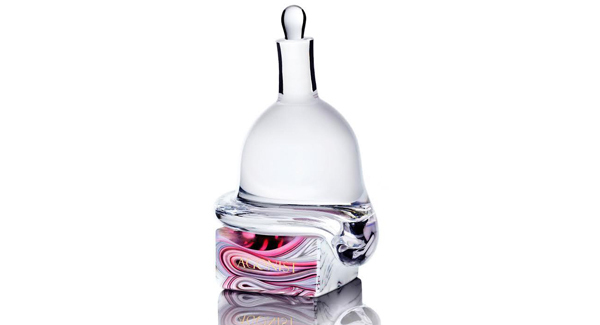
Beyond looks, the most arousing element of a woman’s physical arsenal is her scent. Where the mysterious work of natural pheromones end, the subtle addition of a man-made elixir of love takes over.
Since ancient times, perfume of quality has always been expensive, its ingredients difficult to procure, and the vessel holding it, fashioned to signal the magical, primal power to seduce.
In small quantities and demanding protection from light, craftsmen offered perfume holders in precious materials and breathtaking finishes, fit for the most intimate toilette of a lady.
Holding a silken glass Roman ampulla in our hand, we are as close to the warmly beating heart of a Patrician woman as we can possibly get in the separation of millennia.
Tear-shaped lachrymatories, (small vessels to catch the tears of mourners), in terracotta or glass are common finds in Greek and Roman tombs.
Perfume was made from herbs, spices, oils, and crushed flowers and the oldest known perfume still is in Pyrgos in Cyprus, and is thought to be at least 4,000 years old. By the 14th century, France had already cornered the market, cultivating thousands of acres of flowers to be distilled in oil or alcohol in highly secret recipes.
Considering the stench of even a high-ranking person in the 1300s, the masking influence of perfume, set on the belt or hung around the neck in a solid wax, took on social significance as well as a romantic role. Leather had an eye-watering, greasy smell, and for that reason gloves were often impregnated with heavy perfumes.
In the early 18th century, vinaigrettes, small boxes with a pierced grill to hold a sponge soaked in perfume, saved the tottering sensitivities of gentlefolk crushed in the ballroom or rattling along with whiffy companions by carriage.
Today, still enriched with many of ancient ingredients including ambergris (whale vomit), honey, musk, cedar, lichens, and hyraceum (petrified droppings of the rock badger), perfume is considered an essential sensory signature.
Any bottle designed to hold perfume not severely diluted with alcohol will be reasonably small (allowing the materials to be that much finer), non-porous, reasonably opaque and must be tightly sealed against evaporation.
Victorian bottles would have been brought to the perfume supplier for refilling and were purchased as stand alone, decorative objects or as part of a set. Heavily-cut glass, opal glass, and glass with painted or silver overlays were popular and were matched to a stopper and decorated hinged lid often with a solid or plate silver cap and collar.
Deeply shaded ruby and blue glass gave the perfume added UV protection and sat prettily on a lady’s table. Later, commercial perfume was sold with its bottle as one, and the business of transmitting the body and spirit of the individual scent, became a lasting obsession with generations of designers.
In the late 19th century, the perfume vial and bottle was raised to an art form, providing a gorgeous garden of collectables in the Art Nouveau and, most famously, the Art Deco style. In league with the French perfume houses, René Lalique (1860-1945) produced heavenly confections in glass perfume holders from 1905 into the 1930s.
Utilising the cire perdue (lost wax) techniques, Lalique brought the same attention to detail to his work on modest, pressed glass bottles, as he had on his fabulously expensive jewellery.
Heavy lead-based glass was imagined into nymphs, dragonflies, fauna, and abstract forms, starting with Francois Coty and developing into work for Roger & Gallet, Forvil, Houbigant, Gabilla, Molyneux, d’Orsay, Molinard, and Worth.
(You can find a comprehensive catalogue of Lalique’s magnificent perfume bottles at https://rlalique.com/rene-lalique-perfume-bottles , which includes recent prices realised — always fascinating.)
If you are more interested in later design, rather than antiques, there are affordable, attractive and rare bottles from as late as the 1980s worth looking out for. Even vintage Lalique in, say, a more common scent such as L’air du Temps (Nina Ricci) from the 1950s will often pop up on Ebay for around €150.
Many of the bottles holding contemporary perfumes are directly inspired by the feminine, dreamy forms of early 20th century pieces in glass and they are only one sharp stiletto step from the ephemeral world of high fashion.
Brands to watch for their stunning vessels include Van Cleef & Arpels (known largely as jewellers), Cartier (of course), Chanel, Guerlain, Jean Paul Gautier, Swedish house Agonist (from €880 per liquid crystal bottle filled), Lancôme, Kenzo, Bvlgari, and Zandra Rhodes.
Buy perfect examples, without chips and with as much of its original packaging as possible.
CONNECT WITH US TODAY



Be the first to know the latest news and updates









