Alexander (McQueen) the great
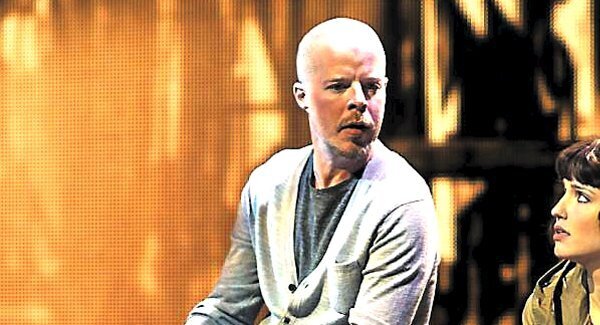
AMES PHILLIPS, the award-winning playwright behind McQueen, The Play, talks of his inspiration. “I saw a way to write the play I think he would have liked, a fairytale show that was very much like one of his shows.” Working with the support of the late designer’s family, he’s scripted a must-see production for any fashion fans heading to London this month. Stylishly directed by theatre and opera veteran John Caird, McQueen celebrates the difficult times the designer survived and the redemption he found in his work.
The play is set during a dark night of the soul for the designer as he struggles for inspiration for Plato’s Atlantis, the last full collection he presided over.
Stephen Wight as McQueen, who ended his life by hanging while intoxicated in 2010, is first seen in his Mayfair home with a belt in his hand. Milliner Philip Treacy, his friend and long-time collaborator, phones to check in. Dianna Agron, of Glee fame, breaks into the house during their conversation and begins trying on his designs. Her character Dahlia is based on a dream woman that inspired McQueen’s The Girl who Lived in a Tree collection (Autumn/Winter 2008). Philips says she can be interpreted variously as McQueen’s subconscious, devotee and alter ego. So begins the playwright’s “dream-vision fairytale” which takes the audience around London and through the designer’s past.

Dahlia demands a dress and the pair are suddenly on Savile Row. The tailoring skills McQueen learned there after dropping out of school at 16 were one of the hallmarks of his work. In a 1996 BBC documentary, former colleagues describe him as a quick and inquisitive student interested in subverting traditional details like the placement of a lapel, an early indication that he was not meant for a career with them. He later observed more avant-garde techniques while working for Japanese designer Koji Tatsuno and learned much about the business side of design during a stint at Romeo Gigli in Milan.
McQueen was famously capable of cutting on the body, working without patterns to create extraordinarily flattering, beautifully-proportioned silhouettes. He sometimes tore garments from sewing machines half-finished, certain he was capable of doing the job faster and better by hand. Even a designer who sends highly-detailed patterns to the finest Italian factory will only get the staff’s interpretation of his vision run up, whereas McQueen’s pieces took form completely organically. Wight, who looks remarkably like the designer he plays, does an impressive job of assembling a dress on Agron’s body from scratch.
Aged 22 and with an unusually comprehensive CV, Lee McQueen won a place on Central St Martin’s prestigious Fashion MA course. Sitting on the floor of his MA fashion show, Vogue contributor Isabella Blow spotted his talent immediately, bought the collection and made him her protégé. Blow was also passionate about the work of Philip Treacy, whose basement workshop in Belgravia became McQueen’s first studio. Treacy’s creations went on to form an indelible part of the McQueen look.
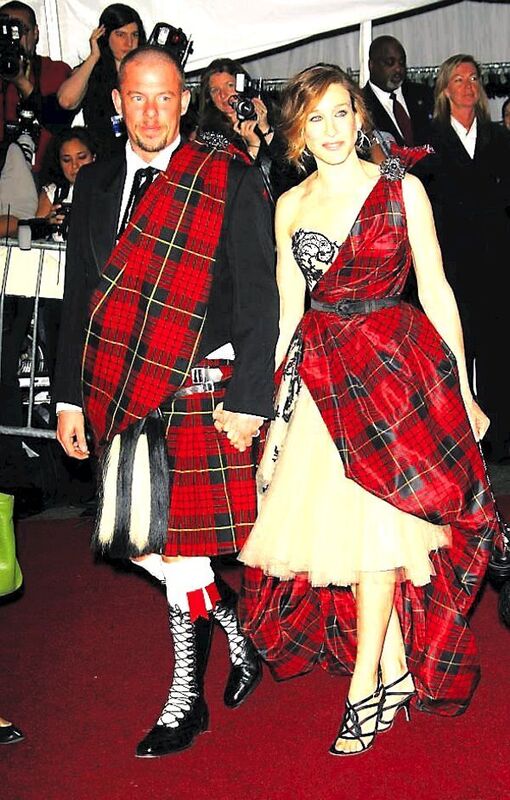
Blow called him Alexander, as in “the Great”, and he used the name when he founded the company in 1992 because he did not wish to lose his unemployment benefit, which still went to Lee. He was arguably the most controversial designer of the ’90s, shocking audiences with his “bumster” trousers (which were actually meant to highlight the base of the spine, the most erogenous part of any body in his opinion).
Kylie bought one of the first pairs and the look soon took off in the slightly more conservative form of low-rider jeans. Highland Rape (Autumn/Winter 1995), widely considered his breakout show, was initially lambasted for its slashed dresses and staggering models. The designer told Time Out that he meant to suggest the rape of a culture, not the women on the catwalk.
In a scene where Dahlia defends McQueen to a journalist (who lobs real-life criticism sparked by his work), her dialogue reminds me of interviews with Katy England, the designer’s right hand from 1994 to 2007. “When people said he was misogynistic we couldn’t believe it,” England told SHOWstudio in March. “He worked surrounded by strong women, his mother and his sisters were always there. We both really admired strong, tough-looking women with great attitude. Perhaps that was a bit frightening to people but it felt very natural to me and to him.” McQueen’s appointment as Creative Director of Givenchy in 1996 also raised lots of eyebrows. How would a self-described “English yob” fare at one of Paris’ most conservative couture houses? It turned out to be a rather unhappy time for the designer. Janie Samut, Le Figaro’s then Fashion Editor, criticised him for making “no attempt to ease his accession to this empire [Givenchy]”. In advance of his first show, she asked whether he respected Hubert de Givenchy’s talent. “What talent?” he replied.
His five-year tenure received mixed reviews. In Maureen Callahan’s Champagne Supernovas, his successor Julien MacDonald relates “the couture collections were amazing. The ready-to-wear — nobody bought the clothes. If you looked at the figures, it was a disaster.” The play does not cover the Parisian part of his life, which reportedly coincided with extreme drug use and alienation from old friends as he began moving in A-list celebrity circles.
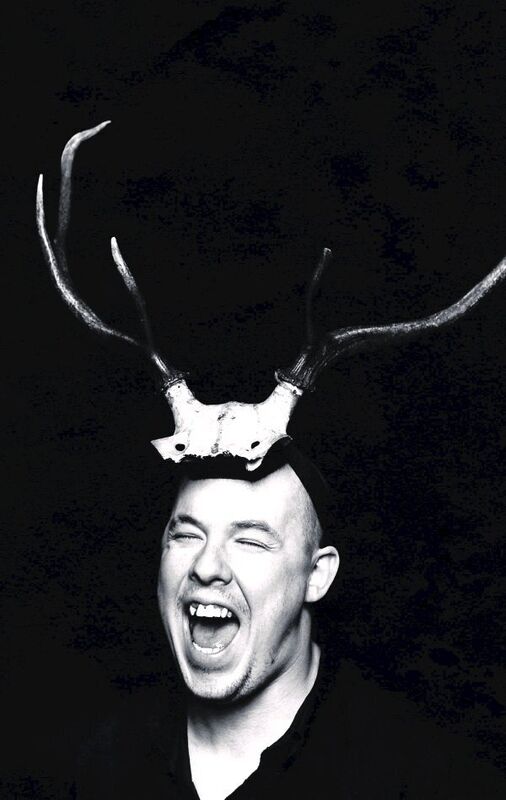
cQUEEN’S iconic No.13 show (Spring/Summer 1999), in which Shalom Harlow has her dress sprayed with paint by robots while rotating on a turnstile, is thought to represent how personally he took the professional criticism.
The play takes a brave stab at emulating the spectacle by having Agron rotate in a similar fashion, her dress assaulted by coloured lights.
Choreography between scenes hints at other well-known McQueen theatrics. Red-headed twins like those in The Outlook, his Shining-inspired show for autumn 1999, trip about on points. A dance marathon is reminiscent of They Shoot Horses, Don’t They? (Autumn/Winter 2003), which involved dancers, models and the audience in a festive celebration of the clothes.
McQueen’s relationship with Isabella Blow, whose ghost visits McQueen in a pivotal scene in the play, soured after he joined Givenchy. She did not benefit financially from the move and reportedly felt abandoned by him. She suffered badly from depression and died by her own hand in 2007. The pair has a blazing row on stage, which corresponds with real-life interviews in which McQueen expressed his love for her but also frustration that her personal strength did not match her public charisma. The scene ends with Blow giving enthusiastic support to his Plato’s Atlantis ideas and an affectionate goodbye.
Phillips weaves quotes from the designer into the play’s dialogue, including his assertion that clothes should be like weapons. Standing on an East-End rooftop, McQueen tells Dahlia of his long-held fascination with birds of prey.
They made him think of the random nature of fate, yielding collections like It’s a Jungle Out There (Autumn/Winter 1997), which was inspired by a Thomson’s gazelle and included horns stitched to beautifully-tailored jackets. When Dahlia grows melancholy and complains of feeling ugly, he gives her a high-collared coat comprised of gold feathers to make her “look like a queen”.
Fashion pundits often relate his armour-like designs to a desire to protect women that stems from witnessing domestic violence as a child.
One of the reported conditions of McQueen’s 2001 partnership with PPR (now Kering) was that his clothes become more saleable. His fashion talent, both with tailoring and the draping he learned at Givenchy, was especially plain when he toned down the theatricality of his shows.
The “Oyster” gown from Irere (Spring/Summer 2003), a millefeuille of grey silk, is a stunning example and a highlight of Savage Beauty, the McQueen retrospective currently running at London’s Victoria & Albert Museum.
Towards the end of their night together, Dahlia attempts an overdose and McQueen forces her to be sick and talks her into a calmer state. Phillips explains that in saving her, the McQueen character saves himself for another night.
“What is fascinating about Alexander McQueen is the things he made, not the one night he lost his battle with the darkness. It is every night he grappled with dark thoughts and turned them into something beautiful.”
McQueen, The Play is at St James Theatre, London, until June 27; Alexander McQueen: Savage Beauty, is at the Victoria and Albert Museum until August 2.
CONNECT WITH US TODAY



Be the first to know the latest news and updates