The Pillowman: David McSavage is finding himself on the stage
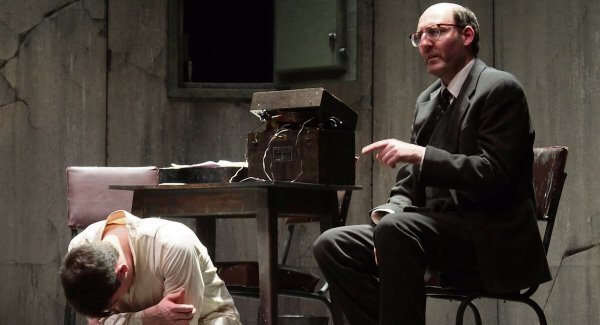
HE play The Pillowman is in rehearsals and its star, David McSavage, is worried that he’s too loud. This concern seems ‘un-McSavage’. This is a comedian, after all, who made his name by standing in Temple Bar every Saturday and poking fun at passers-by, loudly demanding their attention. Nevertheless, as he prepares to make his theatrical debut in the first Irish production of Martin McDonagh’s play, vocal projection is bothering him.
“With TV and film, everything is miked-up and you can talk naturally,” he says. “But how can you talk LIKE THIS without it sounding a bit weird? This ‘projection’ thing — I’m not sure about it all.”
The play’s director, Andrew Flynn, assures his star that he’s doing brilliantly. Nevertheless, McSavage seems nervous about acting onstage and it imbues him with an unlikely vulnerability. This vulnerability doesn’t prevent him from being extremely funny, nor dissuade him from making wonderfully offhand barbs about everything from Enda Walsh’s plays to the Abbey theatre. A vulnerable McSavage is still an assuredly savage McSavage.
Moreover, if the comedian is nervous about his performance, he should take solace that it was McDonagh himself who recommended him for the role.
“The minute Martin suggested it, I could absolutely see it,” says Flynn. “I’d never met David, but I’d seen his work on telly — which I loved — and it made sense. And a weird thing happened. The costume designer would normally sketch costumes with a specific actor in her head, but, this time, she didn’t know who was playing the part. Yet, weirdly, just from her reading of the character, she handed me a drawing one day and it looked like David. It was really, really strange.”
In The Pillowman, McSavage is Tupolski, one of two fascistic Kafkaesque interrogators who intensively grill a young writer, Katurian (Peter Campion), about his short stories and the exorbitant violence within them. The problem is that this violence has bled into reality. A twitchy, self-reflexive work, buoyed by gruesome imagery and constant reversals, the play takes the creative act itself as its core subject. The young McDonagh wrote it in the same prolific period in which he penned the famous Leenane Trilogy, in the mid-1990s.
“The play is intricate and involved, a well-tailored piece of work,” says McSavage. “The guy obviously had some kind of f**king fever when he was writing it. What’s interesting as well is that a writer is being interrogated about his work, and about how good it is. So that’s very funny to me.
“I’ve written sketches that have been banned and the first thing you have to learn about writing sketches, or doing comedy, is ‘don’t explain’. You don’t try to defend what you do. But Katurian is defending.”
McSavage is a natural fit for McDonagh’s world. McDonagh’s Leenane plays staged a deranged photo-negative of the homely, folksy Ireland the nation once clung to as its guiding myth, and McSavage’s own TV work, in The Savage Eye, lances that same boil of ‘Irishness’, bleeding out all the grotesques barely contained by the myth. Sending up the thinly disguised horrors that pass us by every day in Irish life is a way of confronting them, says McSavage.
“Laughter helps,” he says. “Just because these terrible things happen, that doesn’t mean normal people can’t look at it, comment on it, and try to make sense of it, or heal themselves.
“I think that when we can laugh at something, even when it’s really dark, it’s a way of releasing it.”
If The Pillowman explores the relationship between horror and art, it is also about the faith of the artist in their own work. When Campion wanders into the interview, he says that when McDonagh attended rehearsals, he emphasised this faith.
“We discussed belief, what a person believes they are capable of,” says Campion. “That belief is in Katurian. He’s only had one story published, but when the police ask him, ‘Oh, you’ve got so many stories, do you?’ he says, ‘Yes. I do’. It’s not bravado. It’s belief.”
Katurian’s self-belief resonates with McDonagh’s own faith in the exquisite batch of plays he wrote while still in his early 20s. A sense of the steeliness of this belief becomes apparent when — in replying to McSavage’s criticism of the Abbey Theatre for “putting on shite like ‘She Poops to Conquer’,” when it could be staging The Pillowman — Flynn explains that McDonagh would never have allowed the Abbey to produce it in the first place. “Martin will never let a play of his be done at the Abbey,” he says.
“And this is important in understanding Katurian in The Pillowman. Martin McDonagh was one of the most rejected writers.
“The Abbey management of the 1990s told him he wasn’t a playwright, that he should stop writing plays, and Martin now has that framed on his wall in London.”
The Pillowman premiered in London in 2003 and it is somewhat odd that it has taken so long for it to make its Irish premiere. Flynn — having let the rights go once before — was hellbent on producing it here, eventually. His company, Decadent, has emerged as a big player on the national scene in recent years, and so, once the money fell into place, he was on the phone to McDonagh.
The two men go back a long way. The Tipperary native was an assistant at Druid, when the Broadway-sweeping production of the Leenane Trilogy took flight, and with Decadent he has toured McDonagh shows to huge acclaim in recent years.
Clearly, Flynn is a man with no deficit of self-belief himself. All he’s got to do now is convince McSavage to channel his inner loudness. It shouldn’t be too hard.
- The Pillowman runs in Town Hall, Galway, until tomorrow; the Gaiety, Dublin, March 2-14; Everyman, Cork, March 16-21; and Lyric, Belfast, March 24-Apr 19















