Don’t dash the rush
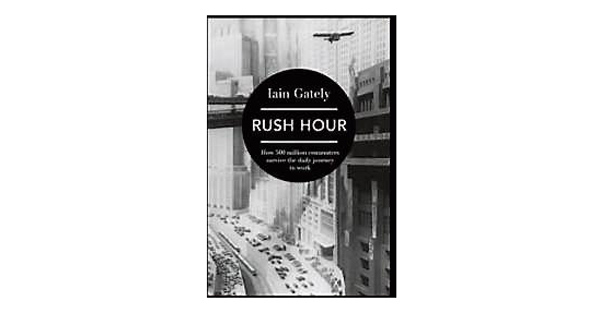
IAIN GATELY’S last books explored the relationships between humans, tobacco and alcohol so when he sets out to scrutinise commuting, it suggests he’s completing a trilogy on the ills of modern society.
But you don’t have to travel further than his latest book’s jacket to discover that Gately, notwithstanding the fact that he used to spend five hours a day getting to and from work, sees commuting as a positive feature of life.
“It has dictated the growth and form of cities; has been a proving ground and marketplace for new technologies; and has given countless people freedom of movement and the opportunity to improve their lives,” the text enthuses.
Countless people who have lost countless hours bleary-eyed in a blur of brake lights or crammed against wet strangers struggling to see the next stop through windows dripping with condensation might find that theory intriguing. By which they’d mean insane. But Gately knows where he’s going with his idea and it makes for an illuminating and entertaining journey.
For a start, he points out, commuting is no modern phenomenon but began, in Britain at least, in the 1830s. The Industrial Revolution had turned the UK’s cities into overcrowded cesspits of dirt, disease and danger so anyone privileged enough to be able to move to the surrounding countryside hitched up their coat-tails and did so.
Initially restricted by the range of horse and carriage, train travel let them venture further afield and the steam trains that rapidly developed in the 1830s to move freight to and from the manufacturing hubs, quickly found they were more in demand for human cargo.
From zero in 1831, the number of passenger journeys in Britain grew to a million in 1840 and to 316 million by 1870. Early commuters risked — and frequently lost — life and limb on board trains that lacked basic safety features, ran on poorly maintained tracks, and endured regular near misses thanks to timetables that relied on village clocks and church bells that ticked and clanged with no synchronicity whatsoever.
Even worse for the etiquette-obsessed Victorians, they risked embarrassing faux pas because they had no idea what rules of social engagement applied in the informal and often undignified setting of a bone-rattling train ride, particularly if seated in uncomfortable proximity to the occasional commoner who had been so bold as to join the journey.
Should such a person try to engage in conversation, it was helpful to be practiced in an array of “abrupt or tart replies” or employ “a species of grunt expressive of dissent or dissatisfaction”, the popular Railway Traveller’s Handy Book advised. Alternatively, a book or newspaper was a good defence against unwelcome chatter and so sprang up the kiosks and stalls that remain a feature of the railway station to this day.
Commuting had other influences that linger on. Suburbanisation was a direct result of the desire to leave the office and its unpleasant environs behind at the end of each day. Much the same happened in the United States, although later and with less reliance on the train. Here too, inner city living was losing its appeal, as an international urban planning conference heard in New York in 1898.
“It was estimated that the host city’s horses deposited ‘2½ million pounds of manure and 60,000 gallons of urine’ on its streets every day.” They also died in service at the rate of 15,000 a year, causing serious carcass congestion. Happily for New Yorkers and other city dwellers around the US, they were soon to have the choice of swopping horses for horsepower. Americans took to automobiles with unbridled enthusiasm so that even today, 87% of commutes are by car — more than double the rate in Japan.
The vision of clean, orderly streets was rather optimistic as no-one seems to have predicted the parking problems or the competitive nature of the rush hour driver. But car owners were not deterred and their love

CONNECT WITH US TODAY



Be the first to know the latest news and updates

















