Who is protecting the protectors? The fight for human rights
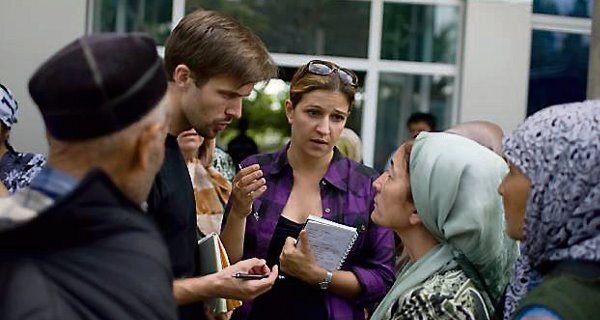
Human rights investigators don’t campaign from a keyboard. A new documentary shows the dangers they face in reporting abuse and atrocities, says Jonathan deBurca Butler

Who is protecting the protectors? The fight for human rights

There is a scene from Katy Chevigny and Ross Kauffman’s latest documentary which shows a tired, emotional but resolute Fred Abrahams facing his foe Slobodan Milosevic in court.

Abrahams is seen giving evidence against the former Serbian leader for war crimes that involved the “Serbian police and Yugoslav army purposefully targeting civilians” during a war whihc saw human rights abuses on all sides.

“It was horrifying,” recalls the human rights activist in the voiceover, “talking to the guy you were tracking for ten years.”

Abrahams recollection of his time in Kosovo and the former Yugoslavia is just one of several chilling stories featured in Netflix’s latest documentary offering, E-Team.

The film follows the high-stakes investigative work of four human rights workers as they travel to places such as Syria and Libya uncovering evidence of human rights abuses. The story is often harrowing, always raw and, for the most part, inspiring.

“The filmakers approached us about doing an in-depth profile about our work,” says Abrahams. “They said they didn’t want to do a propaganda piece about Human Rights Watch and we said we didn’t want that either because we have people to do that already. There was a bit of a risk for us because we let them inside to take a look at the inner workings of what we do. It’s not always perfect, they wanted to show warts and all because that’s what makes a good film, but I think the filmakers captured something real.”

Abrahams own path to human rights activism was, he says, very much “down to circumstance”. Having studied German and International Studies at Columbia University in New York, he found himself graduating at an opportune time in history.

“I had the good fortune to graduate college in 1989 when the Berlin Wall fell and I had studied German,” recalls the 47-year-old. “So when a recent graduate is looking for something to do and the Cold War ends and a whole region of the world opens up...I jumped on it. I went to Eastern Europe and got the chance to meet activists and dissidents, the most inspiring people. People who went to prison for standing up for their beliefs so that’s where I came into contact with human rights activists and I became fascinated.”

Abrahams has worked for Human Rights Watch for well over two decades and he has documented human rights violations and war crimes in places such as Albania, Bangladesh, Iraq, Lebanon, Sri Lanka and Israel. Inevitably, his work has got him into some tricky situations.

“All of us have been detained briefly,” he says. “Actually Anna and Ole, a married couple who feature in the documentary, have a wonderful story about how they basically fell in love in detention during the war in Georgia. But I do recall one moment in Kosovo when we went through areas of active fighting and we drove through a minefield once. That’s a very uncomfortable feeling; not something that I enjoyed at all.”

Travelling through minefields, entering cities that are being bombarded by airstrikes and skulking over closed borders in the middle of the night are all part of the job and while he does not want to focus too much on the occasional drama that can be part of his work, Abrahams hopes that people who see the film will come away with a slightly different view of human rights groups like his.

“If there’s one thing that I hope people take away from the film, it’s maybe breaking this perception that human rights workers sit at a desk and write ideolgical treatise or stand on street corners handing out leaflets,” he says. “All of that has its place in the movement but our work is really about fact-finding and documenting violations and publicising them.”

Although he freely admits that encountering oppression, abuse and death on a regular basis can be tough, Abrahams says he tries to use his emotional responses as constructively as possible.

“I channel my anger into the work that I feel can change the situation,” he explains. “I feel blessed to work for an organisation that I believe has impact. And that makes going to these places and seeing these horrible things worth it because I feel that I can return with my notebook and my camera and use that material to improve the situation.”

“I’m not naive,” he continues. “I know the limits of our work. We don’t end wars and we have incremental successes and setbacks but it’s empowering to feel like you can make a difference. I am blown away by the courage and determination of the people we meet. That can be the people who suffer a violation but who nonetheless come forward to speak about it or it can be the local activisits who do this with a bravery far beyond us. We go to these places as visitors and return home but these people work, live and have families in war zones and put themselves at risk without reward. I don’t know if I could do it.”

E-Team is on www.netflix.com

More in this section

Cookie Policy Privacy Policy Brand Safety FAQ Help Contact Us Terms and Conditions

© Examiner Echo Group Limited













