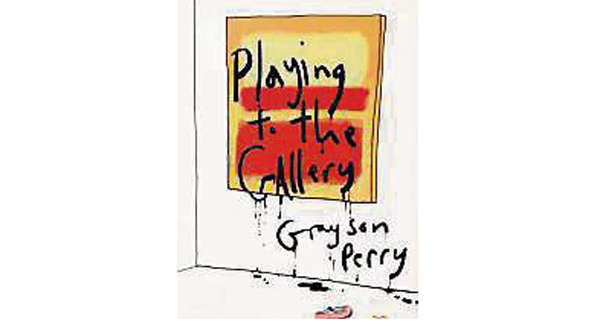
Book: Playing to the Gallery
Grayson Perry

Book: Playing to the Gallery

DESCRIBED, not inaccurately, as a ‘fully paid-up member of the art establishment’, Grayson Perry has written an easy-to-read guide that reveals many of the strategies used by him, and no doubt other creative talents, to gain admission to that same select coterie. An alternative title to the book, as suggested in its own dust jacket, is ‘Sucking up to an Academic Elite’, but this is very much tongue-in-cheek, and typical of an artist who delights in being mischevious.

In truth, the reason Perry is lauded is not so much because of his eyebrow-raising antics, such as attending events dressed as Little Bo-Peep, but rather because his ceramics are startlingly good. Combining elements of everyday life with high art and classicism, his decorated pots are brilliant, witty and full of insight and feeling. His level of creativity cuts a swathe through entrenched notions of what is considered ‘craft’ and what is ‘art’. While also an accomplished printmaker and painter, it is Perry’s genuinely complicated personality that gains him endless media attention.

Born in 1960, his early life, growing up in Essex, was not short of emotional distress, due to the breakup of his parents’ marriage. His imaginative life, nurtured during these years of adolescence, largely derived from confusions of gender, Airfix kits and unfulfilled aspirations to pursue a career as an army officer. In the 1980’s, his early ceramic works featured scenes of sadomasochism and bondage. Combined with a penchant for transvestism, these gained him an instant reputation as an artist to watch; he is still a legendary figure in St Martin’s College of Art where, each year, students compete to design the most outrageous costume for Perry. Recently, inspired by the TV series The Only Way is Essex, he turned to architecture, designing a house encrusted with ceramic images of a mythical Essex woman called Julie. Although not welcomed by conservationists, the heavily decorated house is a gingerbread delight that, surprisingly, evokes the Viking heritage of the river Stour.

In Playing to the Gallery, Perry has produced a reader-friendly book that lays bare the mechanisms that drive the modern economic miracle of “Cultural Tourism”. Paris now attracts 27million tourists annually, while London lags not far behind. Seven million will visit Tate Modern this year, with the former London electricity generating plant now vying with the Vatican in terms of popularity. In Chicago, a single public sculpture, Cloud Gate by Anish Kapoor, has become an international emblem for the city. Costing more than $20 million (€15.5m) to construct, Cloud Gate has featured in the television series Boss, and in films such as Source Code — directed, perhaps not coincidentally, by David Bowie’s son, Duncan Jones. Like Perry, Bowie is a product of south London suburbia and echoes of the singer’s

androgynous costumes and carefully-cultivated transgressive persona — his Ziggy Stardust of 1972 — are clearly etched in Perry’s psyche.

From his unique vantage point, both as part of the establishment and also gently poking fun at it, Perry is well placed to highlight the hidden mechanisms that underlie today’s art world.His book is a treat, brightly written and entertaining, but also accurate in its observations. Enlivened by cartoons, it demonstrates how art has moved from being a marginal activity and interest to being very much part of the mainstream. The irony of the co-existence, within museums, of private corporate events alongside exhibitions featuring political and social protest is deftly revealed, as is the separation of mass tourism from the awarding of status that accompanies privileged access; both are equally valued by today’s museums in terms of their contribution to turnover. Diplomatically, Perry doesn’t offer his own opinion on a fellow artist, such as David Hockney, but instead quotes a curator’s opinion. In seeking to differentiate between the taste of the wider public, and the often opaque reasons for one artist being highlighted while another is excluded, he cites the work of Hockney and the famous painter of street scenes in Salford, LS Lowry; both artists extremely popular with the public, but often treated with disdain by a curatorial elite. In the 1980’s, the artistic duo of Komar and Melamid commissioned extensive surveys amongst the public, seeking to find out what people liked in a painting. When the results were collated, they then proceeded to create works of art that included these popular wishes; the results were, predictably, kitsch.

Equally, with the language of art criticism, Perry identifies the gulf between the way curators describe works of art, and the limits of language as understood by even well-educated audiences. He cites a study by Alix Rule and David Levine, where they fed thousands of contemporary art press releases into a computer programme, and so came up with a single idealised ‘art speak’, where entire sentences of jargon could mean little or nothing. The impenetrable language used by critics is described by Perry as akin to a ‘linguistic arms race’, the results reading, as he puts it, like inexpertly translated French. He also identifies the dodgy underpinnings of many aesthetic judgements of the art world elite, demonstrating how people are conditioned from an early age to appreciate certain images and objects, and reject others.

Ultimately, what the majority of people like is what they have grown used to. However, he cites tests that reveal popular preferences broadly coinciding with the opinions of art historians and critics. He comes up with a quirky equation to explain how art has moved from being an engine of political change to an asset class. Half of the equation is a half-decent idea, linked to an ambitious dealer and multiplied by the number of studio assistants. On the other side are the people who can afford to buy expensive art.

Perry is delightfully willful in his own likes and dislikes. Victorian narrative painting and 1970’s photorealism, two genres rarely giving a showing in many museums, are high on his list of ‘likes’. He finds inspiration in Japanese and Islamic art, as well as in painters of the Italian Renaissance. He quickly moves through the fields of Conceptual art, to Relational Aesthetics and participatory art. One of his favourite truisms is that an artist will never have a good career unless their work fits into the lift of a New York apartment block. A director of Sothebys confirms that red paintings sell best, followed by white, blue, yellow, green and black.

Alan Bowness, a director of Tate, describes four steps to validation: peers, serious critics, collectors and dealers, and lastly the public. However, times have changed, and public interest, as represented in attendances and media interest, is now a powerful force. Interestingly, Bowness did not mention curators, whose irresistible rise in recent years as power brokers has been a direct result of puzzlement in the public realm as to what constitutes great art. Dealers also play an important role, and will even sometimes tantalise the market by rejecting a request to purchase from collectors they don’t know, opting instead to reserve pieces for the most prestigious private collections.In the 1980’s, if a painter’s work was acquired by Charles Saatchi, their success was assured. Equally, if Saatchi then decided to sell his holdings of a particular artist, that same success could be short-lived. In terms of assessing how works of art fare with the passing of years, Francesco Bonami, curator of the Venice Biennale, distinguishes between works of art that acquire patina, and those that gather dust. Again, a throwaway comment, but one based on years of experience.

Perry ends with a humorous ‘gauge’, to be used in terms of assessing where an art work would look best. Top of the list predictably is Tate, followed by Elton John’s lawn, a provincial arts festival, a hipster coffee bar in East London, an oligarch’s entrance Hall, a National Trust gift shop, a roundabout in Milton Keynes, a car boot sale, IKEA, and, last but not least, ‘mum’s back bedroom’.

Overall, this book is an excellent guide to gaining an understanding of seemingly eccentric projects that can involve considerable investment of time and money. However, Perry highlights the increasing demand for a return where events must have popular appeal, and museums that charge admission are forced to increasingly depend on footfall. Following these imperatives can, and will, exclude quieter, more reflective artists. Perry himself manages to combine both attributes; while his appearances can create a media frenzy of paparazzi, his art is clearly the result of hours of quiet contemplation and total absorption in what he is making; the mark of a true artist.

While revealing one of his sources of inspiration — “My technique, for example, is to drink beer and watch X Factor and get my felt pens out” — in reality the making each one of Perry’s large glazed and decorated pots is a daunting challenge, one that involves months of patient and exacting work.

x

More in this section

Cookie Policy Privacy Policy Brand Safety FAQ Help Contact Us Terms and Conditions

© Examiner Echo Group Limited













