Book Review: Green - The History Of A Color
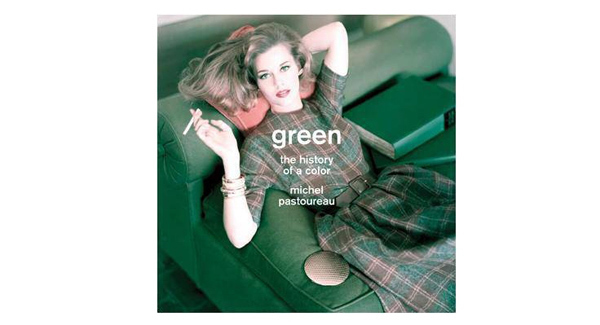
ONE of a series of books, each focusing on a particular colour, Green: The History of A Color, by French academic Michel Pastoureau, is a treasure trove of information and surprising discoveries.
Having taught for over 30 years at the Sorbonne’s École Pratique des Hautes Études, Pastoureau, a specialist in medieval art, is well-placed to provide an overview of the importance of colour, not only in art but in all aspects of life.
From the evolution of dyes and discovery of pigments, to the way in which colour was understood, interpreted and described, he provides a compelling narrative, ably translated by Jody Gladding and illustrated with reproductions ranging from ancient art up to 20th century design and photography. In the oldest art known to mankind — the cave paintings of Stone Age man — the pigments available were basic reds, yellows and blacks, and green does not appear. While painters in Hellenistic times used pigments such as malachite and verdigris, green was not highly regarded, and there is no precise word in the Greek language to describe it; Homer famously refers to the sea as bronze-coloured, or ‘wine-red’. Although Homer was blind and his writings may not reflect the impressions of a sighted person, the fact that blue and green are rarely mentioned in literature of the period led historians in the 19th century to wonder if the ancient Greeks suffered from some form of colour-blindness. The Romans used green more extensively, in painting their temples, statues and murals, calling it viridis, from which is derived the French word vert. But they rarely used green in dyeing cloth, probably because it was associated with Germanic and Celtic tribes.
One exception was Nero, who famously regarded green as his favourite colour, eating leeks and supporting the green stable in chariot races. He was even described as viewing gladiator fights through an emerald, to reduce the sun’s glare. Gazing at an emerald in ancient and medieval times was thought to ‘rest’ the eye. The ancient Egyptians venerated green, as the colour of fertility and regeneration.
In the Koran, as in the Hebrew Bible, references to colour are virtually non- existent. However, accounts of the prophet Mohammed describe him as having a fondness for green, and wearing a turban of that colour. When in the 10th century the Fatamids broke away from the rule of Baghdad and founded the city of Cairo, they chose green as their dynastic colour. It was later used by Arab knights to distinguish themselves from the white and red-clad Crusaders and has remained the colour of Islam ever since. Later translators of the Hebrew Old Testament into Latin did introduce more descriptive terms, but references to green were still rare. The poor reputation of the colour in Mediterranen Europe was not helped by its popularity amongst marauding Vikings and other Northern peoples, but things began to look up in the 12th III, reviving an idea promoted by Aristotle, advocated green as a ‘middle’ colour, suitable for religious vestments.
What Pastoureau establishes beyond doubt is the lack of knowledge in medieval times of the colour spectrum that is known today. Rainbows are described inaccurately by writers, and visual representations in illuminated manuscripts are equally inaccurate. He also notes there is no recipe, before the 18th century, outlining how painters might mix blue and yellow pigments together to make a third colour. The notion of green as a restful, peaceful and temperate colour gained ground. In the early 12th green vestments appear in the stained glass windows of Augsburg cathedral, while verdant orchards are the scenes for courtly trysts. In the early 15th illuminated manuscript, the Tres Riches Heures of the Duke de Berry, the month of May is symbolised by women wearing green gowns, while the Celtic festival of Bealtaine celebrated the new growth of green in springtime. Jan Van Eyck’s bride, in ‘The Arnolfini Wedding’, wears green. The colour was also seen as symbolising the fickleness of love; ‘green behind the ears’ being one of many expressions linking the colour to rash behaviour. The legend of Tristan and Isolde, who drink a love potion and take refuge in a forest, celebrates a mythic ‘green’ knight. The notion of green dragons and serpents also took hold and the colour became associated with evil spirits and witches; as in the old French saying yeux verts, yeux de vipère — green eyes, viper eyes. In England, the legend of Sir Gawain and the Green Knight begins at King Arthur’s court at Christmas, when a green knight appears and demands single combat. Sir Gawain takes up the challenge, one that culminates in a showdown between the two at the ‘Green Chapel’ a year later.
Pastoureau examines archival evidence for colouring fabrics. The technique for dyeing had been perfected in Germany, but was governed by strict guild laws. Dyers were restricted to certain colours. This caused problems, as the method for making the best green involved first immersing fabric in a vat of blue and then in a vat of yellow, called ‘weld’. In 1386, Hans Töllner, a dyer in Nuremberg, was caught in possession of a vat of yellow for which he had no license. He was driven out of business and exiled to Augsburg. Because of these trade restrictions, green fabrics tended to be coloured with vegetable dyes that faded quickly, adding to green’s reputation as a colour of fickleness and inconstancy. In fresco paintings, Judas is often depicted wearing a green cloak and merchants falsely declaring bankruptcy were said to have put on ‘the green bonnet’, while the baize covering card tables represented gambling and risk. During the Reformation, green, along with red and yellow, was particularly frowned upon, although at the same time increased scientific research developed knowledge of colours and colouring.
For the majority of Irish people across the globe, who believe without question that the ‘Emerald Isle’ has a monopoly on this colour, Pastoureau’s book comes as a shock. While there is no index — a lamentable lack — diligent reading unearths few references to Ireland. The scientist from Lismore, Robert Boyle, is credited with the early identification of green as a secondary, rather than a primary colour, while the Irish flag of green, white and orange is briefly mentioned as symbolising peace between rival factions. This is a considerable oversight in a book that is largely confined to Western Europe. Ireland does have an international reputation as the quintessential “green” island; the use of a green flag by the United Irishmen is certainly worth mentioning, while the tendency for New York and Chicago to “go green” on St Patrick’s Day, is a social phenomenon that impacts on millions.
The recent rise and rise of European “green” politics and the ecology movement is discussed, as is the role of the colour in Modernist art and design, but the heart of Pastoureau’s book is in the medieval period and this is where his discussions are at their most insightful and interesting. All in all, a beautifully-illustrated and thought provoking book.

CONNECT WITH US TODAY



Be the first to know the latest news and updates

















