West Cork's model railway is back on track
West Cork’s biggest tourist attraction has had a major facelift, says Áilín Quinlan, who gets a preview

West Cork's model railway is back on track

The renovation project underway at Clonakilty’s Model Railway Village has left West Cork’s premier tourist attraction looking like a mouth with missing teeth – but only temporarily.

A scaled model of four West Cork towns located along the former West Cork Railway line, the popular amenity, which attracts some 40,000 visitors every year, closed last November as part of a major renovation project.

The job — to assess the 400 miniature buildings on the complex before moving them inside to a workshop where they are being re-painted, repaired and even replaced — in time for the 20th anniversary celebrations in July.

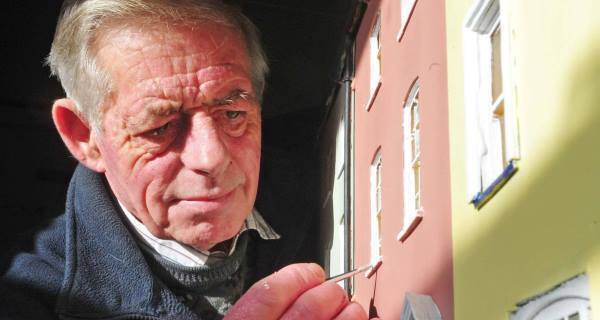
With the centre now in full shut-down mode, several employees have been diverted from their usual posts to help carpenter Norman Waugh and model-maker Finbarr O’Sullivan with the skilled work, which is taking place under the supervision of former county architect, Billy Houlihan.

Houlihan, who was heavily involved with the original design of the Village nearly two decades ago, has come on board to lend his expertise free of charge.

“It’s very detailed work,” says Waugh, who worked on the Model Village as an apprentice carpenter in the early nineties, before moving full-time into the construction sector. He’s enjoying this project, he says: “This is a job that, no matter where you go in Ireland, you’ll never do again. It’s a once-off.”

Each of the miniature buildings in the four towns – Bandon, Clonakilty, Dunmanway and Kinsale – is an exact 1:24 scale replica of the residences, places of worship or business premises that they’re modelled on. Each is also architecturally correct, down to the tiniest detail.

As part of the renovation project the hundreds of structures which constitute the Model Railway Village – 80 in ‘Bandon’, 125 in ‘Kinsale’, 45 in ‘Dunmanway’ and some 150 in ‘Clonakilty’ — had to be carefully assessed for damage. Most needed to be re-painted, while a substantial number had to be completely replaced. So it comes as no surprise that the works, which were initially due to be completed in time for a February re-opening, are now gearing up for an April unveiling. It can take between six and eight weeks to build a new model from the ground up, according to manager Kim McNamara.

It’s very slow, careful, painstaking work — like the new replica of Brennan’s Mill in Bandon, on which the team was hard at work when the Irish Examiner visited.

The town, which appears to have sustained the most weather damage of the four, has been the first to receive the attentions of the repair crew — Brennan’s Mill alone, workers explain, will require a significant amount of attention:

“They have to replace 150 windows in this building alone. Each window has to be made, then manually painted and inserted,” McNamara explains.

Each of the 2” X 1” resin windows is made using a silicone mould, which itself must be crafted by hand.

Every building will get a weather-proofing coat of anything from four to seven coats of paint. “We’ve gone back to the old Heritage colours which are very gentle pastels,” says McNamara.

“It’s painstaking and very detailed work, so our original estimate of February has to be extended — we’re re-opening on April 4th.

Located as it is, on the seaward side of the complex, Bandon has borne the brunt of the weather over the years.

As a result, says McNamara, there are major issues with warping and cracking in the walls of the structures which have to be addressed as a matter of urgency – not to mention the results of 20 years of general wear and tear.

In all, it’s estimated that some 15 of the town’s 80 buildings will have had to be replaced by the time the revitalised Village re-opens. The work is all done inside, in a dedicated workshop — existing models are brought in to be repaired and repainted, while new replicas are also planned, built and painted here.

Once completed, the little buildings will be stored until the re-opening. Some old buildings are so damaged they have had to be scrapped, but many are being salvaged for parts – nothing is wasted. Says McNamara: “A lot of the new buildings are being built from scratch but elements such as windows are being salvaged from the original structures.”

The new buildings are also being made of fibreglass, which is more weather-resistant than the materials used in the construction of the old models, which tend to be either made of timber or a mix of timber and resin.

There are several stages in the re-building work, which starts with an assessment of each building. Using original drawings, a box of laminated wood or ‘womb’ is constructed to the basic shape of the building being replaced. A gel-coat is applied, followed by a resin and fibreglass matting which forms the walls of the building. The ‘shell’ is then removed from the wooden ‘womb’ and windows, roofs and doorways added. Finally each new model receives up to seven coats of paint.

McNamara is also working on the installation of a new slideshow on the photographic history of the model village, from its birth in the 1990s, to the present day.

The Model Railway Village in Clonakilty will re-open on April 4

A model of success

-The Model Village was opened by former president Mary Robinson on July 9, 1994.

-As West Cork’s premier tourist attraction, it boasts an estimated 40,000 visitors every year

-The church alone took four-and-a-half months to complete, and is made entirely of fibreglass. All the original models were built by FÁS workers and are exact replicas of original town buildings as they appeared at the turn of the century.

-An indoor playroom was provided in 2005, an outdoor play area four years later, and, just two years ago, a popular interpretative centre was installed.

-Almost 700,000 people have visited the centre since 1994.

More in this section

Cookie Policy Privacy Policy Brand Safety FAQ Help Contact Us Terms and Conditions

© Examiner Echo Group Limited







