Reviews
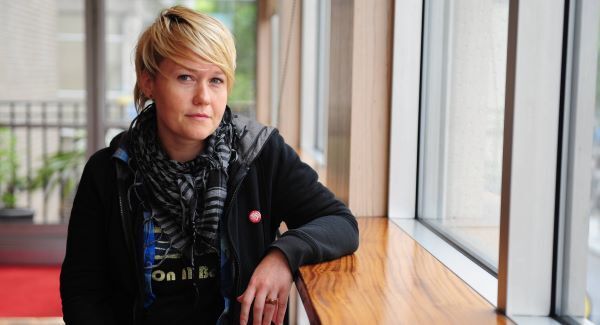
Amy Conroy’s (above) new play has an interesting premise — eavesdropping on secondary school teachers in the staff-room. We glimpse the frailties and frustrations of people charged with inspiring a nation’s youth.
The play does not deliver, taking wrong turns that reduce what might have been a delicate character study to flat melodrama.
That’s not to say that the production is without charm. Conroy’s hit debut, I Heart Alice Heart I, revealed her wonderful comic dialogue and scenarios, and both are to the fore here.
She can produce sympathetic characters, and while too many are thinly sketched in Break, the actors bring out their humanity.
Conroy’s lonely German teacher — who confesses to being jealous of one of her female students — is delivered wonderfully.
The plot hinges on the teachers’ response to the suicide of a pupil. Eager to be seen to be doing the right thing, the school’s vice-principal recruits Kelly (rap artist, Elayne Harrington) to provide the pupils with workshops in rap and slam poetry.
Yet the teachers, fending off their own peer pressures and caught up in banal conflicts, most need to express themselves, and Kelly quickly gets under their skin.
The plot is weak.
It stakes out a narrative terrain familiar to us from American movies like Dead Poets Society and Dangerous Minds, both of which Conroy explicitly references. Outside of focusing on teachers rather than students, it falls prey to a similarly flat logic: ie, the system is bad; people are good.
What mars the play above all else, however, is an uncertain formal style and a too-lengthy running time. With a little tweaking, it could become the more considered play that one can hear screaming within it.
* Until Sep 21
www.fringefest.com
By Marc O’Sullivan
The heart of Louise White’s new play is a small boy lost in the city, who must ask directions of strangers to find his way home. Its greatest achievement is the employment of young actor, Cuan White, who has the task of carrying the piece. The boy is aided by the other actors, who take turns falling to their knees to help him with his lines. It sounds corny, or unprofessional, but, in the context of Way Back Home, it works.
Way Back Home uses music and visuals, as well as the spoken word The sound design is by Alma Kelliher, and the visuals — watercolours projected on a screen behind the stage — are by Clare Henderson. Both establish the mood, which is soft-centred. Anyone who remembers their childhood as violent or threatening will wonder at a piece that eschews terror of the unknown and presents being young, lost and alone as mild bewilderment.
The other characters, two women and a man, recount experiences from their own lives. The young man has lived in France, and now works in an accountancy office; one of the women has moved to Dublin from Australia; the other is a native of the city. None of their memories are remarkable. Indeed, their recollections are only enlivened by their tics; the young man shakes one leg when he speaks, while one of the women keeps putting up her hand for attention, as if she were still in school.
There are distractions — voice-overs, dance, projections — and references to contemporary phenomena, such as ghost estates and evictions. These hint at a bigger picture, of a society that is also in need of direction. It would hardly be spoiling things to reveal that the show has a happy ending. It could hardly go any other way.
* www.fringefest.com
CONNECT WITH US TODAY



Be the first to know the latest news and updates

















