From Heaven to hell in Mexico
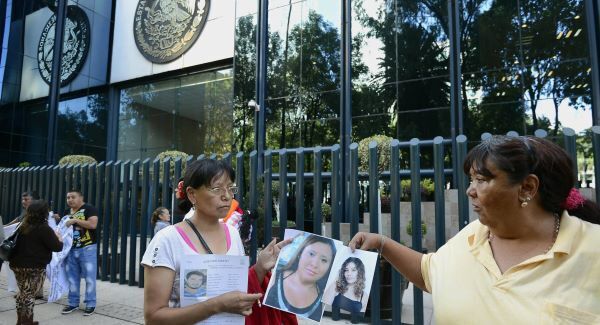
The incident occurred at 11.30am on a Sunday morning. “There is no proof that a kidnap occurred,” the city prosecutor announced a week later.
Security cameras were wiped clean but Heaven is situated a stone’s throw from Mexico’s Angel monument, a landmark equivalent to the Spire in O’Connell St, Dublin. Locals witnessed the arrival of eight vehicles outside the club, unloading 17 men who forced the revellers into cars at gunpoint before speeding away.
The victims appeared to have been escorted out of the club by the owner in a prearranged plan. A single witness gave testimony, in disguise, fearful that police may be connected to the kidnappers. He then went into hiding. On the morning in question, he stayed on inside the club as he was friendly with a waiter and on hearing the ruckus outside escaped by climbing over an adjacent roof.
Two weeks later the authorities acknowledged that the missing 12 did exist and were indeed missing. Three weeks later, relatives were assured by police that “with every hour that passes we are getting closer to the truth”.
It seemed more like the power of positive thinking than the outcome of rigorous investigation. A “major announcement” would be made the following day, said the prosecutor. The families turned up but the message was simply to hold on. Two months later the trail had gone cold as the ‘Heaven Twelve’ join the rest of Mexico’s 26,000 disappeared, neither alive nor dead, their relatives waiting, hope diminishing each day but never entirely extinguished.
Most of the Heaven victims hailed from Tepito, a sprawling neighbourhood with the country’s largest market of pirated goods selling shoes, computers, toys, guns and heroin.
Two gangs operate there; the Union and the Tepis. The father of the youngest kidnap victim, Jerzy Ortiz (16) has spent the past 10 years behind bars, charged with extortion. In April, five people disappeared from another nightclub in the city, while two days before the Tepito kidnap, a petty criminal was shot dead in a nearby club.
Victims of drug violence include army generals and journalists, infants and the elderly. The Mexican government declared war on the drug cartels six years ago, sending army troops to patrol cities and highways. An estimated 60,000 people have since been killed, yet the drug trade and its cartels remain intact despite a few high profile arrests.
In December 2012 Mexico’s newly elected president, Enrique Peña Nieto, pledged to end the bloodbath and strengthen the justice system. The government established the Search Unit for Disappeared Persons (UBPD) in May but has yet to find a director, an office or a budget.
“We will not rest until we have this unit up and running,” said Jesus Murillo Karam, Mexico’s attorney general. The decision to start the unit arose after a nine-day hunger strike by victims’ relatives outside Kuram’s office. In Mexico, justice advances at the pace set by angry relatives. The overdue steps are relatively simple; a register of missing persons; a DNA databank and a change in the law to allow relatives to report missing persons after 24 hours.
Impunity is another problem as convictions for drug related murder are rare, witnesses terrified to come forward and protection measures yet to be trusted. Mexico is overwhelmed by crime syndicates which have expanded their operations to include people smuggling and profits are invested in legitimate businesses.
Acapulco, the once glamorous resort, has become a dumping ground for headless corpses. Wealthy Mexicans have abandoned picturesque Cuernavaca, an hour outside Mexico City. The last time this reporter set foot there, the director of the state anti-kidnap unit had just been caught digging a grave for a corpse of his own.
It is a sign of the times that the first ‘breakthrough’ for the relatives of the missing 12 was an expression of support from Javier Sicilia, a poet whose son was murdered along with six others in 2011 by drug gang members after a minor incident in a bar. Sicilia established the Movement for Peace with Justice and Dignity, sparking a major mobilisation.
In Mexico, victims are guilty until proven innocent under the perverse assumption that they must have been up to something if crime gangs picked on them.
A Human Rights Watch report in 2011 highlighted more than 170 cases of torture, 39 ‘disappearances’ and 24 extrajudicial killings by the Mexican military and police. There is a growing consensus in Mexico that the drug trade, worth $25bn a year, cannot be resolved by violence alone but by a combination of decriminalisation, treatment, alternative opportunities and the seizing of criminal assets.
The relatives of the Tepito Twelve designed a poster with photos of their loved ones and a brief profile of each; the boys are addicted to Xbox and working out in the gym; the girls earn a living, chase the boys and take care of the kids. The 12 are a cross section of Mexico’s ‘other half’ who work in the informal economy, a web of semi-legal activities that revolve around the sale of goods and repair of electronics in street stalls and markets.
The criminal investigation continued; two waiters and a woman, inside Heaven at the time of the kidnapping, were detained. In another twist, the charred corpse of Dax Rodriguez Ledezma, one of the three owners of Heaven, was discovered in July. Ledezma had been hiding in Huitzilac, a small town outside the capital. He came out of hiding to go to the cinema, along with his wife and a friend. All three were killed.
After several weeks of silence, relatives turned up at the government prosecutor’s office, waiting three hours for an audience which never happened. “He’s busy.”
They left and decided to block a nearby street to draw attention to their plight. Fifty riot police arrived and squared up to them. If it was any other protest they would be quickly removed but the sensitivities around the case resulted in the police pleading with them to return to the investigator’s office: “Hold on another 10 minutes senora,” said the officer in charge. “I’ve held on for 36 days,” replied Teresa Urrutia, grandmother of Jerzy Ortiz, one of the missing.
A driver got out of his car and insulted them. In this city of 20m, traffic is unbearable. Ten minutes later, a middle aged bureaucrat appeared in a suit and tie. “The prosecutor will see you now.”
On Aug 22, news filtered through that a mass grave had been discovered in a secluded wood outside Mexico City. DNA samples confirmed the remains of 10 of the missing people. Investigators happened upon the site when searching for a weapons’ dump.
Forensic experts advised relatives that the victims had been killed the same day as they were taken away, a crumb of comfort as funerals were prepared. The authorities are convinced that the 12 were killed in an act of revenge, the owners of Heaven handing them over like sheep to slaughter.
In a further twist to the tale, government investigators displayed clothes found at the scene, none of which were recognised by relatives as those worn by their missing loved ones. Such is the mistrust of the investigating team that relatives have invited a group of Argentinian forensic experts to double-check the evidence.
Hope springs eternal. “The only thing I’m waiting on is a miracle,” murmured one grandmother, waiting yet again for final confirmation of what her heart already knows to be true.
* Michael McCaughan is a specialist in Latin American affairs, researching, writing and broadcasting from the region for the past 25 years. His latest book Rodolfo Walsh; life and death is a biography of an Argentinian writer and revolutionary of Irish descent. Available now.















