One woman's story of premature birth
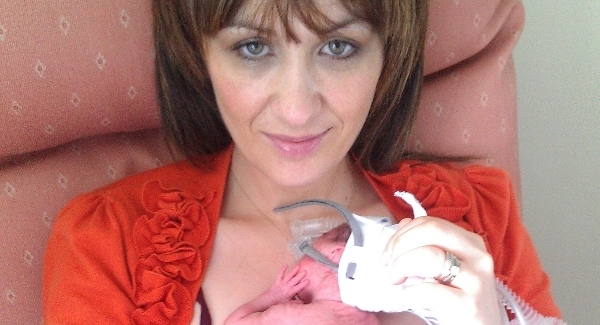
With three boys already she looked forward to a more balanced family unit.
However, a scan in week 21 left her deeply concerned. It revealed the girls were affected by a rare condition that occurs only in identical twins in the womb.
Know as twin-to-twin transfusion syndrome (TTTS), it occurs when blood moves from one twin to the other. The twin who loses the blood is the “donor”, the twin that receives it is the “recipient”. For the donor, it can lead to decreased blood volume, causing slower growth and poor urinary output — thus little or no amniotic fluid. For the recipient, it can mean too much blood, putting a strain on the baby’s heart.
When the TTTS was discovered, Debbie was referred to the Rotunda for fetal laser surgery in an effort to interrupt the flood of blood from one twin to the other.
“We thought it was successful on the day, but things subsequently got worse,” says Debby.
A scan at the Coombe some days later showed the donor baby was in trouble, with hardly any amniotic fluid around her.
“She was what they call shrink wrapped,” says Debbie. A decision was made to deliver the babies by caesarean section at 24 weeks. It was a tense time.
“If one of them died, the other would die instantly.” This is because they shared a placenta — the only biological structure that can cause the death of more than one person at the same time.
Miraculously, both twins survived. The donor, Pippa, was just “hours from death”, Debbie says. She weighed 1lb 1oz, the size of a half bag of sugar. Sophia, the recipient, weighed just three ounces more. They were whisked away instantly to the intensive care unit (ICU).
Debbie’s husband, Gary, showed her pictures of the girls he had taken on his phone. “It still didn’t prepare me when I finally got to meet them,” Debbie says. “It wasn’t so much their size as how skinny they were. Their skin was transparent. I could see their little hearts beating. They were like skinned rabbits. Their ears were still fused to their heads.”
The girls, born last May, have faced many battles since. Sophia spent 128 days in hospital before being allowed home. Pippa spent 138. She’s been hospitalised five times in the past year — Sophia twice.
Sophia’s reached all her developmental milestones. Pippa’s marginally behind, but is deaf. Both twins have regular health scares.
Debbie, from Mount Mellick, in Co Laois, has had a gruelling 12 months. She’s grateful for any help, and mentions the Irish Premature Babies (IPB) charity.
“When you give birth prematurely the breast pump you need is hospital grade, otherwise you’re not going to get any milk. And premature babies particularly benefit from mother’s milk, it’s like magic medicine. IPB donates breast pumps to hospitals and I was able to use that. They cost about €2,000 or €95 a month to rent, so it’s a substantial saving for parents.”
Dubliner Jenny Scanlon, who lives in Kilkenny, is also grateful to IPB. She heard of them in the Coombe when she gave birth at 28 weeks to her son James.
“A few of the parents I met in the Coombe knew about IPB and I looked them up on Facebook. There’s a big focus on raising awareness. For parents who don’t know a lot about what it means to have a premature baby, it’s great to read the stories. It made me feel less alone,” Jenny says.
Dr Gene Dempsey, consultant neonatologist at Cork University Maternity Hospital (CUMH) says his hospital has benefited from a breast pump donated by IPB.
“Giving maternal expressed breast milk really reduces the risk of infection of the gut in premature babies,” Dr Dempsey says. “We have very high expression rates in the unit, up to 90%, and that’s a reflection of the great care.”
Approximately 4,500 premature babies are born each year in Ireland, of whom about 500 sadly die.
CONNECT WITH US TODAY



Be the first to know the latest news and updates

















