Warring systems: are nation states better than traditional societies?
Jared Diamond assures me he is not a threat to my life. “I can promise you that I have not made a move to kill you, yet. Nor have I detected any move on your part to kill me. But in a traditional society, both of us would have made a move to kill each other by now, or else run away,” he says.
Diamond looks younger than his 75 years. He was born in Boston in 1937, and moved to Los Angeles when he was 28, where he has lived since. As a young child, at the turn of the 20th century, Diamond’s father came to the United States from the Ukraine, fleeing pogroms. Diamond says the resultant loss of Yiddish was “a terrible loss. My father’s parents probably spoke Yiddish at home. That just shows the gap in the United States between immigrant parents and their children. The immigrant language is so often lost, and that is sad.”
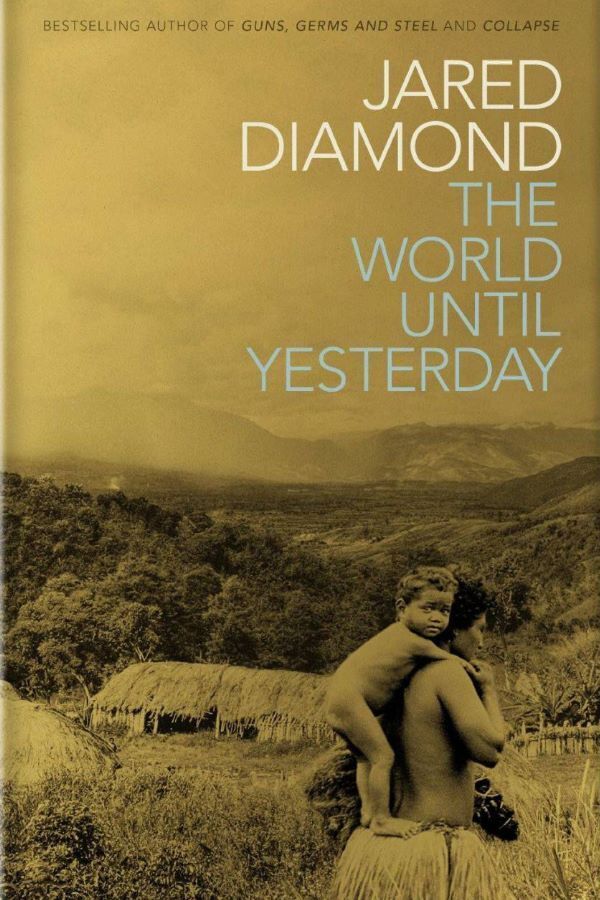
The Pulitzer Prize-winning polymath and science writer is talking about his new book, The World Until Yesterday, which examines behavioural differences between humans in tribal, stateless societies and humans in bureaucratic nation states.
Diamond’s argument is if states came into existence 5,400 years ago, and agriculture in the last 11,000, humans have spent much of their time as nomads. So modern nations are new concepts, and we have much to learn from traditional cultures.
Having spent the last 50 years visiting New Guinea, Diamond uses a mixture of anecdote and research to prove his thesis.
The ways traditional societies raise children, spend their leisure, and communicate are often superior to practices in the first world, he says.
But Diamond’s praise for the tribal lifestyle stops there. Aspects of these societies, would be deplorable to westerners.
“Traditional societies do things that we disapprove of. Some of them abandon their elderly. Some of them kill their babies, if they happen to be weak. We in the West think that is terrible. But they do it, not because they are evil, but simply because they are living under a certain set of circumstances.”
Diamond doesn’t moralise. When I ask him whether human beings are violent, or gentle, he says it’s a pointless question. Human behaviour is a matter of circumstances.
In state societies, the institutions we take for granted, such as the police judiciary, and a functioning democratic government, minimise violence.
As traditional societies lack the vast bureaucratic apparatus of the state, its people, he says, are in a chronic condition of war.
“Just look at the deaths caused by Germany participating in two world wars in the 20th century. Although this was, no doubt, horrible, it was also averaged out in a century in which they were no wars for 90 years. In traditional societies, without a state government to declare war, or to sign a peace treaty, wars tend to be chronic.”
“In state warfare, it is considered bad and evil to kill women and children. Even in Germany, on the western front in World War II — the eastern front was another matter — it was not the policy to kill women and children. But in traditional societies, it’s routine to kill women and children in war. So the outcome, overall, is that the death toll in traditional societies is ten times higher than in state societies.”
I’m not convinced of this book’s thesis: primarily because much of its empirical evidence is based on large blocks of mathematical data that seem reductive when discussing the lives of so many people. However, Diamond says in his chapter on war that peaceful traditional societies do exist.
Yet this has failed to stop a torrent of criticism from reviewers; as well as organisations like Survival International, who fight to protect tribal peoples’ lands and livelihood.
The campaign group’s director, Stephen Corry, lashed out at Diamond in the Observer, calling his book “completely wrong — both factually and morally — and extremely dangerous”.
Diamond accuses Survival International of fabricating the truth to publicise their campaign.
“The average percentage of people who die of violence in traditional societies versus state societies is ten times higher. The question, then, one needs to ask is: why on earth is Survival International denying this fact?”
“As an organisation, they are saying traditional societies are not war-like. The reality is that they are. Essentially, we both have the same goals: to protect indigenous people. But, tragically, they are founding those goals on a lie, whereas my argument is based on fact.”
Some of Diamond’s bold statements lack the nuance for politics. For example, his claim that the state has its own interests at heart is certainly true. But it’s debatable whether every state “wants to preserve peace”.
Many reviewers have spent considerable time focusing solely on Diamond’s coverage of traditional societies.
But his book touches upon other subjects, which are fascinating, albeit less controversial: such as his views on religion.
A non-practicing Jew, Diamond says his wife still attends synagogue on the high holy days of the year, while his two children took their bar mitzvahs.
This might explain why a rationalist-atheist like Diamond affords religion such respect. It’s more likely he thinks it serves a useful function.
“An evolutionary, and common sense, perspective would say that some societies would have eventually abolished religion by now,” says Diamond, “that atheist societies should gain an advantage over religious societies. But this is not the case.”
If religion’s role in explaining how the natural world works has been replaced by science, Diamond says that it can still be effective in helping humans deal with stressful situations to defuse anxiety.
“In my book, I discuss an incident in 2006, during the Lebanon War, where people in the Israeli town of Tzfat, near the Syrian border, were being subjected to rocket attacks.
“It turned out that those Israelis who were chanting Psalms managed to defuse their anxiety and they didn’t explode in anger and do stupid things,” he says.
Diamond is readying for an afternoon of lectures, interviews and more publicity. No doubt, he will meet his critics throughout the day, but he doesn’t seem too bothered. In fact, this army of opposition probably helps him sell more books.
CONNECT WITH US TODAY



Be the first to know the latest news and updates

















