Dramatic clash of ideas
THE curtain is down on another Dublin Theatre Festival, and in the ongoing ‘battle’ between the traditional text-based play and experimental contemporary theatre, it is the latter that appears to be winning out.
Certainly, the most resonant fare at this year’s festival fell into the experimental camp. Against the daring audience immersion of The Boys of Foley Street or the inspired visual mania of Mystery Magnet, works such as Declan Hughes’s The Last Summer and Deirdre Kinahan’s Halcyon Days just felt somewhat staid. That’s not to say that these plays were not entertaining. Both productions were funny and affecting at times, and featured some sterling performances. Yet each lapsed into an all too theatrical sentimentality. Kinahan’s piece — about two residents of a care home — was particularly culpable in this regard. Both plays, ultimately, were hampered by predictable contrivances of plot and character.
By contrast, in the post-dramatic theatre of Pan Pan’s Everyone Is King Lear in his Own Home, plot and character were not structural elements designed to transmit meaning and dignify human experience. Rather, they queried the concept of humanity itself, and put our cherished sense of dignity at risk.
Whether it was entertaining is another matter. Every member of the audience — whether familiar with Shakespeare’s original King Lear or not — would, at times, have found themselves baffled or even annoyed by the obscure interior logic of the piece. And there were some plain dull ideas in there, too. The delirious image of a mouse rolling around the stage in a glass ball, for instance, did not gain anything by having Judith Roddy sing ‘I Saw a Mouse’ in accompaniment. Yet, despite its quirks, and indeed because of them, the piece managed to reckon uniquely with the horrifying frailty of humans — with the frailty of our minds and of our bodies. And this frailty came across far more palpably than it did in Kinahan’s play, which dealt with not dissimilar subject matter.
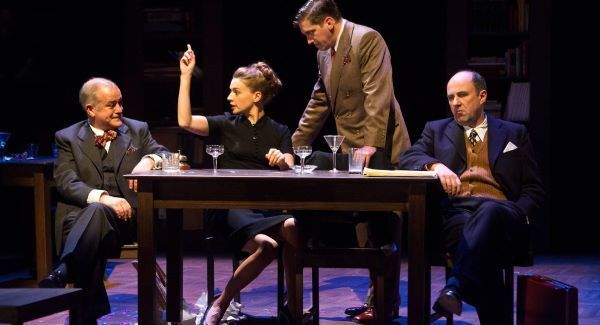
Not that the traditional play is out for the count. It should be noted that The Talk of the Town, Emma Donohue’s play about Irish writer Maeve Brennan, sold out so quickly that an additional week had to be hastily programmed. Meanwhile, one of the highlights of this year’s festival was DruidMurphy — the revival of three Tom Murphy classics by Galway company Druid. These gripping ensemble pieces attested to the Tuam playwright’s genius, and showcased conceptual skills seldom seen today in the written play. Conversations on a Homecoming, A Whistle in the Dark, and Famine feature characters who dwell in the ‘real’ world but also in a mythic one. And, importantly, the myth is our myth — the social mythology of Ireland for a century and more. With inspired plotting, each play carries a sense of social urgency, examining the points of contact between the political and the personal, while dramatising the necessity of hope in spite of the inevitability of despair.
The Boys of Foley Street, the third piece in ANU Productions’ ongoing cycle about the Dublin’s Monto area, similarly engaged with the myth of nation. Like Murphy, Louise Lowe’s work is concerned with what our national myth tries to exclude. One of the most admirable things about The Boys of Foley Street was that, while it was expressly political, it left room for the audience’s own thoughts. Rendering an accurate, if stylised, social document of the Monto during the late ’70s, the immersive show was intensely grim — with narrative content centring on prostitution, drug abuse, and violence — yet there were indications, too, of how a living community cannot be reduced solely to such sensational ‘headline’ elements. Aside from its politics — and this is something that thus underscores its politics — there is a respect for all human experience.
In the end, coming to terms with the human is always the fundamental basis of politics and it is also the basis for theatre. A reckoning with humanity was at the forefront of most shows this year.
Devised by Forced Entertainment, one of Britain’s torch-bearers for contemporary theatre, The Coming Storm saw six performers deliver a bevy of incomplete stories, while trying to stave off thoughts of their mortality. The aborted stories motif vaguely recalled Italo Calvino’s novel If on a Winter’s Night a Traveller, and similarly seemed to pine for a redemption of human experience that will never come.
Like Pan Pan’s piece, The Coming Storm frequently tested the audience’s patience and attention levels but it also had a haunting affecting power. This ability to trigger old familiar thoughts, emotions and sentiments, but in a reinvigorating way, is why post-dramatic theatre currently trumps the traditional play, which seems so mired in convention. It was why Have I No Mouth, Brokentalkers’ moving slice of experimental documentary theatre, and The Wooster Group’s irresistibly mad production of Hamlet, also worked. Neither discovered new human thoughts or feelings — but they did manage to find new triggers for the old ones.
A notable feature of this year’s festival was the prominence of literary adaptation. In The Select, American company Elevator Repair Service took on Ernest Hemingway’s The Sun Also Rises, while elsewhere prose fiction by two towering figures of Irish literature — Joyce and Wilde — was adapted for the stage.
The Corn Exchange’s staging of stories from Dubliners was enjoyable, if hit-and-miss. Joyce’s tales of adolescent remembrance proved particularly awkward to stage. The company’s commedia dell’arte stylings added charm at certain moments — most notably in The Boarding House and Counterparts — but the finest shorts (A Painful Case, The Dead) were those that just did the sensible thing and got out of Joyce’s way. The production will be remembered fondly, however, for its great ensemble cast, which included the outstanding Mark O’Halloran and Derbhle Crotty.
Overall, however, both Dubliners and the Abbey’s production of The Picture of Dorian Gray tended to expose only the key differences that exist between theatre and literature. Neil Bartlett’s experimental staging of Dorian Gray was inventive, yet marred by annoyances such as canned laughter to encourage ironic distance from Wilde’s famous aphorisms. The use of Victorian society itself as a narrator — whereby a host of house servants and socialites stood behind microphones — was initially a striking conceit, but one that became clunky. Ultimately, you felt, the point of Wilde’s story is that the horror of Gray’s predicament cannot be represented, and the production never came to terms with this. The lesson of both Dubliners and Dorian Gray was that literature can perhaps deal better with the unrepresentable than theatre can.
Theatre, at root, is about making things appear. For this reason, the most provocative show at this year’s festival was the playful Mystery Magnet by Belgian visual artist Miet Warlop. There was no plot, just a series of absurd and often absurdly violent episodes in which weird, vaguely human creatures destroyed the stage, and each other, in vivid living colour. It was a joy for the senses and delightful in its delirious gratuitousness.
CONNECT WITH US TODAY



Be the first to know the latest news and updates

















