Charting a way to success
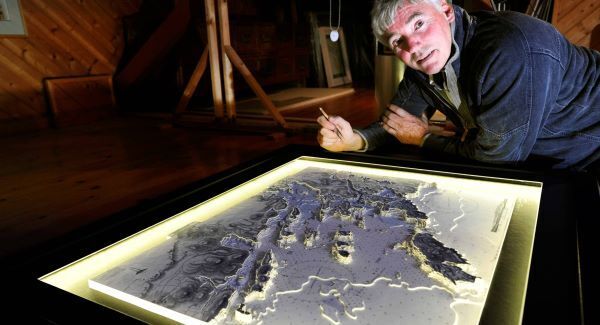
Bobby Nash’s charts have put him on the nautical map with the Volvo Ocean Race and celebrities, writes Tommy Barker

Charting  a way to success

THERE’S something very special about nautical charts — showing safe passage, they aid travel at sea, they hint at adventure, and they herald ‘here be danger, rocks and reefs.’

And, if you’re a product designer who’s had enough of a corporate life working for the likes of Apple, Nortel and Sensormatic, they can even chart a way to self-employment, and to pitching your wares to the world’s wealthiest, like Eddie Jordan who has a new 150’ motorboat under construction in Southampton.

For designer and artist Bobby Nash, who grew up sailing at Newcastle West on the River Shannon, nautical charts in all their romance, mystique, mystery have literally mapped out his own family business, called Latitude, one that has crossed oceans — and which appropriately returns this month to Irish seas, courtesy of the 39,000 mile Volvo Ocean Race.

When the Volvo roadshow last sailed in Galway in 2009, Nash’s artistic, yet precise, chart creations of Galway Bay, Galway Port and the Aran Islands were commissioned and given as prestigious presentation prizes for the Galway leg’s inshore races.

Now, as the race culminates in Galway to an even larger international profile, Nash has added another commission dimension to his own Volvo input and company output: his charts have been presented to each of the nine ocean ports hosting stages of the 2011-2012 race.

Nash’s handiwork with a scalpel is on display in those nine ports’ municipal buildings or yacht clubs, from Abu Dhabi to Auckland in New Zealand, as well as Alicante, Cape Town, South America’s Itijai to Lisbon, Lorient, Miami, and, next week, Galway.

Nash’s home-based business in Kinsale enhances classic charts, of any harbour, sea, ocean or lake, anywhere on the planet. While working as an industrial designer years ago, he fitted British Admiralty charts with tiny lights to indicate lighthouse s, navigation markers and beacons, flashing in exact sequence: they’ve since become familiar sights in bars, hotels, holiday homes — even lighthouses.

Then, Nash had his very own lightbulb Eureka! 3am moment, and it’s kept him going ever since. By layering several identical charts, he makes painstakingly-produced, hand-made 3D charts which literally bring the standard 2D charts to a new dimension — and they now travel all over the world. He’s had over 1,000 chart commissions, many for multiple copies.

He also integrates his scalpel-wielding workmanship into bespoke pieces of furniture, usually tables with glass tops and illumination with inset charts, and has worked on them with yacht designer Rob Jacob. Made in some cases from walnut, and sometimes in stainless steel with carbon fibre, these chart-topped tables have ended up in living rooms, boardrooms, and in the plush salons of superyachts.

As Euro 2012 ends within days, and as the Olympics gears up in London, a bit of world sporting focus hones in now on Ireland, as the Volvo Ocean race is the third biggest sports event in Europe this summer.

As that race’s nine 70’ long mega-boats beat a path to Galway, generating millions for the tourism economy, it’s clear, whatever about our ebbed economic tide, there’s money left abroad.

As part of his drive to further spread his niche business to this elite, Bobby Nash recently ‘did’ the Monaco Boat Show, on the cheap. He went as a punter and carried a Cap Ferrat chart under his arm, a walking ‘stand’ — and it paid dividends.

Mixing enterprise with passion, Nash admits that “it’s one thing to make beautiful objects to sell, it’s another thing to actually sell them”. The key to his success now is a mix of word of mouth, and a very good website. (www.latitudekinsale.com) Other pick-ups are random: he featured in a Clodagh McKenna TV Kinsale cookery special — after it aired in New Zealand he stared getting commissions from the Antipodes.

All of his jigsaw-like individual pieces take hours to make, more take days, and some take weeks of cutting, splicing, and gluing on mount boards. Throw in an archipelago with hundreds of islands and there are thousands of precision cuts to be made. There’s a mixed blessing in his work: he gets to see some of the most glorious places on the planet, but only in 2D.

This year, apart from the Volvo Race commission, Nash is doing prizes for Cowes, Falmouth and Palma Superyacht races, but it’s not all yachties who fall for the romance of sea charts. Latitude also does collage-like ‘storyboards,’ and many of their charts end up being given as wedding presents — “well, it beats a steam iron,” he laughs — sometimes given from a group of friends, or from bride to groom. He recalls Tasmania as one of the most exotic to depict and, almost without exception, every commission is location-specific to the recipient: “it’s like a baby photograph, everyone wants to see and display their own,” Nash quips.

As a business it all sort of came about by accident, or by adversity.

Back in the late 1990s, Bobby worked as a product designer with electronic tagging firm Sensormatic/Tyco, and “when we were Tyco-ed, there were redundancies.” At the time, he was experimenting with his ‘active art’, the coastal light charts with microprocessors controlling the optics, and he did the Dublin Boat Show around 2000 to great acclaim: “The reaction blew us away, exhibitors said they wanted to be beside us, that we were like a honey-pot. They work if you’ve salt in your blood, a holiday home by the water, or a boat.”

“Given that initial reaction, I thought, ‘is there a business in this, a Plan B?’ We booked the London Boat Show for ten days. The reaction was fantastic.”

Nash’s raw material is the classic British Admiralty charts, many centuries old, done by intrepid sailors in longboats with leadlines and resulting in “the GPS of their time.”

Since building up his unique and personal business, he’s been granted free access to the Admiralty archives of historic, heroic charting of what’s under the world’s waves “because they say I make their work look good.”

Galway leads the way

Galway has the wind in its sails, with Europe’s third biggest sports event of the year — after the Olympics and the Euro 2021 finals — about to land on its shoreline. It wrested the host honour from 80 other competing cities.

Sailing’s the sport, and while the uppermost end of this costly international game isn’t uppermost on the radar of most traditional sports fans, it is set to draw up to 800,000 visitors to Galway, over nine days from this weekend.

In income terms for the City of The Tribes and its many festivals, it’s set to bring a seasonal injection of around €80m. That’s more than gets spent on the horse racing splurge of the annual Galway Races which bring around 150,000 people each year. The increased impact of this year’s sailing event is calculated on the 2009 Volvo stopover visit in Galway, which was attended by 650,000 over ten days, and was worth €56m.

The Volvo Ocean race now has its concluding leg in Galway: up to 800m will see sections on TV. The Round the World yacht race wraps up in Galway on Jul 3, having started 39,000 miles ago.

The nine competing boats each have a crew of 11, but the event’s entourage alone swells to 3,000, and Galway’s organisers have promised to get around 20,000 landlubbers out on the bay.

More in this section

Cookie Policy Privacy Policy Brand Safety FAQ Help Contact Us Terms and Conditions

© Examiner Echo Group Limited













