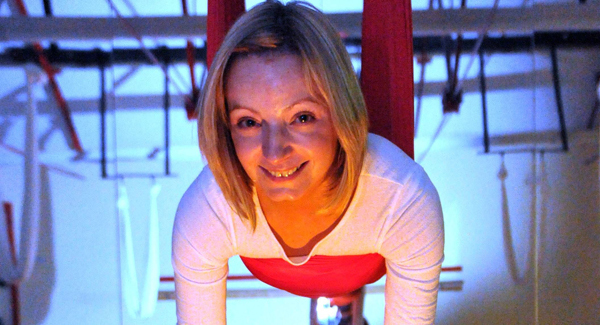
Just hanging out

ADULTS don’t do backflips often. Or sit on swings. Or hang upside down. But 20 years since I last swung off the playground monkey bars, I’m backflipping like a pro, beside six other free-flying, laughing adults in a Cork dance studio.

Just hanging out

AntiGravity Yoga (AGY) is enjoying a surge in popularity, with nine centres established in Ireland in the past year.

Created by aerial choreographer and former gymnastics specialist, Christopher Harrison, AGY is a low-impact cardio workout blend of yoga, pilates, dance, gymnastics and calisthenics — all done while holding on to a suspended hammock.


Harrison founded aerial dance-troupe AntiGravity in New York in 1990, and created AntiGravity Yoga as a daily workout for the performers. He began to teach AntiGravity Yoga classes six years ago, to great acclaim. Pink performed on an antigravity hammock in the opening of the 2010 Grammy Awards, Mariah Carey supposedly used it to tone up after the birth of her twins, and Courtney Love swears by her daily AGY practice. The residents of Made In Chelsea also tried out AGY in a recent episode.

“There are a million benefits of AntiGravity Yoga,” says AGY Master, Laura Armada Buch, who introduced the discipline in Ireland last year.

“AntiGravity Yoga takes the best elements of different techniques and fuses them. We can get people doing things that they would have found impossible. It’s like being a child again, it puts the fun element back into exercise. Some people don’t stick to exercise, but we see most people here doing one or two AGY classes a week,” says Buch.

The main health benefit exclusive to AGY is the decompression of the spine and joints. Hanging upside down causes synovial fluid to fill the gaps between the vertebrae and lengthen the spine. Apparently, taking just one class can make you a quarter of an inch taller, although the extra height only lasts for between five to seven days. All of this can result in looser joints, increased flexibility, and can relieve pain from athletic or other injuries.

The class starts with a meditation. With the studio in darkness, and relaxing music playing in the background, I sit cocooned in a red silk hammock suspended from a steel beam. No-one can see me as I’m told to let my chin fall to my chest and close my eyes, and enjoy this strange, beautiful, water-bed-like experience.

“When I first sat into the hammock, I stopped and realised that I’m never still. The hammock gave me a lovely sense of being still,” says dance studio owner, Nicky Hayes, who runs the only AGY class in Cork.

“It’s not like aerobics or Zumba, because you can work at your own pace,” says Hayes, who varies techniques throughout each class to suit beginners and more experienced AGY enthusiasts.

Twenty minutes later, I am hanging upside-down, trying my first ‘monkey’ inversion, feet wrapped tightly around the sides of the swing, the backs of my hands trailing the floor.

Being upside-down makes me feel slightly nauseous and watery-eyed, and I am afraid I’ll have to slink out of the class early. This is not a first: I suffer from travel and motion-sickness in general. My instructor explains that slight dizziness can occur after the first inversion and recommends sucking on a mint before a class to counter any nausea.

“Seventy percent of people don’t feel any discomfort, but 30% of people may feel some initial discomfort with the inversions. It’s not natural for most people to hang upside-down, but you quickly develop a trust,” says Buch.

And, indeed, after an hour of free-flying, stretching and swinging, I try the inversion again, and feel far more confident. Not bad for a woman who averages five aerobics classes per year.

“It’s really rewarding to teach such a fun class and to see the impact it has on peoples’ lives,” says Buch.

“We’ve also seen increased self-confidence, especially in middle-aged women, who have had children and may have lost a piece of their identity. We work really hard on their self-confidence, and we see progress after three or four weeks, with women who couldn’t do a chin-up initially,” she says.

“It’s also great for toning — we’ve seen people lose dress sizes quickly, as you use your own body weight as resistance.”

Buch used AGY to regain her pre-pregnancy stomach seven months after giving birth, and also says that she has been migraine-free for the past 18 months, due to regular AGY sessions.

“It’s good for people with skin conditions, too. Hanging upside-down releases toxins and it’s almost like a facial in that way,” she says.

Will I try it again? Definitely. Simply because it is great fun. Even beginners’ Anti-Gravity Yoga poses look impressive. And I’m not sure if it’s my imagination, but as well as sore upper arms, I imagine I feel slightly taller over the next few days.

. For more information, see www.antigravityyoga.ie. A course of six sessions costs €90; introductory sessions are available at €15 per class. Classes last between 60-90 minutes.

. Note: Those who should not practice AntiGravity Yoga include people with glaucoma, pregnancy, shoulder/back surgery, high blood pressure.

x

More in this section

Cookie Policy Privacy Policy Brand Safety FAQ Help Contact Us Terms and Conditions

© Examiner Echo Group Limited










