Inquest into Cork airport plane crash returns accidental death verdicts

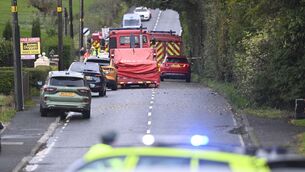
The jury returned its verdicts yesterday after deliberating for just over half an hour on evidence relating to the flight, which crashed in thick fog on its third landing attempt at around 9.50am on February 10, 2011.
The pilot and captain of the 19-seat aircraft en route from Belfast to Cork — Jordi Sola- Lopez, aged 31, from Manresa, Barcelona; co-pilot Andrew John Cantle, 27, from Sunderland; Patrick Gerard Cullinan, 45, from Belfast; Brendan McAleese, 39, from Co Antrim; Richard Kenneth Noble, aged 48, from Belfast; and Joseph Michael Evans, aged 51, also from Belfast — all died.
Coroner Frank O’Connell read the verdicts in relation to each victim, one after the other, into the record at Cork County Coroner’s Court and said: “I hope I won’t have the duty to read six verdicts like that again. It simply underlines the horrific nature of the tragedy in this case.”
He offered his sympathies to the relatives of the deceased before addressing the survivors. “You were lucky people to get out of that wreckage,” he said. “I offer you my sincere sympathy on the very unfortunate and life- changing experience and thank you for coming here to relive that experience.”
Earlier, the inquest heard the conclusion of evidence from Leo Murray, who led the Air Accident Investigation Unit’s probe into the accident.
He told the inquest on Tuesday the probable cause of the crash was a catastrophic loss of control during an attempted go-around initiated below the 200ft decision height in instrument meteorological conditions. Several other factors were of significance including:
- The approach was continued in conditions of poor visibility below those required;
- The descent was continued below the decision height without adequate visual reference outside the cockpit;
- An uncoordinated operation of the flight and engine controls when the third and fatal go-around was attempted;
- Tiredness and fatigue on the part of the flight crew members.
Mr Murray told the coroner yesterday it was ultimately the responsibility of Mr Sola-Lopez to manage the flight and to make decisions about landing or diverting. But the flight crew, he believed, were under “self-induced pressure” to land at Cork Airport.
Previously identified systemic deficiencies at the operational, organisational, and regulatory levels in which the flight operated, such as pilot training, scheduling of flight crews, maintenance, inadequate oversight by the operator and the state of registration, then came in to play, he said. It meant the flight commander was faced with a situation where he “didn’t have the tools or the ability to make prudent decisions on the day”.
Irish Aviation Authority manager Seán Patrick, who was operations manager at Cork Airport’s Air Traffic Control (ATC) tower on the morning of the accident, told the inquest later the flight crew were given the option of landing at Kerry Airport which was clear of fog.
He said after the second aborted landing, the ATC’s approach controller gave the flight commander details of weather conditions at Shannon and Waterford airports, where fog had reduced visibility to just 300 metres.
At 9.30am, as the aircraft maintained a holding pattern over Cork, the commander was told visibility at Kerry Airport, just 40 miles (64km) west, was 10km-plus. But when weather conditions improved marginally at Cork, the commander said he would make a third landing attempt.
Mr Patrick said the ATC controllers could not see the runway through the thick fog and were only aware that something had happened when the aircraft’s emergency locator transmitter went off on impact at 9.50am.
Addressing the jury later, the coroner said he was of the view that the flight crew were doing “nothing other than their best” to get the plane on the ground.
“They encountered a number of difficulties but the primary problem was the thick fog. Whether they made the best decisions on the day is not a matter for you to comment on.”
Speaking afterwards, survivor Heather Elliot said the evidence underlined just how lucky she and the other five survivors were. Fellow survivor Laurence Wilson said he didn’t realise just how close he and the other survivors were to death until he heard the horrific details at the inquest.
“We really now see how lucky we were,” he said. “It makes things which used to be very important not so important. It definitely gives you a new outlook on life.
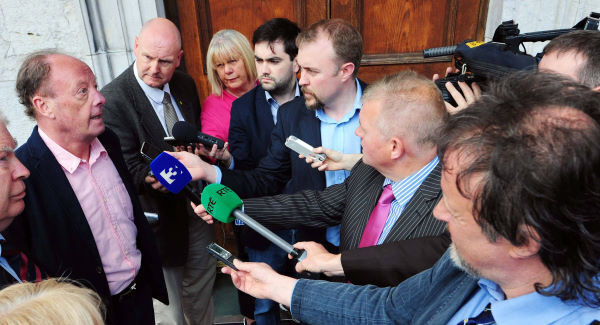
The families of three victims of Flight 400C have vowed to ensure that all 11 safety recommendations arising out of the 2011 air crash tragedy at Cork Airport are implemented.
UK-based aviation legal expert James Healy Pratt, the head of aviation and travel at the leading aviation claimant law firm Stewarts Law LLP — who represents the families of the late Patrick Cullinan, Richard Noble and Brendan McAleese — said they will do whatever it takes to ensure there is no future loss of innocent lives in air accidents.
“This tragedy happened three years and four months ago but its effects on the families of those who died, and those who survived, continues to this day. The families are appreciative of the thorough Air Accident Investigation Unit (AAIU) investigation.
“The families firmly believe it is essential for all 11 safety recommendations to be acted upon. Only then can air safety be improved as well as the prevention of the future loss of innocent lives in air crashes. The families will do whatever necessary to ensure those 11 safety recommendations are met.” But he warned that changes to aviation regulation take time and said, hopefully, the required changes will be made within 18 months, and pushed through by the AAIU.
He was speaking outside Cork County Coroner’s Court after it emerged several of the AAIU’s 11 safety recommendations issued in January have yet to be implemented.
Leo Murray, the AAIU official who led the exhaustive probe into the accident, told coroner Frank O’Connell all the addressees who were party to the recommendations responded within the required 90 days — some with quite lengthy replies.
He said some of the AAIU’s recommendations were accepted, some partially accepted, and some responses were satisfactory and some were not.
He declined to detail which issues are outstanding because negotiations are continuing.
The AAIU is actively considering all the issues, he said, and will publish its responses on its website before the end of this month.
Mr Healy Pratt is now preparing for a crucial stage of a lawsuit filed before Christmas in Chicago on behalf of the relatives of Mr Cullinan, Mr Noble, Mr McAleese and other named parties.
Their families are suing M7 Aerospace, the plane’s manufacturer, and Honeywell International and Woodward Governor Co, the makers of the plane’s sub-components — including a pressure temperature gauge in engine number two, which was found to be faulty.
Mr Healy-Pratt said confidential settlements have already been agreed between the families and the flight’s “operational interests” — Flightline and AirLada.
Beth Webster, partner of dead co-pilot Andrew Cantle and his parents, John and Ann, have lodged papers in the High Court here, suing Flightline and AirLada.
Ireland’s Air Accident Investigation Unit issued 11 safety recommendations to various agencies in January.
Four were made to the European Commission directorate responsible for commercial air transport regarding flight-time limitations, the role of the ticket seller, the improvement of safety oversight and the oversight of operating licences.
Three were sent to the European Aviation Safety Agency regarding the number of successive instrument approaches that can be made in certain weather conditions, the syllabus for appointment to commander and the process by which Air Operator Certificate variations are granted.
Two were made to the Operator, Flightline SL, regarding its operational policy and training.
One was made to Agencia Estatal de Seguridad Aérea, the Spanish Civil Aviation Regulatory Authority, regarding oversight of air carriers.
And one also to the International Civil Aviation Organisation (ICAO), regarding the inclusion of the approach capability of aircraft/flight crew on flight plans.
Richard Kenneth Noble, 48, from Jordanstown in Belfast was a company director.
He was formally identified at CUH by his wife, Alison. She was too distraught to attend the inquest.
The co-pilot, Mr Cantle, 27, from Sunderland, was at the flight controls as the aircraft landed. His body was identified at CUH by Manx2 employee, Dylan Evans.
It was his first job as a pilot, and he had just 19-hours flying time with the operator.
His parents Ann and John were in court for the hearing.
Capt Evans, 51, from Silvio St in Belfast, was the deputy harbourmaster of Belfast Port. His body was identified by his brother-in-law, Carson Rankin, whose sister, Angela, was in court for the hearing.
From Malone Rd in Belfast, Mr Cullinan, 45, was a chartered accountant and a partner in KPMG’s Belfast office. His body was identified at CUH by his brother, Aidan. His mother, Rose, brothers Aidan, Kieran, and Seamus, and other relatives, attended the hearing.
Flight captain and commander, Jordi Sola-López, 31, from Spain, was in control of the aircraft’s engine throttles as it made its third and fatal landing attempt. It was his first flight as commander. His body was formally identified by his mother, Rosa.
His parents, Tony Sola and Rosa López, were represented by the honorary vice consul of Spain.
Mr McAleese, 39, from Kells in Co Antrim, was a company director.
A cousin of former president Mary McAleese’s husband, Martin, his body was formally identified at CUH by his brother, Joseph, who attended the inquest along with his widow, Ann Marie.
CONNECT WITH US TODAY



Be the first to know the latest news and updates