Colm O'Gorman's perfect rib-eye steak and lemon meringue cheesecake
These showstopping dishes are sure to impress this summer 
Colm O'Gorman's perfect rib-eye steak and lemon meringue cheesecake

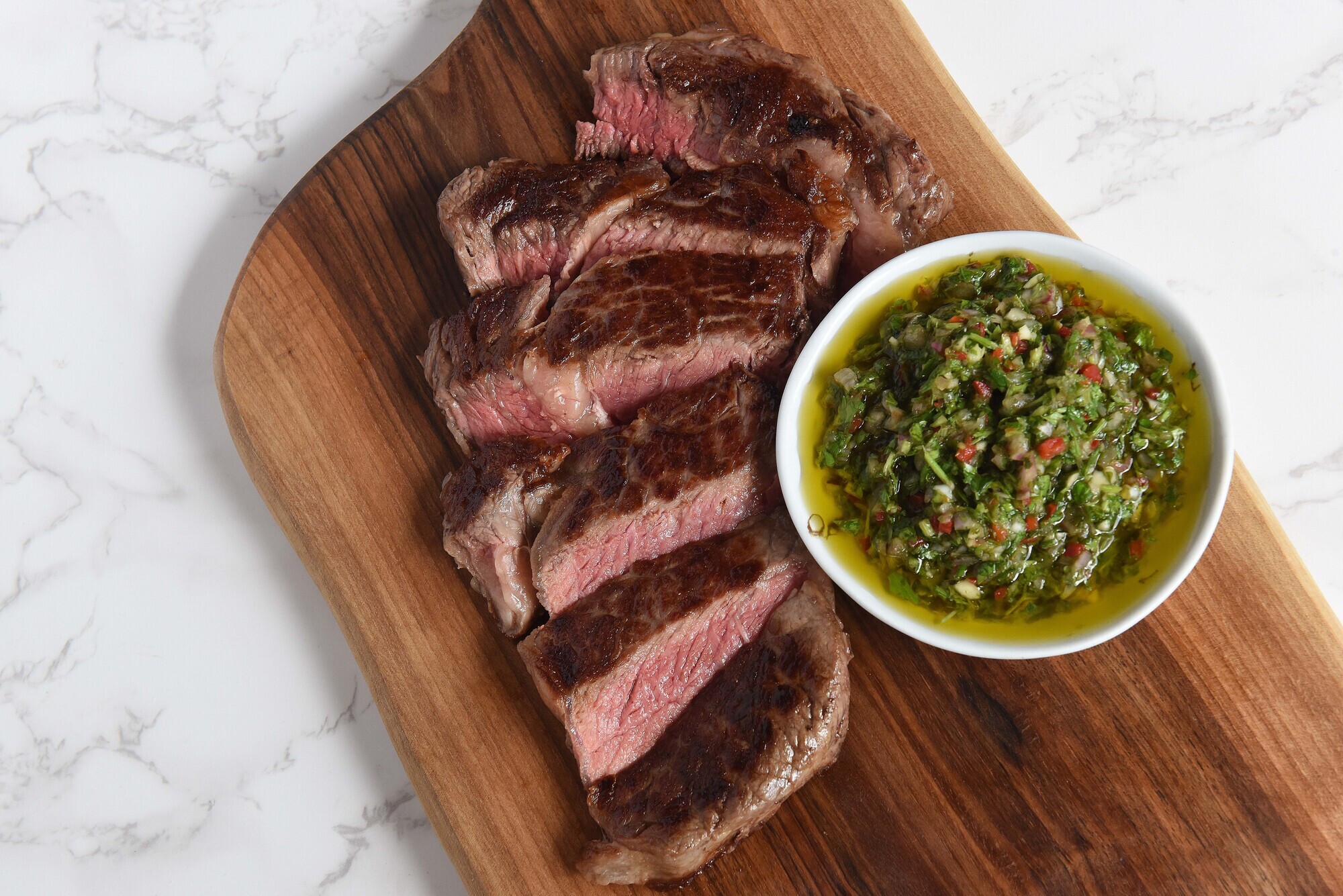
Rib-eye steak with chimichurri sauce. Photograph Moya Nolan

My top tip for cooking a great steak is to use a meat thermometer, one of the probe types. They are relatively inexpensive, but if you use one, you are pretty much guaranteed a perfectly cooked steak every time.

Buy a good-quality steak. For this family feast I used four beautiful dry aged 10oz Irish Angus Rib-Eye steaks from Farmhousegrocer.ie, a local family run farm near me in North Wexford. Let your steaks rest at room temperature for at least 30 minutes before you cook them. I season my steaks just before cooking them, using just some flaky sea salt. If you are cooking these on a barbecue, get your grill good and hot, and pop them on. If you are cooking them indoors, use a good quality, heavy based non-stick pan. Get the pan very hot over a high heat. I never use any oil; your steak has enough fat and I find using any oil just inhibits the development of a lovely, seared crust on the steak. Season the steak with a little salt and pop it in the pan. Reduce the heat to medium.

I like my steaks medium rare, so I give them two to three minutes each side until they have a nice crust, and my meat thermometer tells me they are at around fifty-five degrees Celsius. For a rare steak, aim for fifty degrees, for medium go for sixty and for well done, seventy degrees. I usually take my steak off the grill when it is a few degrees shy of the temperature I want and then let it rest for at least five minutes before serving it. Season with some fresh ground black pepper at this stage. Resting the steak after you take it off the pan or grill is critical. It allows the juices in the meat to redistribute throughout the steak. If you cut into the steak straight off the grill, all those juices, and all that lovely flavour, will flow out and be lost.

Rib-eye steak with chimichurri sauce

recipe by:Colm O'Gorman

Impress family and friends with this mouth-watering rib-eye steak with chimichurri sauce

Rib-eye steak with chimichurri sauce

Servings

4

Preparation Time

50 mins

Cooking Time

6 mins

Total Time

56 mins

Course

Main

Ingredients

  • 4 dry aged 10oz Irish Angus Rib-Eye steaks

  • Chimichurri sauce:

  • 35g fresh parsley

  • 15g fresh coriander

  • ½ tsp dried oregano

  • 2 cloves garlic

  • 2 small shallots

  • 1 red chilli

  • 3 tbsp red wine vinegar

  • 75ml extra virgin olive oil

  • 1 tsp flaky sea salt

Method

  1. Let your steaks rest at room temperature for at least 30 minutes before you cook them. 

  2. Season with flaky sea salt.

  3. If you are cooking on a barbecue, get your grill good and hot, and pop them on. If you are cooking the steaks indoors, use a good quality, heavy based non-stick pan. Get the pan very hot over a high heat. Season the steak with a little salt and pop it in the pan. Reduce the heat to medium.

  4. For medium rare, give the steaks two to three minutes on each side until they have a nice crust. On a meat thermometer, they should be around fifty-five degrees Celsius.

  5. For a rare steak, aim for fifty degrees, for medium go for sixty and for well done, seventy degrees.

  6. Take the steak off the grill when it is a few degrees shy of the temperature you want and then let it rest for at least five minutes before serving it. Season with some fresh ground black pepper at this stage. 

  7. Chimichurri sauce: Finely chop the herbs, shallots, and chilli. Grate the garlic. If you want to save some time, you can just very roughly the garlic, chilli and shallot and pop them into a food processor along with the herbs and pulse them a few times until they are finely chopped.

  8. Mix the lot in a bowl with the vinegar, let it sit for about ten minutes. Add the oil, stir, and then taste. Add a little more salt if needed. Serve on the side of, or drizzled over, your perfectly cooked steaks.

Warm Potato Salad with Roast Onion and Beetroot

recipe by:Colm O'Gorman

This stunning potato salad can be served warm or cold and goes perfectly with a rib-eye steak

Warm Potato Salad with Roast Onion and Beetroot

Servings

4

Preparation Time

30 mins

Cooking Time

30 mins

Total Time

60 mins

Course

Side

Ingredients

  • 1kg baby new potatoes

  • 400g fresh beetroot

  • 3 onions, white or red

  • Extra virgin olive oil

  • 2-3 tbsp balsamic vinegar

  • 1 tsp flaky sea salt

  • Some freshly ground black pepper

  • 150g feta cheese

  • Handful toasted pumpkin seeds

  • Seeds from half a fresh pomegranate

  • 20g flat leaf parsley

Method

  1. Heat your oven to 200°C. Wash the potatoes and cut them into 3cm chunks. Toss them in some olive oil and flaky sea salt and put them in the oven to roast for thirty minutes, until they are golden and cooked through.

  2. Wash and peel the beetroot and cut them into similar-sized chunks. Toss them in more olive oil and pop them into the oven on another tray and roast until the are cooked through. They will take about the same time as the potatoes.

  3. Peel the onions and cut them in half lengthways. Toss them in a little olive oil and sprinkle with salt and some fresh ground black pepper. Place the onions cut side down on a baking tray and roast them in the same oven for twenty to twenty-five minutes until they are soft and cooked through.

  4. When the potatoes, beetroot and onions are done, let them cool slightly and then put the potatoes and beetroot into a large serving bowl. Separate the layers of the roasted onions into individual petals and add those to the bowl.

  5. Chop the parsley and add about half to the bowl. Season with a little more ground black pepper and toss the roasted vegetables in more extra virgin olive oil, about two tablespoons should be plenty. Add the balsamic vinegar.

  6. Crumble the feta cheese over the top.

  7. Finish with the toasted pumpkin seeds, pomegranate seeds and the rest of the chopped parsley. Serve warm, but any leftovers can be eaten cold and will also be delicious.

Lemon Meringue Cheesecake

recipe by:Colm O'Gorman

This showstopper dessert is a combination of a classic cheesecake and a lemon meringue pie

Lemon Meringue Cheesecake

Servings

8

Preparation Time

3 hours 0 mins

Cooking Time

60 mins

Total Time

4 hours 0 mins

Course

Dessert

Cuisine

Irish

Ingredients

  • For the base:

  • 200g digestive biscuits

  • 100g unsalted butter

  • For the filling:

  • 350ml cream

  • 300g cottage cheese

  • 200g cream cheese

  • 100g caster sugar

  • 3 sheets of platinum leaf gelatine

  • 2 lemons

  • 1 egg white

  • For the meringue:

  • 2 egg whites

  • 100g caster sugar

  • For the lemon curd:

  • Juice and zest of 2 lemons

  • 100g caster sugar

  • 50g unsalted butter

  • 1 egg, plus 1 egg yolk

  • To serve:

  • A handful of toasted flaked almonds

  • Some strips of lemon zest

Method

  1. Make your cheesecake and meringues the day before you want to serve this dessert. That way you can be fully confident that the cheesecake will have set, and all you will have left to do is make the lemon curd and then dress your cheesecake before serving it.

  2. Pulse the biscuits for the base in a food processor until they are reduced to a crumb. Melt the butter and add in, combining it thoroughly with the biscuit crumb. Spread the mixture over the base of a 23cm spring form or push up baking tin and press it down firmly to get an even layer. Pop the tin in the fridge to chill while you prepare the filling.

  3. Put the leaves of gelatine in a bowl of cold water and soak them for ten minutes. Heat 175ml of the cream in a saucepan, taking it almost to the boil and then, take it off the heat. Remove the leaves of gelatine from the water and give them a good squeeze in your hand to remove any excess water. Add to the pan of hot cream and stir them in. They will dissolve almost instantly.

  4. In a mixing bowl, combine the cottage cheese, cream cheese, sugar, the zest of one lemon and the juice of two. You can do this in a food mixer. Next, add in the cream and gelatine mixture and stir to combine it thoroughly. Lightly whip the remaining 175ml of cream until you have soft peaks and fold it through the cheese and cream mixture.

  5. Whisk an egg white until you have stiff peaks, and then carefully fold that through the mixture. You can leave out the egg white if you wish, but it adds a beautiful lightness to the filling that is well worth the little extra effort.

  6. Pour the mixture into the cake tin, giving it a few gentle taps on your worktop to sure it is spread evenly across the tin. Cover the tin with some cling film and allow it to set overnight in the fridge. If you prefer to make your cheesecake on the day you will serve it, make sure you allow at least three hours for it to set. Allowing it to set overnight though guarantees that it will be ready to serve when you need it.

  7. To make the meringues: Heat your oven to 120 Celsius. Whisk the egg whites in a mixer or food processor at medium speed until you have stiff peaks. Now, with the mixer running at the same speed, add the sugar a tablespoon at a time, allowing a few minutes between each addition to allow the sugar to dissolve into the egg whites. Whisk until all the sugar is added and you have a glossy meringue mixture with shiny, stiff peaks.

  8. Line a baking tray with non-stick paper and use two dessert spoons to measure out some of the meringue, placing it on the tray. You could pipe the meringue if you wish to make little meringue kisses, but I like a more irregular shaped meringue on top of this dessert. Bake the meringues for one hour, then turn off the oven. Leave the meringues in the oven, with the door pried slightly ajar with the handle of a wooden spoon until it is completely cool. You can leave the meringues there overnight if you wish until you are ready to use them the next day. Once cool, they should be stored in a dry, airtight container until needed.

  9. To make the curd: Put the lemon zest, juice, sugar and butter into a heatproof bowl along with the sugar and butter. Use a bowl that will sit into the top of a saucepan of gently simmering water so that it rests high enough in the pan but does not touch the water. Stir every now and again until the butter has melted, and the sugar has dissolved.

  10. Put one egg plus the yolk of another into a bowl and lightly whisk them. Now add the whisked egg slowly into the lemon mixture, whisking all the time. Keep gently whisking over the heat to cook the curd. Once it is creamy and coats the back of a spoon and has a custard like consistency it is done. Remove the bowl with the curd from the saucepan and set it aside to cool. Stir it occasionally as it cools to avoid a skin forming over the top.

  11. When you are ready to serve, carefully remove the cheesecake from the tin. Spoon some lemon curd over the centre of the cheesecake and add lots of the meringues. Add some strips of fresh lemon zest and finally, scatter the top with toasted almonds. Drizzle the cheesecake with a little more lemon curd for effect just before you bring it to the table.

x

More in this section

ieFood

Newsletter

Feast on delicious recipes and eat your way across the island with the best reviews from our award-winning food writers.

Cookie Policy Privacy Policy Brand Safety FAQ Help Contact Us Terms and Conditions

© Examiner Echo Group Limited