The chocolate revolution changing the rebel city
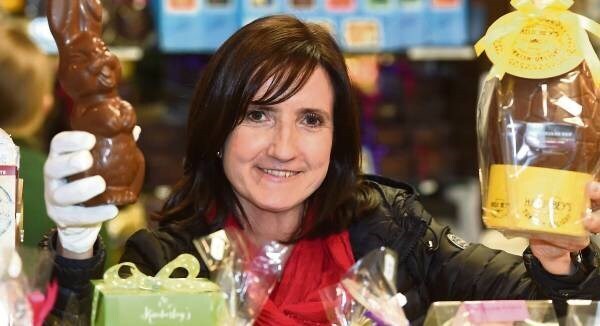
If there is ever a morning for the nation’s laying hens to take a breather, it is surely Easter Sunday, when the bulk of all eggs consumed will be foil-wrapped and cloyingly sweet for we Irish are apparently (Euromonitor 2017) the third highest consumers of chocolate in the world, putting away a staggering 16.3lbs per person each year
But there is an argument to be made that we are consuming an awful lot of chocolate-flavoured confectionery and far less actual chocolate.
It is an argument the only two nations to top our consumption — Germany (17.4lbs pp) and Switzerland (19.8lbs pp) — would agree with, taking the opposing side in an EU battle as to whether ‘chocolate’ produced in Ireland and Britain even merited being called ‘chocolate’.
This was only settled in 2003 by a special EU derogation allowing the Irish and British version to continue to be sold in continental Europe as chocolate though it contains significantly lower cocoa mass than the EU minimum of 25% and also substitutes cocoa butter with vegetable oils and other lesser fats. In other words, the Irish consumer has had little experience of real chocolate.
However, change is afoot with the ‘Food County’ of Cork once more leading the charge. Shana Wilkie, from Midleton, was the first person in the country to produce Irish ‘bean-to-bar’ (BTB) chocolate while another Leesider, Rose Daly, runs The Chocolate Shop, sited in the centre of the English Market (also operating as an online retailer, www.chocolate.ie).
Easter Essentials🐣🌸 @EnglishMarket pic.twitter.com/08lDMs9BW9
— The Chocolate Shop (@wwwchocolateie) March 28, 2018
This bijou little emporium carries an excellent range of loose chocolates and other confectionary but deserves special recognition as Ireland’s first true champion of premium BTB chocolate, sporting a superb offering from around the world.
In his 1990 book, Les Vertus Thérapeutiques du Chocolat, French doctor Hervé Robert rubbished long-held notions that chocolate caused ailments such as migraine, acne, obesity and tooth decay, instead stating its alkaloidal cocktail of caffeine, theobromine, serotonin and phehylethylamine made it quite the tonic, an anti-depressive and an enhancer of pleasures, including sex.
Indeed, it is claimed Montezuma drank chocolate all day long, the better to service his concubines.
Whether purported aphrodisiacal powers are real or not, there is no doubt alkaloids (complex organic plant compounds found in just 10% of the world's plants) have physical consequences and benefits when ingested and only became available to Europeans in the 17th century with the arrival of tea, coffee and, yes, chocolate.
It is believed chocolate was first produced some 3,000 years ago by Mexico’s earliest civilisation, the ‘Olmec’.
It is a complex and laborious procedure — both the husbandry of the notoriously fickle cacao tree and the process of turning its beans into chocolate — suggesting an extremely advanced society possessed of both time and wherewithal to produce such a premium product.
The cacao tree produces fruiting pods containing the beans and can only be grown under specific conditions — wet, humid, hot and solely in a band 20 degrees above and below the equator.
The bitter beans are first fermented to develop flavour after which they are dried and roasted. The beans are then ground, removing the shell to leave cacao nibs, which yield cocoa solids or cocoa mass and cocoa butter.
Pure (dark) chocolate is made up of cocoa mass, cocoa butter and sugar and nothing more; proper milk chocolate, made with 50% cocoa (butter and solids) also contains milk, either powdered or condensed. Irish ‘milk chocolate’ usually contains more milk again, up to 20% vegetable oil and 20% cocoa solids at most.
Rose and her husband Niall opened the shop in 2000.
It's #ValentinesDay! Make memories that last a lifetime! With chocolate in your heart ❤️ pic.twitter.com/BzLdP9ExTJ
— The Chocolate Shop (@wwwchocolateie) February 14, 2017
“Niall would often tell the story of queuing for olives one day in about 1997,” says Rose, “when he realised the market and Cork had changed and a chocolate stall could survive on its own in here.
“He had been wholesaling chocolate for several years before that — he’d got into Belgian choc originally. Shortly after we opened he discovered the Valrhona bars. They were the first to get into the BTB concept but our stock kept going out of date because there just wasn’t the demand back then. People were suspicious — even now it happens, when they think of chocolate, they think of the stuff they grew up with.
“We were only surviving in the early days and that was mainly selling the loose chocolates but we hung on. Chocolate sales are seasonal and you need that in a city the size of Cork: Christmas, followed by Easter, followed by Valentine’s, followed by Mother’s Day and, more and more, party favours for weddings and tourists in the summer. People started tasting the BTB bars but it took a long time.
“The only cheese we had when we were young was Calvita and the like —imagine then growing up and thinking cheese could only be cheese if it was like Calvita. If they were used to a fine chocolate at all, it was probably something like Lindt, which is quite palatable but is heavy on the vanilla and thin, designed to be eaten quickly with your coffee.”
For nine-tenths of its long history, chocolate was drunk rather than eaten.
Ironically, considering the above-mentioned contretemps with the EU, a British firm, JS Fry & Sons, was the first to produce chocolate as an edible bar, in 1847.
The BTB phenomenon, where a producer carries out the entire process themselves, turning raw beans sourced from a single area, sometimes even a single plantation, into finished bars of premium quality chocolate, is still a mere chronological blip in chocolate’s history but they are very much here to stay.
If you’ve grown up only eating traditional Irish chocolate confectionery, the initial complexity of taste can almost overwhelm the novice palate, from the fruity Madagascans to the earthy notes of West Africa or the berries and citrus of a Peruvian Tumbes.
But eventually all other lesser confectionaries pale into insignificance; to this writer’s mind, akin to the difference between wine gums and fine wine.
“Valrhona were the first to do it,” says Rose, “about 30 years ago. Prior to that, people weren’t really interested in origin. It would have been a good five years after opening before they really took off for us with people tasting and noticing the difference, wanting to try a different one or one they had tasted on holidays.
“Willie’s Cacao was probably the second wave of BTB manufacturers and [Willie Harcourt-Cooze, raised in West Cork, schooled in Cork city] really captured the public imagination with his Channel 4 TV series. He included a lot of savoury recipes and brought out a book and his next show was about his attempts to convert people from mass market stuff to BTB.”
Then in August 2016, tragically and unexpectedly, Niall died.
Heartbroken to announce the untimely death of handsome, garrulous, gregarious, irreverent chocolate loving Niall pic.twitter.com/0RM5z6BRoO
— The Chocolate Shop (@wwwchocolateie) August 28, 2016
Rose and their only daughter, Niamh, were heartbroken but Rose never thought of giving up the shop.
“Not for a second, and I don’t fully understand that, actually. I just said, I had to go to the shop. Maybe it was denial, maybe it was a sense of, that’s exactly where he was — if his spirit was anywhere, it was there. I couldn’t separate him from it. It was like thinking back to the energy he put into it from the very start, the continuing passions. It was just, this was going to keep going, this was us.
“It was something I had to do and still have to do, it’s part of the journey. When we began, it was mostly Niall that drove the shop with his personality and energy. Obviously there were two of us and he couldn’t have done it without me, but in the beginning it was his baby, it was his belief that it was going to work.”
Though too modest to say it, Rose’s knowledge and palate developed over the years in tandem with Niall’s and, in conversations with this writer, Niall forever deferred to her tasting ability.
Eleven months after his death, Rose joined the world-renowned chocolate expert Martin Christy on a group expedition to a Peruvian chocolate plantation.
“That also felt like part of the journey I’ve been on since Niall died,” says Rose, “I just felt it was something we would have done together, and during that first year, I probably needed a change of scene but I wouldn’t have gone on holidays — and it was absolutely fabulous.
“To drive along these dusty tracks on the side of steep mountains with no barrier, to go up the Amazon on a boat, get off, literally climb up the bank and suddenly you’re in the groves with the cacao pods growing right there on the trees.
“We cut open hundreds of pods and sucked the beans. I found myself turning around to say things to Niall. People always say you shouldn’t work with your spouse but we made a good team, he was always the outgoing one and I was doing things in the background, I was more cautious and Niall less so.
“Now I have to wear both hats. That’s another part of the journey, as well.”